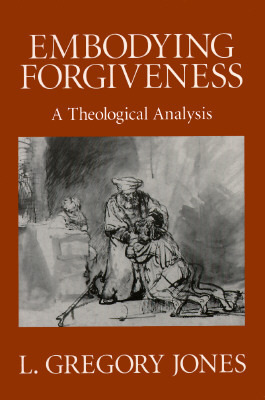
Book Review: Embodying Forgiveness

Embodying Forgiveness: A Theological Analysis

This book, Embodying Forgiveness by Methodist pastor L. Gregory Jones, makes forgiveness more possible by demonstrating its’ theological necessity. Therefore, this is an important grow-my-faith book for individuals committed to truly living their faith. The book challenges readers to grow in ways that can be uncomfortable (growth that’s challenging to achieve can move us with particular stride along the long-haul journey of genuine maturing in faith).

This is a book that must be read slowly. The concepts presented grab a reader’s attention such that one must pause to take in the book’s ideas, find the emotional capacity to live each aspect of the book’s insights.

Sample excerpts include:

  • “….people are mistaken if they think of Christian forgiveness primarily as absolution from guilt. The purpose of forgiveness is the restoration of communion [between parties] (page five).”
  • “Christian forgiveness involves a high cost, both for God and for those who embody it. It requires the disciplines of dying and rising with Christ, disciplines for which there are no shortcuts, no handy techniques to replace the risk and vulnerability of giving up ‘possession’ of one’s self, which is done through the practices of forgiveness and repentance. This does not involve self-denial, nor the ‘death’ of self through annihilation. Rather, it is learning to see oneself and one’s life in the context of communion [i.e., community] (pages 5-6).”

A worthwhile read!

Kim Burkhardt blogs at A Parish Catechist and The Books of the Ages (and a “Content Creator/Individual” member of the Association of Catholic Publishers). If you are a new visitor, it would be great to have you follow this blog (thank you!). If you know someone who would like this blog post, please share it with them (thank you!). You can also support this blog by clicking here when you are going to shop on Amazon (that lands A Parish Catechist a commission on Amazon sales).
Caring for others, appreciating their care for us

Orange and yellow sunset

Matthew 22: 34-40 is frequently quoted in this blog: “The greatest commandments are…love the Lord your God….and….love your neighbor as you love yourself.”

There’s a lot that goes into living each aspect of love God, love your neighbor, love yourself. Loving God involves investing time and effort into a continuing relationship with God. Loving our neighbors requires getting out of ourselves to care for others in a myriad of ways, large and small. Loving others “as we love ourselves” requires that we live lovingly within ourselves (and to live by faith’s principles – including moving away from behavior that causes any trouble, even for ourselves). 

How well do we put into practice loving other people? How well we care for other people is, surely, one of the greatest measures of how well we live our faith. So many aspects to being mindfully of other people’s welfare.

There’s a wonderful bumper sticker that says “Love your neighbor means everybody.”Fully living that bumper sticker requires bringing everything we learn in faith to the table. Truly being centered on kindness, thoughtfulness, caring, generosity, and unselfishness – in other words, focusing on loving the people around us – is what faith principles move us toward being. Christ said in Matthew 22:34-40, “All the Law and the demands of the Prophets hang on these two commandments.” 

Robert Hayden’s haunting poem Those Winter Sundays speaks both to quiet love-in-action and to the pain of not acknowledging receipt of love-in-action. Taking in this thoughtfully observant poem requires action on our part – coming to more fully appreciate the people who care for us (and to say so!) as well as prompting us to better care for the people around us. Caring for others is so often done quietly!

Those Winter Sundays

By Robert Hayden

Sundays too my father got up early

and put his clothes on the blueblack cold,

then with cracked hands that ached

from labor in the weekday weather made

banked fires ablaze.  No one ever thanked him.

I’d wake up and hear the cold splintering, breaking.

when the rooms were warm, he’d call,

and slowly I would rise and dress,

fearing the chronic angers of that house,

speaking indifferently to him,

who had driven out the cold

and polished my good shoes as well.

What did I know, what did I know

of love’s austere and lonely offices?

Kim Burkhardt blogs at A Parish Catechist and The Books of the Ages (and a “Content Creator/Individual” member of the Association of Catholic Publishers). If you are a new visitor, it would be great to have you follow this blog (thank you!). If you know someone who would like this blog post, please share it with them (thank you!). You can also support this blog by clicking here when you are going to shop on Amazon (that lands A Parish Catechist a commission on Amazon sales).

Faith: grasping toward knowing God

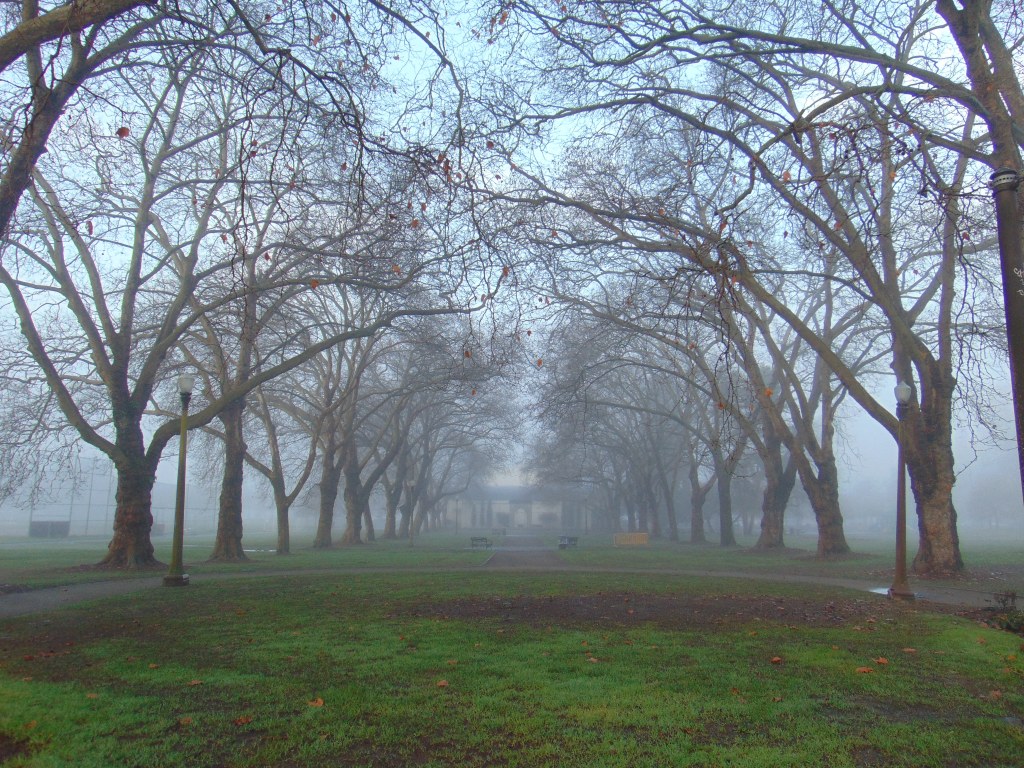
Two rows of trees

How well do we know and describe God? Individuals sometimes express frustration at the imperfections of how faith traditions talk about God (sometimes, people view religion negatively as a result). It was pointed out to me that our human attempts to communicate about God “merely reflect our human efforts that hint around various aspects of the contours of who God is.” Our communication about God is partial and imperfect and should be recognized as our limited human efforts to know the divinean effort to appreciate for what we do learn rather than an imperfection to criticize.

This idea of the scope of our incomplete perceptions hit home – from a surprising perspective – while visiting with my mother on Christmas day. Parents and children think that they know one another. Children of blind parents think they have a close grasp of their parents’ experience. Blind parents – like all parents – think that they know their own children. Hmmm….. My mother knew that I had blonde hair when I was a young child (I was born blonde)….. Well, fast forward to the present day….. When I showed up at my mother’s house this November for the Thanksgiving holiday, I chose not to tell her that I’d had my hair cut short after having long hair for many years (I hadn’t fully made peace with my new hair style). My mother learned of my haircut when one of my siblings commented on my haircut (a few years ago, my mother found out about that sibling’s tattoo when I commented on the tattoo!). Later that Thanksgiving evening (after I’d gone home), my sibling told my mother “that Kim’s hair looks darker now that it’s short” – my sibling suggested that I had perhaps dyed my hair….. A month later, on Christmas Day, my mother asked if I had dyed my hair when I got it cut this summer. ”No,” I said, “My hair is naturally brown. When my hair is longer, the summer sun has time to bleach some of the longer strands to blonde. Now that it’s short, all that’s visible is my hair’s natural brown color. (awkward pause…..) ”Hmmm, my hair has been brown since early childhood…..”  This generated an awkward moment – my mother was puzzled, I was surprised. I realized later (while driving home) that when I was ages four and five, when my hair naturally changed from blonde to brown, no one thought to tell my mother that the color of my hair had changed. Her parents, her grandparents, her siblings, my father, her friends – no one told her that her oldest child’s hair had changed from blonde to brown (it also didn’t occur to me as a child to tell my mother that the color of my hair had changed). I’ve now had naturally brown hair (with streaks of summer blonde) for most of my life; my mother thought for all these years that her daughter was still blonde! It came as a shock for my mother to find out that she’d been uninformed all these years about such a basic thing as the color of her her child’s hair; it came as a shock to me to find out that my own mother has thought all these years that I’m still blonde!

Transfer this Christmas Day conversation to our human efforts to know – and to communicate about – the nature of God. Ultimately, we humans are going to know as much about God as God reveals to us – finite amounts. We communicate about God to the degree that we know about God. What matters most regarding our knowledge of God is to know that God loves us and that God wants us to love both God and each other.We don’t need to fully understand God to positively live lives of faith.

Kim Burkhardt blogs at A Parish Catechist and The Books of the Ages (and a “Content Creator/Individual” member of the Association of Catholic Publishers). If you are a new visitor, it would be great to have you follow this blog (thank you!). If you know someone who would like this blog post, please share it with them (thank you!). You can also support this blog by clicking here when you are going to shop on Amazon (that lands A Parish Catechist a commission on Amazon sales).

This Sunday: Fourth Sunday of Advent

A home Advent wreath

This Sunday – Dec. 24th – is the Fourth Sunday of Advent.  It is also Christmas Eve (and, three days after today, the darkest day in the Northern Hemisphere – a time to bring light into the world).  This Sunday, we light all four candles on our Advent wreaths.

Advent is a time for us to reflect upon, engage in, and renew our faith.

Four topics associated with Advent (i.e., faith-renewing reflections) are hope, peace, joy, and love.  Last week, I reflected broadly on these four topics in a blog post that can be viewed here.  This week, I reflect on these same topics, but in such a way to challenge each of us to personally and meaningfully engage with these topics:

  • Hope: What can you do this week to bring hope into someone’s life?  When I volunteered in the prison system, I co-led a study about people who successfully “left-crime-behind” following incarceration. 100% of the formerly-incarcerated people we interviewed who “left crime behind” after incarceration reported having someone in their life who made a difference in their life, a person who helped them change their lives change for the better (made time for them).  What tangible form of support can you provide for someone you know who is experiencing a challenge in their life?  Spend time with them?  Help them navigate a challenging situation?
  • Peace: What can you do this week to contribute to peace in the world? Contribute $$ to a charity that provides civilian relief in war zones?  Start volunteering at a local charity that serves challenged individuals (like volunteering at a local jail)?  Be the person “who gets off the merry-go-round” in a situation of endless and/or senseless discord (i.e., workplace disagreements, family disputes, etc.) and “take the high road” to support another person in that situation?  As indicated in last week’s post, peace is the result of sacrificial love – Christ’s sacrificial love for us and our sacrificial love for other people.
  • Joy: Be the joy in someone’s life this holiday season.  Drop off a surprise holiday gift, do someone’s task for them at work, bring Christmas cookies to the office, go Christmas caroling……  We can all find something to do to bring some joy into someone’s life!
  • Love:  Who can you bring some “loving care?”  When Jesus was asked which of the commandments is greatest, he said “Love the Lord your God with all your heart, with all your soul, and with all your mind.’ This is the greatest and most important commandment. The second is like it: ‘Love your neighbor as you love yourself.’” (Matthew 22: 34-40).  It’s easy to love the people we like and with whom we enjoy spending time.  It matters just as much that we bring love to the people who might seem harder to love – a relative or friend who is in a time of need (we’re busy!), the irritable relative, the difficult co-worker we’d rather not work with, the homeless person who perennially displays challenging behavior outside the grocery store, the socially-isolated person we know who doesn’t seem to be able to connect with the people around them….  Loving someone involves a time commitment – time well spent!

Kim Burkhardt blogs at A Parish Catechist and The Books of the Ages (and a “Content Creator/Individual” member of the Association of Catholic Publishers). If you are a new visitor, it would be great to have you follow this blog (thank you!). If you know someone who would like this blog post, please share it with them (thank you!). You can also support this blog by clicking here when you are going to shop on Amazon (that lands A Parish Catechist a commission on Amazon sales).
 

Advent: hope, peace, joy, love

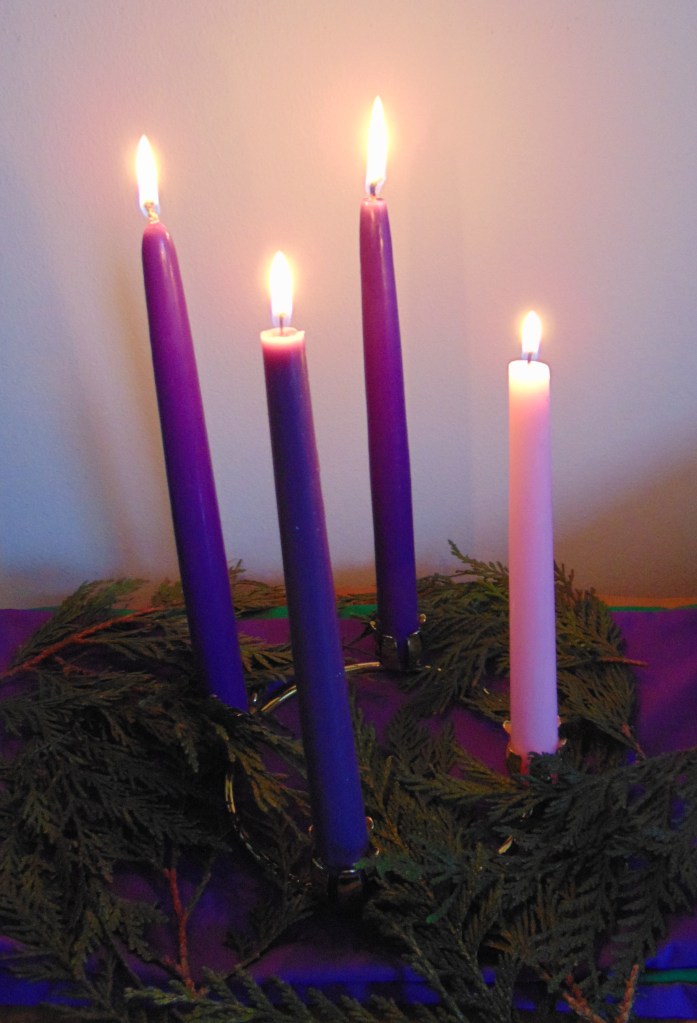
A home Advent wreath This Sunday – Dec. 17th – is the Third Sunday of Advent. This Sunday (and each day this week, if you are doing this at home), we light two purple candles and a pink candle on our Advent wreaths. Advent is a time for us to reflect upon, engage in, and renew our faith. There are four topics associated with Advent (i.e., faith-renewing reflections):
  • Hope: Hope is one of the three theological virtues – hope, faith, and charity – which are viewed by Catholics and Episcopalians as being infused in us by God at baptism (read more about theological and cardinal virtues here).  Read Pope Francis’ suggestions about cultivating hope here.  During Advent, we light candles of hope (light) during a season of darkness (northern hemisphere).
  • Peace: On a personal level, peace is more than “quiet, harmony, internal balance” that can be sought or achieved “for its’ own sake.”  Rather than seeking personal peace as an end in itself, peace is the result of sacrificial love – Christ’s sacrificial love for us and our sacrificial love for other people.  Pope Francis thoughts on this idea can be read about here.  Peace is a consequence of a faith well lived rather than something we can achieve for its’ own sake.
  • Joy: Joy “is the fruit of living all the virtues.”  In addition, joy comes from knowing “the love God has for us” (1 John 4:16) and from being of service to other people.  In short, joy comes from a life well-lived rather than a state of being that we can – or should – cultivate for its’ own sake (living for others helps produce joy rather than the self-focused activity of us seeking joy for our own sake).
  • Love (another of the three theological virtues!):Perfect love casts out fear” (1 John 4:18). In a world where we need more peace, casting away fear – via love – could go a long way toward achieving more peace (many ill human behaviors driven by fear.  Not just societal level wars – how many times have each of us made personal/localized decisions based on fear when we could have made better decisions?).  Love, therefore, is important for us to put into practice and to seek to cultivate in others.  When Jesus was asked by the Pharisees which of the commandments is greatest, he said “Love the Lord your God with all your heart, with all your soul, and with all your mind.’ This is the greatest and most important commandment. The second is like it: ‘Love your neighbor as you love yourself.’ All of Moses’ Teachings and the Prophets depend on these two commandments” (Matthew 22: 34-40).  Do you love the Lord your God with all your heart?  Do the people around you see in your behavior that you love them?  What goal could you set this Advent to be more loving?
Kim Burkhardt blogs at A Parish Catechist and The Books of the Ages (and a “Content Creator/Individual” member of the Association of Catholic Publishers). If you are a new visitor, it would be great to have you follow this blog (thank you!). If you know someone who would like this blog post, please share it with them (thank you!). You can also support this blog by clicking here when you are going to shop on Amazon (that lands A Parish Catechist a commission on Amazon sales).

Geography of Faith (poetic ponderings)

river

I heard recently that Thomas Merton used the phrase Geography of Grace. That phrase inspired me to try some poetic faith-geography imagery of my own, posted below:

Where do we travel in our faith journeys?

  • We move – seemingly unaware of the mechanics our own locomotion – toward new journeys of the soul prompted by the Holy Spirit
  • We wander unknown paths, exploring new faith terrain
  • We walk with others along their paths, supporting their faith journey
  • We head with belligerence, certainty, confusion, or uncertainty toward a dead end
  • We sing with joy and weightlessness toward the upper mountain heights of God’s love
  • We run along stream-side paths, delighting in the company of fellow faith travellers
  • We trod down dirt roads toward – or into the depths of – despair
  • We take joy in love-filled spaces of caring for one another
  • We wander down detours, looking for any useful lessons from the experience
  • We find our way out of detours!
  • We rest in grace-filled meadows
  • We explore “monasteries of the spirit” (such joy when these come along!)
  • We wonder when happening upon liminal places

May your faith journey be wonder-filled.

Kim Burkhardt blogs at A Parish Catechist and The Books of the Ages. If you are a new visitor, it would be great to have you follow this blog (thank you!). If you know someone who would like this blog post, please share it with them (thank you!). You can also support this blog by clicking here when you are going to shop on Amazon (that lands A Parish Catechist a commission on Amazon sales).
Second Sunday of Advent….Faith Renewal

A Home Advent Wreath

This Sunday – Dec. 10th – is the Second Sunday of Advent. This Sunday (and each day during Advent’s second week), we light two purple candles on our Advent wreaths (we can have an Advent wreath at home by getting one from one’s church, ordering one online, or finding one in local stores).

Participating in major liturgical seasons – Advent and Lent – is a great reminder to renew our faith lives! During Advent:

  • We anticipate the anniversary of Christ’s birth at Christmas (hope)
  • We recognize in the four candles of the Advent wreath the topics of hope, peace, joy, love
  • Reflect on deepening our faith and put this into practice in our lives. The four topics associated with the Advent wreath candles – hope, peace, joy, and love – are great topics to cultivate. We receive these from a relationship with Christ (a relationship cultivated in prayer!); we learn to radiate these to the people we encounter.
  • Engage in penance-charity-prayer
  • Engage more actively (more often, with more reflection) in church services and church activities
  • Consider how to be more caring to the people in our lives

Looking for ways to renew your life of faith? Here are a few tips:

  • Participate in acts of charity, prayer, and penitential reflection of how we can become better people (I’m currently asking God to improve an aspect of my life in which I’m seeing I need to become a better person). In prayer, focus particularly on hope, peace, joy, and love.
  • An printable pdf copy of our Advent calendar – with daily Advent reflections – is still available at A Parish Catechist’s Advent portal.
  • Looking for reading material to help renew your faith this Advent? Check out our list of our favorite faith books on the A Parish Catechist website.

Kim Burkhardt blogs at A Parish Catechist and The Books of the Ages (and a “Content Creator/Individual” member of the Association of Catholic Publishers). If you are a new visitor, it would be great to have you follow this blog (thank you!). If you know someone who would like this blog post, please share it with them (thank you!). You can also support this blog by clicking here when you are going to shop on Amazon (that lands A Parish Catechist a commission on Amazon sales).
Book Review: This is My Body, A Call to Eucharistic Revival

Book: This is My Body

I was recently given Bishop Robert Barron’s book This is My Body: A Call to Eucharistic Revival. When I started reading it, I quickly found it as readable and engaging as Henri Nouwen’s book With Burning Hearts.

The author, Bishop Robert Barron, wrote this book as part of a U.S. “call to Eucharistic renewal” (he helped initiate a U.S. call to Eucharistic renewal while the Chair of the Committee on Evangelization and Catechesis for the United States Conference of Catholic Bishops, USCCB). This book is engaging because it takes readers to the deeper meaning of faith concepts we’re meant to learn; he does so in an easily readable and interesting manner – plenty of “ah ha” moments. At the risk of reviewing this book with too much hyperbole, I stopped earmarking interesting pages after a few pages because I was earmarking most pages.

Here are two excerpts from This is My Body, A Call to Eucharistic Revival:

….”The opening line of the book of Genesis tells us that ‘in the beginning, God created the heavens and the eart’ (Gen. 1:1). Why did God, who is perfect in every way and who stands in need of nothing outside himself, bother to create at all? There are mythologies and philosophies galore – both ancient and modern – that speak of God needing the universe or benefiting from it in some fashion, but Catholic theology has always repudiated these approaches and affirmed God’s total self-sufficiency….God created the heaven and earth ‘of his own goodness and almighty power, not for the increase of his own happiness.'”

“Love, in the theological sense, is not a feeling or a sentiment, though it is often accompanied by those psychological states. In its essence, love is an act of the will, more precisely, the willing of the good of the other as other. To love is really to want what is good for someone else and then to act on that desire.”

This book is intentionally priced affordably to get it into the hands of readers. I am passing along copies to fellow readers who live in my community. If you are looking for something to read, you can order it online here.

Kim Burkhardt blogs at A Parish Catechist and The Books of the Ages (and a “Content Creator/Individual” member of the Association of Catholic Publishers). If you are a new visitor, it would be great to have you follow this blog (thank you!). If you know someone who would like this blog post, please share it with them (thank you!). You can also support this blog by clicking here when you are going to shop on Amazon (that lands A Parish Catechist a commission on Amazon sales).

Welcome to Advent (with a free calendar!): A time of anticipation

Home Advent Wreath

Welcome to the Christian new year (the new liturgical year starts at the beginning of Advent).

The Christian year has two anticipatory liturgical seasons – Advent anticipates Christmas and Lent anticipates Easter. Advent is the four weeks leading up to the fixed-date day when we celebrate the anniversary of Christ’s birth (December 25). Lent, on the other hand, is the forty-day period leading up to celebrating the anniversary of Christ’s death and resurrection (Easter). Easter, rather than being celebrated on a fixed date, is celebrated on the first Sunday following the first full moon after the Spring equinox (any date from late March to late April).

We don’t know the actual date of Christ’s birthday (Christmas). We’d like to think that Christ is more interested in us recognizing him than being hung up on a specific date. We celebrate his birthday on December 25, the story goes, because there was a time when Christians were looking to convert pagans who already had a winter solstice celebration; adding a Christian celebration at about the same time would “make it comfortable or natural” for said pagans to celebrate a holiday of a new-to-them religion at a time when they were already in a festive period…… As for additional relevant dates on Christian calendar, Christ’s mother is said to have visited a relative – Sarah, who was pregnant with John the Baptist – when Mary was about three months pregnant; we celebrate John the Baptist’s feast day on June 24 (thus, thinking of John as being six months older than Jesus). Likewise, we celebrate the feast day of the Annunciation (the date when the Archangel Gabriel came to Mary with the request that she consent to being the mother of God’s son) on March 25 – nine months before the date we celebrate Christ’s birth.

Advent is a time of renewal. We focus on our faith, finding ways to enrich it. We focus on charity (supporting the improved well-being of our neighbors and communities), penance (a reflective recognition of what we’ve done wrong with a view toward being better people), and prayer (an interactive relationship with God). You are invited to engage in these activities this Advent season. To that end, A Parish Catechist is providing this custom Advent calendar (2023). You are invited to print the pdf copy (below) and use it to reflect on ways to engage during this Advent season (see the calendar image below for a visual preview of the pdf calendar). Also, visit A Parish Catechist’s Advent Portal (updates throughout the 2023 Advent Season).

Advent calendar

Welcome to Advent 2023!

Kim Burkhardt blogs at A Parish Catechist and The Books of the Ages. If you are a new visitor, it would be great to have you follow this blog (thank you!). If you know someone who would like this blog post, please share it with them (thank you!). You can also support this blog by clicking here when you are going to shop on Amazon (that lands A Parish Catechist a commission on Amazon sales).

Faith Challenges: there are lessons in faith’s strivings

Understanding and accepting the tenets of one’s faith tradition can sometimes be a challenge. How can one God be a trinity of three persons? How could Jesus have been conceived by a virgin? What about ascensions into heaven? Are non-Christians excluded from heaven? Why do babies need to be washed clean of original sin in baptism (babies don’t act sinfully!)? Why do bad things happen to good people? Are some parts of the Old Testament religious metaphor rather than literal fact?

I have struggled with some of the questions listed above. I have journeyed with people who have struggled with some of the other questions listed above. I have talked to pastors who say they struggle to deliver sermons about the Trinity.

One of the lessons I have learned is that unexpected faith lessons come to light in the process of trying to make sense of religious tenets that don’t readily make sense. I don’t only mean figuring out that which we’re trying to understand – rather, unexpected faith lessons become apparent to us as we work to make sense of matters that don’t yet make sense to us. Beyond the unexpected lessons that we discover in trying to understand topics that challenge us, we sometimes find answers to the topics we set out to understand. Other times, we may not find answers or explanations to what challenges us. However, genuine effort to find answers to challenging questions can – in time – help us to “make peace” with remaining in one’s faith tradition. We find that a faith tradition as a whole can be true even if one (or a few) topics in that faith tradition don’t readily make sense to us. In addition, I find great value in the homilies (sermons) of pastors who readily communicate their own struggles and talk about their own efforts to understand specific topics they haven’t yet figured out.

The academic and theologian James Fowler did groundbreaking work on how we understand and navigate faith throughout our life stages in his book Stages of Faith. In that book, Fowler lays out six faith stages that people can progress through from early childhood into the more mature stages available as we move through life. The first three developmental stages are readily available by high school. Entering into the subsequent stages require us to actively engage in our faith in an “I am choosing to grow up in faith” manner – including making an intentional personal effort to make sense of faith in deeper ways and to work through life’s difficulties with a faith lens.

Kim Burkhardt blogs at A Parish Catechist and The Books of the Ages. If you are a new visitor, it would be great to have you follow this blog (thank you!). If you know someone who would like this blog post, please share it with them (thank you!).