Advent: prepare now – Advent wreath, our Advent portal

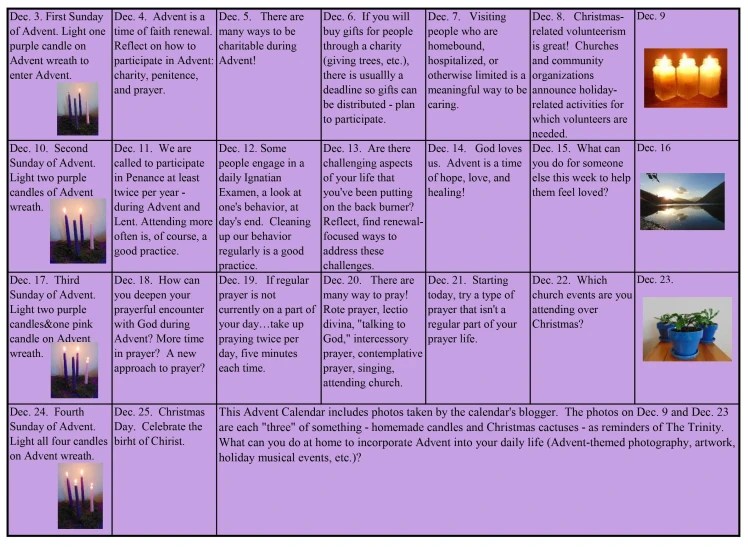
A home Advent wreath

The Advent season will soon be here. The First Sunday of Advent is going to be Sunday, December 3rd.

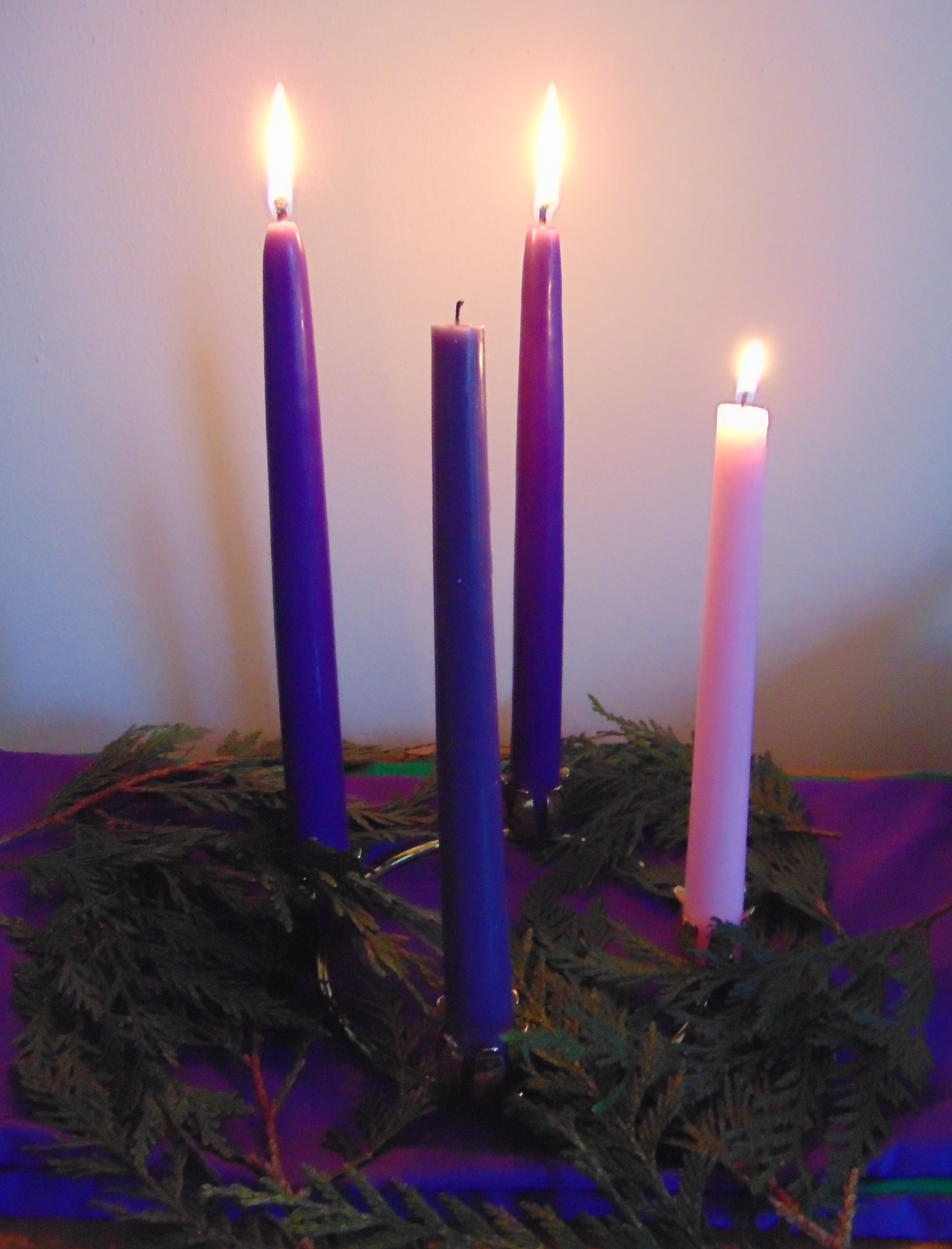
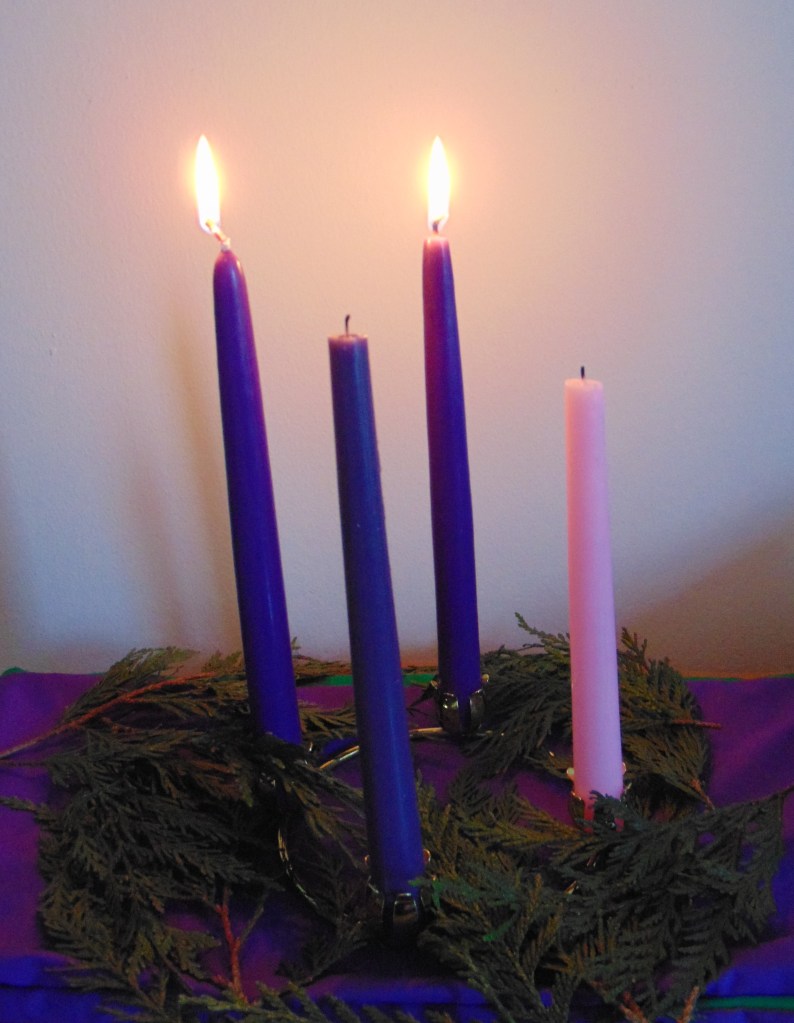
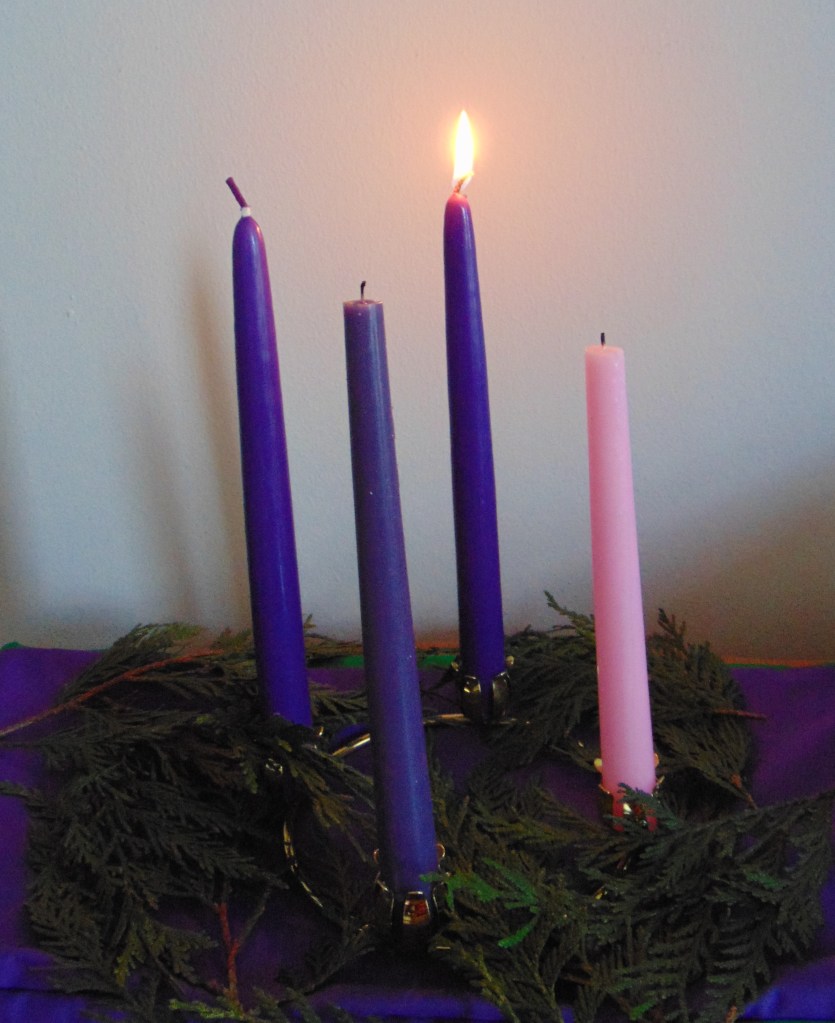
Many churches light an Advent wreath on each Sunday of Advent (one purple candle the first Sunday, two purple candles the second week, two purple candles and the pink candle on the third Sunday, all four candles on the fourth Sunday). It is a popular custom for church attendees to do likewise at home – lighting the corresponding weeks’ candles for a few moments each day, perhaps with prayer and reflection.

Some local churches make home-use Advent wreath kits available to parishioners to take home – round candle holders, four tapered candles of the appropriate colors (three purple candles, one pink candle), and instructions for picking up wreath material and prayer instructions (often, the candle holders can be kept to be used again in future years). Home Advent kits can also be purchased online.

As you start your Black Friday shopping, I encourage you to order a home Advent wreath during your online shopping or pick up a wreath kit from your local church if your church makes home Advent kits available. If you are going to order an Advent kit online, consider ordering one this weekend so that you will receive it in time for Advent. I set up my home Advent wreath today to take the photo shown here.

As I write this blog post, I am preparing a follow-Advent-from-home guide for those of you reading this blog and for visitors to the A Parish Catechist website (if you haven’t visited the website lately, it’s had a visual make-over!). Having an at-home Advent wreath will help you to participate in the Advent-at-home guide that will be posted next weekend (with an email reminder sent to you) at A Parish Catechist’s on the under-development Advent portal.

Participating in major liturgical seasons from home – Advent and Lent – is a great way to bring Church seasons into our daily lives. I hope you’ll join us, starting next weekend, in engaging in Advent at home!

A home Advent wreath

Kim Burkhardt blogs at A Parish Catechist and The Books of the Ages (and a “Content Creator/Individual” member of the Association of Catholic Publishers). If you are a new visitor, it would be great to have you follow this blog (thank you!). If you know someone who would like this blog post, please share it with them (thank you!).

Book Review: Playing with Dragons – Living with Suffering and God

I heard of this book recently while watching a “Great Course” about the history of the Old Testament. The Great Courses presenter who mentioned this book was discussing the cultural context of how dragons came to be mentioned in the Hebrew Bible; in the context of that presentation, he referred to this book Playing with Dragons in the same sense of the book’s Goodreads summary, saying (in effect): “This is a book for those want to go beyond standard discussions of faith and suffering.”

There are multiple layers of opportunity for understanding the depths of religious meaning. The academic/sociologist/theologian James Fowler chronicles in his book Stages of Faith the six stages we have the opportunities to progress through in faith as we age; too often, we adults settle for remaining perpetually in a high-school level of a stage three faith (as described by Fowler). In hindsight, I got stuck for some years as an adult in a transition moving from a stage three faith to stage four faith (a common occurrence, according to Fowler). It took time for me to begin growing in faith again; once I did, I was happy to discover new depths of religious insight – such as metaphors provided to us in Biblical texts and religious ritual. Therefore, I looked forward to Andy Angel’s book Playing with Dragons, Living with Suffering and God when I found recently found the book. I, as the Goodreads summary for this book mentions, “find standard discussions of faith and suffering frustrating” – I often find such discussions inadequate.

Personally, I accept that suffering is “part of the human condition” and a consequence of original sin. God gave us humans the opportunity to have a naturally happy time of it on earth; that opportunity was destroyed through free will via “original sin.” I don’t find the concept of original sin to be a limiting and heavy weight put on humanity; rather, we are provided with the opportunity to move beyond it through baptism and by nurturing a right relationship with God and the people around us.

In this Playing with Dragons book, I am hoped for discussion about how dragons are provided as a metaphor for us to wrestle on a human level with the challenges we must contend with during this lifetime.

This book is summarized on Goodreads as follows: “There be dragons all over the Bible. From the great sea monsters of Genesis to the great dragon of Revelation, dragons appear as the Bible opens and closes, and they pop their grisly heads up at various junctures in between. How did they get there and what on earth (or indeed in heaven) are they doing there? This is a book for those who find standard discussions of faith and suffering frustrating. Andy Angel opens up the rich biblical tradition of living with God in the midst of suffering. He takes the reader on a journey of exploration through biblical texts that are often overlooked on account of their strangeness–texts about dragons. He shows how these peculiar passages open up a language of prayer through suffering in which people share their anger, weariness, disillusionment, and even joy in suffering with God. Angel explores how such “weird” Scriptures open up a whole new way of praying and reveal a God who approves of honest spirituality, a spirituality that the Bible holds open but too many of its interpreters do not.”

What I found in the book was a cultural and religious context of the Old Testament – how and why dragons were symbolic representations of the challenges we wrestle with and – importantly – that metaphor provides us with a way to “wrestle with life’s challenges” in ways that literal vocabulary fails us. Epic dramas are useful.

Kim Burkhardt blogs at A Parish Catechist and The Books of the Ages (and a “Content Creator/Individual” member of the Association of Catholic Publishers). If you are a new visitor, it would be great to have you follow this blog (thank you!). If you know someone who would like this blog post, please share it with them (thank you!).

Book Review: C.S. Lewis’ ‘The Screwtape Letters’

I am not sure how I feel about reviewing a book that many people have already read (i.e., it’s so widely read that it perhaps doesn’t need much of an introduction!)…. With that said, I ended up choosing to review this timeless classic for anyone who hasn’t yet found and read this must-read book.

A friend – and spiritual guide – gave me a copy of The Screwtape Letters when I was in high school. Because it’s such a well-written and insightful spiritual classic, the book’s insights practically inform my faith life. I return to the book periodically, though I don’t ever need to re-read the entire book because the book’s contents impacted me enough the first time for its’ content to leave a lasting impression.

This book is well-described on Goodreads: “The Screwtape Letters by C.S.  Lewis is a classic masterpiece of religious satire that entertains readers with its sly and ironic portrayal of human life and foibles from the vantage point of Screwtape, a highly placed assistant to ‘Our Father Below.’ At once wildly comic, deadly serious, and strikingly original, C.S. Lewis’s The Screwtape Letters is the most engaging account of temptation — and triumph over it — ever written.”

When I first read this book (high school), I was just old enough to grasp what C.S. Lewis was getting at in this insightful, informing, and at the same time entertaining read. I had moved beyond Lewis’ Chronicles of Narnia (my third grade teacher introduced us to that wonderful series of children’s books, which I read six times in elementary school) and was ready to start having my faith challenged on a maturing level. The Screwtape Letters helped me grasp – in an immensely readable way – that temptation comes to us in subtle and psychologically powerful ways in order to tempt us effectively.

I’ve still got the copy of The Screwtape Letters that I was given in high school. I recently came upon another copy in a Little Free Library – I brought it home because I want to pass it on to another reader (if I can find someone who hasn’t yet read it!)… (note: that second copy led to this book review). This book’s writing style makes it a worthwhile read for Christians and non-Christians alike – it tells us as much about our own psychological makeup and how we humans surrender to temptation’s allure as it does about the devils who are out to outwit us. A book for all ages (chronological ages and eras).

Kim Burkhardt blogs at A Parish Catechist and The Books of the Ages (and a “Content Creator/Individual” member of the Association of Catholic Publishers). If you are a new visitor, it would be great to have you follow this blog (thank you!). If you know someone who would like this blog post, please share it with them (thank you!).

Book Reviews: Books about “The Creed”

When I was in college, I found myself unable to describe what beliefs made my denomination distinct when talking to people who belonged to other denominations. “I just know my denomination, I don’t know how to explain it” (I have since heard other people say the same thing, usually said with dismay similar to what I felt). I was surprised by my inability to articulate the beliefs of my denomination. So, I bought and read Fr. John A. Hardon’s Pocket Catholic Catechism to be better able to articulate denominational beliefs (I still have that book).

More recently, I came upon – and started reading – Fr. Peter J. Vaghi’s The Faith We Profess: A Catholic Guide to the Apostles’ Creed.

Both of these books – and any number of books like them – provide a line-by-line explanations of the Apostles Creed and/or the Nicene Creed. These types of books are worth reading for church-attendees and non-church goers alike – these books inform us about the basic beliefs that many Christian denominations profess (the two books I mention here are written from a denomination-specific stance). While my reading of The Pocket Catholic Catechism in college may have broadly more Christian than the denomination-specific book I sought, there was certainly Catholicism within it…..

It’s worth providing a historical context about the Nicene Creed and the Apostle’s Creed. Christianity grew out of a Jewish context, Jesus’s presence and his teachings. Following Jesus’ time on earth, the faith tradition that became Christianity was initially a Jewish sect that began attracting non-Jewish converts – then becoming a distinct religion named after Jesus Christ (i.e., “Christ-ianity”). As Christianity became a distinct – and non-Jewish – religion, it took time for Christianity to fully develop the contours that we now recognize. In the early 300’s, church leaders recognized that any number of groups and individuals were communicating their own ideas and beliefs about what defines Christianity; not all those ideas were compatible with one another, nor were all ideas what we now call orthodox (“mainstream” if you like) – some ideas were viewed as heretical. Therefore, church leaders met in Nicea (in modern-day Turkey) in the year 325 (i.e., the first “Council of Nicea”) and established the Nicene Creed – laying out the core beliefs of Christianity. The Apostle’s Creed – which is of very similar content – is likewise accepted as Christianity’s “Creed” of beliefs. Many Christian denominations accept and profess one or both of these Creeds. These Creeds are often professed by congregations at church services.

These worthwhile books provide thoughtful discussion of exactly what the Apostle’s Creed and the Nicene Creed mean. Simply reciting one of these Creeds at church can be a rote activity; really understanding the Creeds requires thoughtful study. It can be worth taking a fresh look periodically at The Creeds – and these types of books – to see how our perspective and reflections on The Creed changes as we move through life.

Kim Burkhardt blogs at A Parish Catechist and The Books of the Ages (and a “Content Creator/Individual” member of the Association of Catholic Publishers). If you are a new visitor, it would be great to have you follow this blog (thank you!). If you know someone who would like this blog post, please share it with them (thank you!).

Book Review: Nourishing Love – A Franciscan Celebration of Mary

This book takes readers on a novel way of exploring Mary’s life (no, not a novel). For those of us who tend think of Mary either historically and/or as a saint, this book brings us an additional way to consider Mary.

Franciscan author (and priest) Murray Bodo offers us something similar to that of The Chosen TV series: a conceptual view of what it could have been like living Jesus’ or Mary’s lives – making their day-to-day lives more tangible for us than what many of us consider when reading the Gospels. Both this book and The Chosen contain historical aspects of the lives of Mary and Jesus (respectively). Reading historical accounts alone – however – don’t necessarily take us into thinking about the daily aspects what they did and felt as people.

In this book, Nourishing Love, there are reflections that take us to ponder, “what thoughts did Mary ponder?” After Jesus offered her and John to one another as mother-and-son, what conversations Mary and John have about Jesus? Possibly ponderings by Mary and possible – plausible – conversations between Mary and John are presented here to bring us into considering their lives on a very human level.

At one point in the book, the author writes, “Since Jesus was both God and man, he had his mother’s genes and was deeply influenced genetically, as most of us are, by his mother. He was Mary’s son, prompting us to imagine how Mary herself was in fact revealed in the person of her son.” Hmm….. Did genetics cause Jesus to look like his mother? Did Mary and Jesus share similar voice inflections? Did Jesus maintain some of Mary’s habits once he became an adult (ate the same foods for breakfast, had the same evening routines, etc.)? How much did Mary’s human personality influence Jesus’ human personality? The author of this book observes that the stories Mary told Jesus during his infancy and childhood may have influenced the types of stories Jesus chose to tell as an adult – including the parables he told. How she cared for the people around her could have been socially instructive for the human Jesus.

The way this book is constructed made me think of Ignatian exercises in terms of the creativity brought to subjects of faith. There’s a degree to which I felt uncomfortable with this book – I would more naturally gravitate to an academically-oriented sociological construct/analysis of people’s daily lives in first-century Palestine to get a sense of Mary’s life (that type of book would also be interesting!). Sometimes, though, discomfort is good. Discomfort can challenge us to consider topics in new ways; new perspectives help us grow.

Kim Burkhardt blogs at A Parish Catechist and The Books of the Ages (and a “Content Creator/Individual” member of the Association of Catholic Publishers). If you are a new visitor, it would be great to have you follow this blog (thank you!). If you know someone who would like this blog post, please share it with them (thank you!).

Welcome to Advent (with a free calendar!): A time of anticipation

Home Advent Wreath

Welcome to Advent 2023!

Welcome to the Christian new year (the new liturgical year starts at the beginning of Advent).

The Christian year has two anticipatory liturgical seasons – Advent anticipates Christmas and Lent anticipates Easter. Advent is the four weeks leading up to the fixed-date day when we celebrate the anniversary of Christ’s birth (December 25). Lent, on the other hand, is the forty-day period leading up to celebrating the anniversary of Christ’s death and resurrection (Easter). Easter, rather than being celebrated on a fixed date, is celebrated on the first Sunday following the first full moon after the Spring equinox (any date from late March to late April).

We don’t know the actual date of Christ’s birthday (Christmas). We’d like to think that Christ is more interested in us recognizing him than being hung up on a specific date. We celebrate his birthday on December 25, the story goes, because there was a time when Christians were looking to convert pagans who already had a winter solstice celebration; adding a Christian celebration at about the same time would “make it comfortable or natural” for said pagans to celebrate a holiday of a new-to-them religion at a time when they were already in a festive period…… As for additional relevant dates on Christian calendar, Christ’s mother is said to have visited a relative – Sarah, who was pregnant with John the Baptist – when Mary was about three months pregnant; we celebrate John the Baptist’s feast day on June 24 (thus, thinking of John as being six months older than Jesus). Likewise, we celebrate the feast day of the Annunciation (the date when the Archangel Gabriel came to Mary with the request that she consent to being the mother of God’s son) on March 25 – nine months before the date we celebrate Christ’s birth.

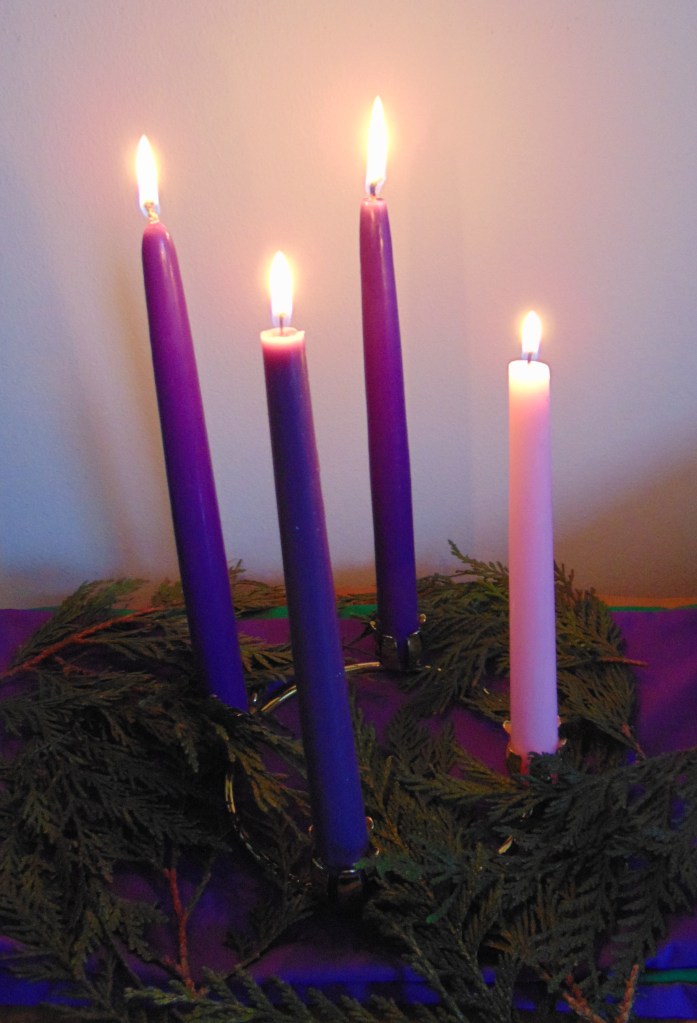
Advent is a time of renewal. We focus on our faith, finding ways to enrich it. We focus on charity (supporting the improved well-being of our neighbors and communities), penance (a reflective recognition of what we’ve done wrong with a view toward being better people), and prayer (an interactive relationship with God). You are invited to engage in these activities this Advent season. To that end, A Parish Catechist is providing this custom Advent calendar (2023). You are invited to print the pdf copy (below) and use it to reflect on ways to engage during this Advent season (see the calendar image below for a visual preview of the pdf calendar).

Also, visit A Parish Catechist’s Advent Portal (updates throughout the 2023 Advent Season).

Advent calendar

Advent calendar with suggestions

Welcome to Advent 2023!

Kim Burkhardt blogs at A Parish Catechist and The Books of the Ages. If you are a new visitor, it would be great to have you follow this blog (thank you!). If you know someone who would like this blog post, please share it with them (thank you!). You can also support this blog by clicking here when you are going to shop on Amazon (that lands A Parish Catechist a commission on Amazon sales).

Book Review: Healing as a Parish Ministry

I was happy to stumble upon this book in a Little Free Library and to then discover that this practical and helpful book was locally written (i.e., Seattle, Washington).

The summary of this book on Goodreads states: “Jesus’ mandate to heal the sick is beginning to enter into faith communities today. In this sound and practical book, Father Leo Thomas and Jan Alkire show how this vital ministry is rooted in Christian scriptural and sacramental tradition. Pastors and lay leaders will benefit from the authors’ faith-filled, balanced wisdom. ‘Healing as a Parish Ministry’ will help all who read it become more effective channels of Christ’s healing to those who are hurting.”

Jesus healed the sick during his time on earth. Jesus instructed his disciples to heal the sick. Pope Francis talks today about the church being a “field hospital.” In a workshop I’m taking through Franciscan University’s Catechetical Institute, the instructor talks about church-goers sometimes preferring to go to their pastor/church for help before going to mental health providers. The message is communicated in many ways that church is meant to be a place where people can come for healing and direction. This book – Healing as a Parish Ministry – provides practical, front-line instruction to parishes – local churches – on how to provide healing ministries at one’s church.

In their book Healing as a Parish Ministry:

  • Leo Thomas and Jan Alkire write about faith healing does not mean curing natural consequences of what happens in life; rather, that faith healing is often about bringing us into the fullness of who God wants us to be – a very healing experience!
  • Thomas and Alkire write about how to set up a parish healing ministry – and why it is important.
  • The authors provide useful resources on how to connect meaningfully and usefully with parishioners who are in a time of need. Of equal importance, they also provide practical tips on what NOT to do so as to avoid alienating parishioners or causing ill will.

I read this book as a person who has found healing in church and who wants healing to be something that happens for many people in church. In my case, I returned to church – after a time away – with a painful neuropathic medical condition. That condition includes a hyper-stimulated sympathetic nervous system and associated physical pain. After returning to church, I found that contemplative prayer (and yoga, in my case) slowly calmed my over-stimulated nervous system – resulting in a reduction in physical pain. When I later came upon this book, I found that the book speaks to the type of healing I’ve experienced – I see the book having practical and real – real-world – insights and application.

This book is a great resource! I recommend this book to anyone who wants churches to be a place of healing.

Kim Burkhardt blogs at A Parish Catechist and The Books of the Ages (and a “Content Creator/Individual” member of the Association of Catholic Publishers). If you are a new visitor, it would be great to have you follow this blog (thank you!). If you know someone who would like this blog post, please share it with them (thank you!).

Book Review: Introduction to Christian Worship

This book – Introduction to Christian Worship (Third Edition) by James F. White – is an academic book elucidating the how-and-why of how Christian church services are organized, how the structure of church services have developed and changed over the centuries (i.e., pastors, liturgists, interested congregants, academics, and religious historians).

This book covers every aspect of the Christian liturgy – both in minutia and comparative details on how (and why) Christian church services (and other aspects of Christian worship such as Christian Initiation, baptism, weddings, and anointing of the sick) are the same across denominations as well as detailed discussion of how various aspects of church liturgy vary among denominations. The history of how church liturgy developed over the centuries is widely covered throughout the book. The wide breadth – and detail – of knowledgeable insight demonstrate many years of comparative religious study by the author (he was, after all, an academic).

Among the very readable insights of this book is an interesting point about the Bible readings that many denominations hear read at church on Sunday (page 75 of the third edition). James White informs readers that the Catholic church developed its’ current cycle of biblical readings read at mass after Vatican II. Many Catholics know of the three-year cycles of readings known as years A, B, C (there is a two-year cycle for the readings at weekday masses); White informs readers that many Protestant denominations also adopted the same reading cycle for weekend services – meaning there is a broad level of uniformity among many denominations of which Bible passages are heard each Sunday (news to me! I knew that several denominations – such as Episcopalians, Anglicans, Presbyterians, perhaps Lutherans and Methodists – read many of the same readings at church on the same calendar as Catholics; this shared practice seems to be more uniform and widespread than I realized. Denominations that read these shared Bible readings each weekend read from “The Lectionary for Mass” for Catholics and “The Common Lectionary” for Protestants). This standardization of readings moved some Protestant pastors away from only reading self-selected Bible passages at church that supported the political views of pastors and/or their congregations.

James F. White’s Introduction to Christian Worship is an informative read for anyone interested in Christian liturgy.

Kim Burkhardt blogs at A Parish Catechist and The Books of the Ages (and a “Content Creator/Individual” member of the Association of Catholic Publishers). If you are a new visitor, it would be great to have you follow this blog (thank you!). If you know someone who would like this blog post, please share it with them (thank you!).

Prayer: Standing on the Threshold

Rev. Maria Grazia Angelini O.S.B. wrote – in an article addressed to the October, 2023 Synod in Rome: “As we prepare to celebrate the Eucharist, let us permit ourselves a little ‘statio‘ on the threshold. Since listening to the Word is never – for anyone – a matter of course. To make it possible, we are asked to stand on the threshold. We are asked to gather from dispersion the thoughts of the mind and the feelings of the heart, to rediscover in them an open question, indeed an invocation. Only in this way will it be possible to hear the Word, the delivery of the body and blood of Jesus, the Son. The words of Jesus, the words all of the Holy Scriptures are our “mother tongue’. And yet there is always a need to regain possession of that language. Such a need is signaled precisely by Jesus’ supreme gesture.”

So it must always be, too, with prayer. Rather than prayer being an activity sometimes thought merely to be a uni-directional communication from us to God, prayer is meant – and in its’ fullness is – a “gather[ing] from dispersion [of] the thoughts of the mind and the feelings of the heart” to pausing on the threshold of our own existence, willing to vulnerably be in the presence of God. In such instances, when in private prayer, no human language needed. God’s presence to us in prayer is fullness of prayer.

Certainly, there are also times for additional forms of prayer – talking to God about our lives (either our own prayer or psalms), intercessory prayer, rote prayer, being in community of prayer at church….. My own favorite prayer is when vulnerably feeling God’s presence is the totality of the prayer experience (my second-favorite prayer is when we sing in exultation at church services such as Easter and Christmas!). Dry periods of prayer – when we don’t feel God’s presence – can also have value (though less exultative on our end); John of the Cross aptly points out that willing to allow God to be present within us allows God to form and change us – even if we don’t sense change that is happening “beneath the surface” while it is happening. The beneficial/productive work God does within us at such times becomes clear to us later. God loves us.

Kim Burkhardt blogs at A Parish Catechist and The Books of the Ages. If you are a new visitor, it would be great to have you follow this blog (thank you!). If you know someone who would like this blog post, please share it with them (thank you!).

The ultimate indicators of faith well lived

Being a person of faith has a two-fold objective. Sometimes, people only seek to cultivate the first half of this faith equation: developing a personal relationship with God (i.e., seeking one’s own salvation and freedom). While a personal relationship with God is absolutely part of the faith journey (i.e., there can be no faith without prayer)…..if our personal faith journey were all that we were to focus on, that would very much limit the scope of being a person of faith. Faith necessarily takes us to loving our neighbor. Sometimes, sociologists and mythologists observe that faith traditions provide us with a framework of how to live well in the world.

In Jesus’ day, he was asked, “Teacher, which is the great commandment in the law?”  Jesus replied, “‘You shall love the Lord your God with all your heart, with all your soul, and with all your mind.’  This is the first and great commandment.  And the second is like it: ‘You shall love your neighbor as yourself.’  On these two commandments hang all the Law and the Prophets.” (Matthew 22: 36-40)

When we grow in faith, our faith becomes visible to the degree that we begin living the seven virtues of Christianity: the four cardinal virtues of prudence, justice, temperance, fortitude and the three theological virtues of faith, hope, and charity. One of these outward signs of our faith is that we increasingly become loving, caring people (i.e., charity….”love your neighbor as yourself” is very much bound up with charity and justice). Loving our neighbor requires caring for the people around us – being upstanding citizens, taking care of our families, being nice to our friends and relatives (even when that’s difficult!), providing for our communities (soup kitchens, prisoner visitation programs, performing well at our jobs, etc.).

Living these concepts well is an ongoing learning aspect of our faith journey. How well do each of us “love God and love our neighbors?” It varies from person to person. While few of us will become like Mother Teresa, the degree to which we become loving should become increasingly visible over time. Fortunate are the individuals who are graced with a natural ability to be good and loving to everyone (or most everyone) they encounter. For all of us, we – and the people who know us – should be able to see incremental increases in our loving behavior over time. For those of us who have to work toward “love your neighbor,” we are fortunate that there are an abundance of lessons within Christianity that move us toward “love your neighbor.” An insightful aspect of how we experience pouring out love to the people around us was recently summed up by Fr. Tim Clark of Seattle: “The sacrificial nature of love saves us from ourselves.”

Kim Burkhardt blogs at A Parish Catechist and The Books of the Ages. If you are a new visitor, it would be great to have you follow this blog (thank you!). If you know someone who would like this blog post, please share it with them (thank you!).