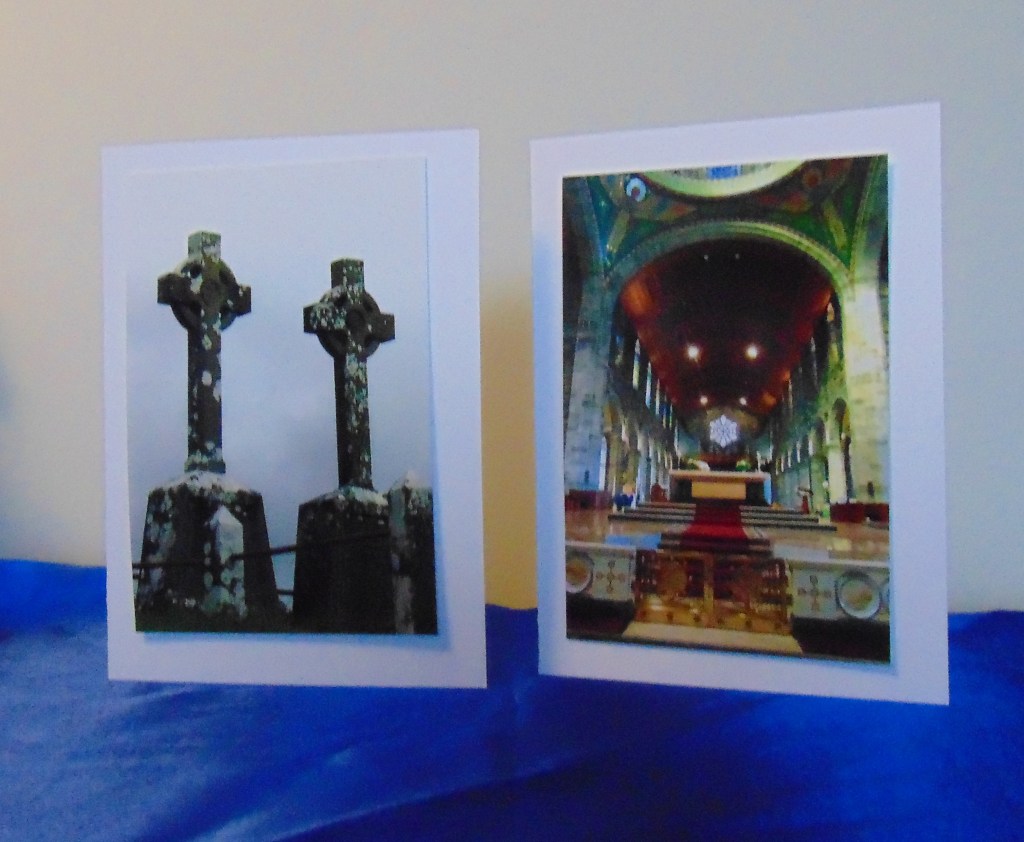
Etsy sale: Parish Catechist’s Christmas greeting cards

Great news: Etsy is offering an Etsy-wide sale through Wednesday. If you are thinking ahead about ordering Christmas cards, a sale on our Christmas cards is an option. Our cards can be found on Etsy here. Thank you.

Kim Burkhardt blogs at A Parish Catechist and The Books of the Ages. If you are a new visitor, it would be great to have you follow this blog (thank you!). If you know someone who would like this blog post, please share it with them (thank you!).

Accompanying one another in our faith journeys

Our faith formation – spiritual exploration and growth in faith – is personal and at the same time communal.  It takes interaction with each other – a faith community – to learn, grow, and mature. Specific faith traditions offer spiritual insights learned over a period of time – we aren’t going to find adequate insights to grow and mature our faith on our own. Further, faith communities are often where we learn social mores that nudge us forward more than what we would glean from sitting home alone reading books (“Hey, come put your faith into action by helping at our soup kitchen,” learn about treating each well within a faith community, etc.). Friends, communities (prayer groups, faith circles, book clubs, etc.) and leaders within a faith community can help us avoid taking detours down unproductive rabbit holes.

Within that context, some individuals emerge who provide us with spiritual accompaniment: pastors, spiritual accompanists, faith mentors, spiritual directors, soul friends, and the like. 

Spiritual accompaniment is a relationship in which one individual helps facilitate another’s exploration and continued growth (maturity) in their faith journey.

Spiritual accompaniment takes innumerable forms, such as:

  • A youth minister takes a spiritually curious young person “under their wing.”
  • Someone at a parish notices that a parishioner “is at loose ends” or “looking for direction in their faith” and takes on a one–on-one faith guidance role.
  • A parishioner who is experiencing a life transition – starting college, entering the workforce, having a child, losing a loved one, retiring, etc – asks their pastor for guidance and is directed toward “Hey, X or Y person would be a good person for you to connect with at this time.”
  • An individual looking to potentially join a faith tradition – or a different denomination within a tradition – may be assigned a mentor and/or a lay minister to guide their faith inquiry.
  • A parishioner may admire a fellow parishioner who has matured in their faith and ask the person for guidance and/or “faith friendship.”
  • In various contexts, individuals exist who provide formal spiritual accompaniment (and/or spiritual directors) to individuals looking for direction in their faith. Such accompaniment often takes place when an individually formally seeks this out; during a period of questioning, doubt, or struggle; during periods of transition (life transitions, transitioning from one stage of faith to another); when a person wishes to continually hold themselves accountable in faith.

While spiritual accompaniment sometimes occurs in some kind of a formal or leadership capacity, we can also support each other – in peer or mentor capacities – in our faith journeys. There are a number of ways to support one another:

  • Participate in faith groups – book clubs, prayer groups, bible studies, etc. Support and discussion about faith happens within such groups.
  • Be welcoming to new people at church – reach out and initiate friendships.
  • Reach out to people in your faith community who seem to be at loose ends or are having difficulty – look for ways to be present and supportive.
  • Be someone in your faith community who talks about how you experience your faith. Someone may be listening for feet-on-the-ground insights about living one’s faith.
  • Consider your faith-related strengths and look for opportunities to discuss those strengths with other people. If prayer is one of your areas of interest, for example, look for opportunities to talk to people about the nuts-and-bolts of cultivating a vibrant prayer life. If you take an interest in community service (running your church’s food bank, etc.), invite people to get involved in service projects.
  • Participate in church-based programs that assist people in their faith – becoming a guide or leader in healing prayer groups, grief support groups, faith education classes, etc.
  • Have an active prayer life. In order to relate to people in faith, we need to have an active relationship with God. Prayer is a relational activity between us and God (rather than a uni-directional monologue). Prayer is essential for growing in faith.
  • Listen to people. Authentic listening is a deeply attentive activity. Hearing people makes it more possible to know “where a person is at” – making it more possible to identify how to support people. Further, being heard is an encouraging activity.
  • Recognize that faith development incorporates a whole person – spiritual, intellectual, emotional, and the context of a person’s life circumstances.
  • Offer insights or encouragement to people – this can go a long way.

Kim Burkhardt blogs at A Parish Catechist and The Books of the Ages. If you are a new visitor, it would be great to have you follow this blog (thank you!). If you know someone who would like this blog post, please share it with them (thank you!).

Legos, faith….Didn’t anticipate this outcome

A recent trip down memory lane led me to wanting a Lego set (my maternal grandmother had Legos for us to play with when we were children…..). So, it seems that I’ve joined the Legos craze. I wasn’t going to be satisfied with just any of the latest “Legos sets.” I drove across town this morning in search of a Legos store where one can find “anything Legos.” I ended up combing through several bins and tables of individual Legos pieces in search of the pieces and colors I wanted. After a time, I realized “perhaps I’ve been here awhile?” I checked the time, I’d been combing through bins for two hours in search of the individual types of Legos pieces I was there to find. A bit manic, perhaps! Perhaps the store clerk was a bit amused (I was the only customer in the store for most of that two hours, so my active hunting through piles of Legos was readily observable). The money I paid for my carefully-selected bag of Legos was perhaps justified simply by the enjoyment of two hours searching intently through piles of Legos!

I subsequently spent much of the afternoon at home beginning to assemble the Legos creation I had envisioned – a Legos church. An unlikely way to spend my day off?

Then, disappointment. After so much effort to collect all the desired Legos pieces I could find, I found out at home (I rather suspected when leaving the store) that I don’t yet have enough pieces to finish erecting a church. I got the foundation laid, started the walls, installed doors and windows, and have something of an altar and tabernacle. Off to the side, I have Legos pieces for a steeple. There aren’t enough pieces, though, to complete the upper portion of the walls or a roof.

Perhaps, however, this is a case of art mimicking life. Or, more specifically, Legos mimicking how we experience faith. We can lay a foundation and start building a faithful life, but we’re really never done. Nor can we finish this on our own. We’ll likely never have all the pieces.

Perhaps I’ll never want a roof on this Legos church. If there were a roof, I’d never be able to see what’s inside. In faith, what’s inside needs to be made visible rather than hidden (i.e., the inside of this Legos church would be hidden to viewers if there were a roof) – we likewise lay ourselves (our insides) before God to be improved upon. We’re to take what we learn in church out into our lives and communities – our faith needs to be made visible by how we live (sometimes pastors say at the end of mass, ““Go forth, glorifying the Lord by your lives”).

In a sense, maybe my Legos church is as done as it is suppose to be. On with the continued building of life and faith.

Kim Burkhardt blogs at A Parish Catechist and The Books of the Ages. If you are a new visitor, it would be great to have you follow this blog (thank you!). If you know someone who would like this blog post, please share it with them (thank you!).

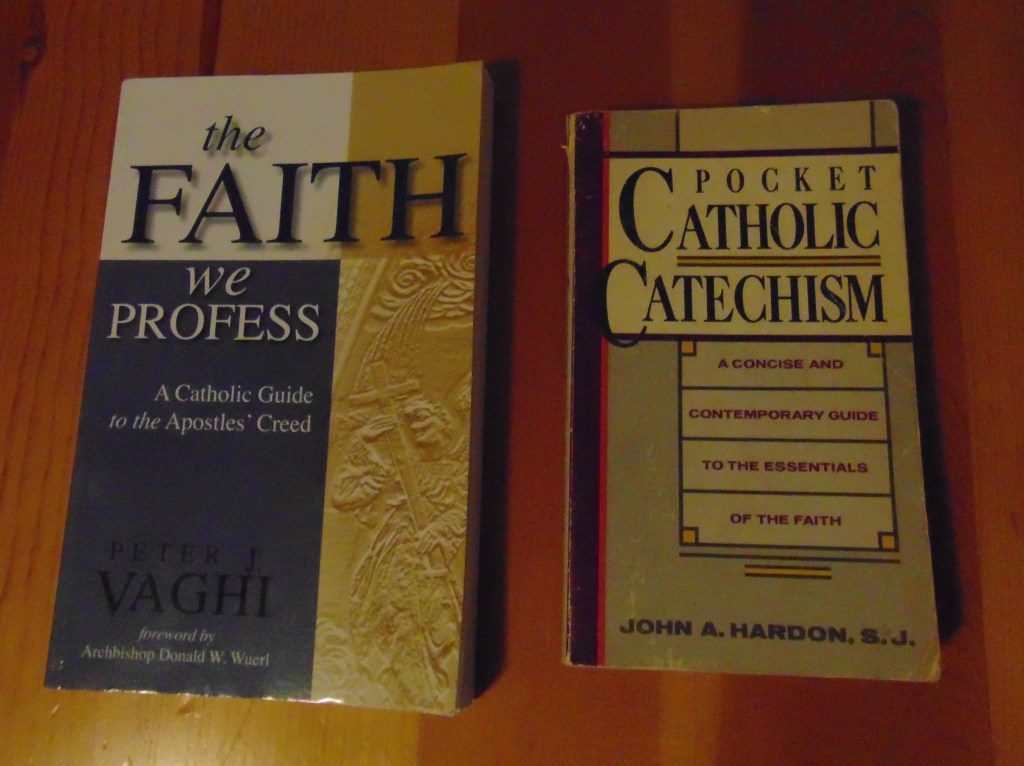
List: How many ways to pray (types of prayer)?

The Benedictine monks of Saint Meinrad Monastery succinctly state on the back cover of their book The Tradition of Catholic Prayer, “Catholics have a rich and ancient prayer tradition that informs contemporary practice….” It’s no wonder that people seek out the variety of prayer options available within Catholicism.

Catholic prayer is a vibrant and varied tradition, bringing to fullness a life-giving relationship between us and God. Jesus came “that we might have life, and have it more abundantly” (John 10:10). “…prayer is not merely an exchange of words, but it engages the whole person in a relationship with God the Father, through the Son, and in the Holy Spirit” (U.S. Conference of Catholic Bishops, USCCB).

How many ways are there to pray?

The essence of prayer is communication, a relationship with God, a being-with or being-in-the-presence-of. When we find a relationship with God – an interactive, two-way interaction rather than a one-way monologue (we wouldn’t relate to the people in our lives exclusively via uni-directional monologues!) – there comes a discovery that God is present with us in prayer.

A friend said to me, “prayer is a very personal communion with God that is meant to be personal, and unique to you….People are… very different in their personal experience in prayer, and that in itself is a beautiful thing.”

Just as we have many differing relationships with the various people in our lives – and a variety of ways that we communicate with the people in our lives – there are any number of ways of communicating with God. A prayer style that works for one person may be very different than what works for the next person. Here are several approaches to prayer:

  • Rote prayer (formal, memorized prayers – these are often provided to us by our houses of worship). Prayers such as the Lord’s Prayer are full of meaning and help us learn to pray. Such prayers give us ready prayer content that we can easily put to use.
  • Psalms. The Book of Psalms – which were meant to be sung – are summarized by Wikipedia thus: the Book of Psalms are “an anthology of Hebrew religious hymns…including hymns or songs of praise, communal and individual laments, royal psalms, imprecation, and individual thanksgivings.  The book also includes psalms of communal thanksgiving, wisdom, pilgrimage, and other categories.”
  • “Talking to God.” Our spontaneous thoughts and words directed to God. God wants to have a relationship with us; relationships are two-way, be open to feeling God’s presence in response.
  • Contemplative Prayer. Resting reflectively in prayer, without a need for words or any human language. Contemplative prayer can – and for some people, does – include a sense of God’s presence in prayer. For more information about contemplative prayer, visit Contemplative Outreach.
  • Praying the Rosary. The rosary is a reflective way of praying a set of rote prayers with a formulaic set of Catholic prayer beads (focusing time on specified topics). Instructions for praying the rosary is available here.
  • Lectio Divina. Lectio Divina “describes a way of reading the Scriptures whereby we gradually let go of our own agenda and open ourselves to what God wants to say to us” (this particular description provided by the Carmelites).
  • Singing at church. “Those who sing pray twice” (a popular phrase in churches).
  • Intercessory prayer. Intercessory prayer that we pray for other people. We come to God with the challenges of those who are in need of support.

My favorite Catholic pray-ers:

  • Teresa of Avila, (16th-century mystic, Doctor of the Church, Carmelite nun, reformer of the Carmelite religious order, Carmelite saint)
  • John of the Cross (16th-century mystic, Doctor of the Church, Carmelite monk and priest, co-reformer of the Carmelite religious order, Carmelite saint)
  • Edith Stein, Carmelite nun, Carmelite saint
  • Fr. Thomas Keating, founder of Contemplative Outreach

Books for further reading:

Clinging: The Experience of Prayer (Emilie Griffin)

The Tradition of Catholic Prayer (The Monks of Meinrad Monastery)

Kim Burkhardt blogs at A Parish Catechist and The Books of the Ages. If you are a new visitor, it would be great to have you follow this blog (thank you!). If you know someone who would like this blog post, please share it with them (thank you!).
Getting to the best in prayer: relational, loving, healing

In the mainstream view of the general public, prayer is sometimes reduced to being viewed as “a uni-directional monologue of us making intercessory requests to God when we need something.”

If our human relationships were limited to uni-directional monologues, that would make for very dry relationships (i.e., transactional rather than interactional) – we likely wouldn’t have many engaging connections with people. Likewise, prayer in its’ fullness is also more than a uni-directional monologue. A rich prayer life is relational and interactive: a two-way communication in which we relate with God (with us as the junior communicator), both offering and receiving wide-ranging communication – including our sense of God’s loving presence.

What about prayer and our questions about why God allows suffering in the world? Isn’t prayer about asking God to fix our problems?

God didn’t create the world to be a world in which we suffer. God made us in order to have us to love. Love, by its’ nature, is two-way and interactional. Further, love – by definition – can’t be forced. Since love can’t be forced, we were given the option of whether or not to love God in return. Further, we have the option of whether to live in right relationship with God. Adam and Eve chose to break this right relationship with God by eating of the forbidden fruit. Since then, we humans haven’t always lived in right relationship with God (I’ve heard it argued that the root of sin is selfishness and/or disobedience). Thus, we live in a troubled, broken world.

Gerald May (a physician, psychiatrist, and writer of faith books) looks at the fact of suffering from another perspective on page nine of his faith book Dark Night of the Soul (May’s book is a reflection on John of the Cross’s original book of the same name). His is a perspective that occurred to me in some fashion several years ago: “….suffering does not result from some divine purgation….Instead, suffering arises from the simple circumstances of life itself.” In their book Healing as a Parish Ministry, Leo Thomas and Jan Alkire state – along a similar lines – about faith healing typically not curing natural consequences of what happens in life – that faith healing is often more of about bringing us into the fullness of who God wants us to be (a very healing experience!)

Personally, I don’t view prayer as only being about us bringing our list of problems to “Santa in the sky” to be fixed. Rather, the first focus of prayer is about entering into an ongoing – and interactive – relationship with God. When we let God into our hearts – when we surrender to letting God live within us (“It is no longer I, but God who lives in me,” Galatians 2:20), God can – and does – transform us into the people that God intended us to be. Then, we become better and emotionally/mentally happier people (at best, we experience a “peace that passeth all understanding”), people who contribute good in the world.

What about praying for healing and praying when we feel so challenged in life that we need God regarding our challenges? What about when we are seriously ill?

There absolutely are times when we need God. Ill health, life challenges. Having an active prayer relationship with God all the time – makes an interactive relationship with God more accessible to us much of the time (there are sometimes dry prayer periods). Just as human parents want to hear from their grown kids throughout the year – not just in times of need – God wants to have an ongoing, interactive relationship with us on an ongoing basis.

Sometimes, miraculous healing does occur through prayer. Jesus performed miracles and healed people. We hear stories today of miraculous healing. Other times, we pray in times of illness and we don’t experience direct healing of specific illnesses.

Sometimes there are ‘healing in prayer’ situations in prayer. We hear of medical healings. There are also cases of emotional and mental healing in difficult times.

Yes, there is healing in prayer

God loves us, wants to have a relationship with us and wants to heal us.

In their Healing as a Parish Ministry book (above), Leo Thomas and Jan Alkire quote Verla A. Mooth’s “Forgiveness and Healing” publication when stating on stating on page 43 of their book: “….The miracle of redemption is that God should change us……This transforming love is poured out in our hearts through the Holy Spirit who is given to us. It can only be a giving and forgiving love.” As such, we become more vibrant and able to live more fully – and, in many ways – healthier lives.

As an example of healing found in prayer, I returned to church in 2016. I returned with a painful neuropathic condition in which a stress response is involved (Complex Regional Pain Syndrome includes hyper-stimulation of the sympathetic nervous system). Prayer very slowly had a calming and healing effect, calming my sympathetic nervous system. I now have periods of being symptom-free from Complex Regional Pain Syndrome.

For more recent reflections about the fullness of prayer, see my previous post here.

Kim Burkhardt blogs at A Parish Catechist and The Books of the Ages. If you are a new visitor, it would be great to have you follow this blog (thank you!). If you know someone who would like this blog post, please share it with them (thank you!).
Feast Day of Hildegard von Bingen

Above: Hildegard’s own artwork of the Trinity

Today – September 17 – is the Feast Day of Hildegard von Bingen: a saint, polymath (a person with significant multiple talents), and Doctor of the Church (Doctors of the Church are saints recognized for having made significant contributions to the Catholic Church).

I have been listening to Hildegard’s music for several years. She lived her life in the region of Germany where my father’s mother’s ancestors later lived and was a Benedictine (I am a parishioner at a St. Benedict parish – another personal reason to like her!).

Hildegard – with her wide-ranging interests, talents, activities, and achievements – is broadly popular across many social strata.

The following summary of Hildegard’s life comes from Wikipedia:

Hildegard of Bingen c. 1098 – 17 September 1179)…. was a German Benedictine abbess and polymath active as a writer, composer, philosopher, mystic, visionary, and as a medical writer and practitioner during the High Middle Ages. She is one of the best-known composers of sacred mononphony, as well as the most recorded in modern history. She has been considered by scholars to be the founder of scientific natural history in Germany.”Hildegard of Bingen… c. 1098 – 17 September 1179)…. was a German Benedictine abbess and polymath active as a writer, composer, philosopher, mystic, visionary, and as a medical writer and practitioner during the High Middle Ages. She is one of the best-known composers of sacred mononphony, as well as the most recorded in modern history. She has been considered by scholars to be the founder of scientific natural history in Germany. Hildegard’s convent elected her as magistra (mother superior) in 1136. She founded the monasteries of Rupertsberg in 1150 and Eibingen in 1165. Hildegard wrote theological, botanical, and medicinal works, as well as letters, hymns, and antiphons for the liturgy. She wrote poems, and supervised miniature illuminations in the Rupertsberg manuscript of her first work, Scivias. There are more surviving chants by Hildegard than by any other composer from the entire Middle Ages, and she is one of the few known composers to have written both the music and the words. One of her works, the Ordo Virtutum, is an early example of liturgical drama and arguably the oldest surviving morality play. She is noted for the invention of a constructed language known as Lingua Ignota.”

A timeline of her achievements is listed here by worldhistory.org .

If you would like to read up on individual saints, Hildegard’s life story provides many interesting facets to read up on.

Kim Burkhardt blogs at A Parish Catechist and The Books of the Ages. If you are a new visitor, it would be great to have you follow this blog (thank you!). If you know someone who would like this blog post, please share it with them (thank you!).
Being a person of faith: more than mental beliefs about religion

Photo: Window at Clonmacnoise Monastery, Co. Offaly, Ireland

In his book Opening to God: Lectio Divina and Life as Prayer, Irish poet David G. Benner writes “Too often faith is reduced to beliefs. But cognitive ascent to propositions has very little to do with genuine faith, which is more a posture of the heart than of the mind. Faith in God is leaning with confidence into God. (page 32)”

I spent years “trying to think my way to God.” That doesn’t work. In 2016, I had a re-conversion experience in which I felt God’s love for me; my faith moved into “a posture of the heart” that I had been trying for years to experience (my faith story is told in more detail here.).

So, how does one move from merely “reducing faith to a set of beliefs” to faith that is experienced and lived? A few thoughts:

  • Certainly, a living faith does necessitate religious learning. Who is God? Who are we in relationship to God? What are the precepts of a life of faith? Individual faith traditions provide such instruction. It is then up to us to allow these precepts to move into our being and to incorporate these precepts into our lives (i.e., incorporate these ideas into how we relate to God, relate to other people, and live our lives).
  • Faith is experiential: a relationship with God. Faith becoming experiential involves doses of grace, surrender, prayer, and love. Living faith is made possible through grace given to us by God (in the Christian tradition, this grace is conferred upon us beginning with baptism….and then grace continues to show up at other times when God knocks on our door). Our portion of “doing faith” – what David G. Benner describes as “leaning with confidence into God” – requires surrender and prayer. Surrender is an emotional giving up, ascenting to allow God to take the driver’s seat in our lives. Prayer is where we participate in a relationship with God. Rather than prayer being a uni-directional monologue of us talking at or to God, prayer is relational and interactive. In prayer, we both communicate to God and receive the presence of God (analogy: our relationships with the people in our lives are likewise interactive rather than uni-directional). I write more about prayer here. The fruits of grace, surrender, and prayer become “the fruits of the spirit” listed in Galatians 5:22-23: “”love, joy, peace, forbearance, kindness, goodness, faithfulness, gentleness and self-control.”
  • We live our faith through how we live. Growing into being a person of faith involves allowing our inner work of faith (grace, surrender, prayer, and resulting love – listed above) to direct our being-ness in the world. A life of faith is absolutely about our own relationship with God, but it is also essentially more than that – life isn’t just about us personally or about our own relationship with God. We are here to be of service to all of God’s children. Everyone is a beloved child of God, our lives are measured to the degree that we move into loving God’s children in thought and deed. Living our faith is about “love God and love your neighbor” (Matthew 22: 36-40) and applyin the precepts of one’s faith tradition (“The Golden Rule,” “Christian charity,” etc.).

Faith is more than a set of beliefs – it is how we relate to the divine and live among God’s children. Acts 17:28: “It is in God that we live and move and have our being.”

Kim Burkhardt blogs at A Parish Catechist and The Books of the Ages. If you are a new visitor, it would be great to have you follow this blog (thank you!). If you know someone who would like this blog post, please share it with them (thank you!).
Hearing God’s voice….in stillness

…….It is often in the stillness where we hear – and can respond to – the promptings of God’s voice.

In 1 Kings Chapter 19 (19:11-13), we read: “The Lord said, ‘Go out and stand on the mountain in the presence of the Lord, for the Lord is about to pass by.’ Then a great and powerful wind tore the mountains apart and shattered the rocks before the Lord, but the Lord was not in the wind. After the wind there was an earthquake, but the Lord was not in the earthquake. After the earthquake came a fire, but the Lord was not in the fire. And after the fire came a gentle whisper. When Elijah heard it, he pulled his cloak over his face and went out and stood at the mouth of the cave. Then a voice said to him, ‘What are you doing here, Elijah?’”…..

Jesus also frequently went to quiet desert spaces to pray to his father. Prayed in solitude and stillness.

For us, a relationship with God likewise requires a willingness to “go inward” – to step away from life’s hustle and bustle encouraged by our outwardly-focused society and sit in stillness. Stillness is uncomfortable for some. Pausing to go inward isn’t always comfortable – we bump up against our own inner tumult. Yet, prayer can get us through such tumult.

When we find a relationship with God – an interactive, two-way interaction rather than a one-way monologue of intercessory prayers from us directed to God (we wouldn’t relate to the people in our lives exclusively via uni-directional monologues!) – there comes a discovery that God sits with us in prayer. God’s felt presence in our lives can – and does – provide “peace that passeth all understanding.”

We also experience a relationship with God by being of service to others – by working to improve the lives of other people (Jesus told his apostles that the greatest commandments are “Love God and love your neighbor” – Matthew 22: 36-40 ). Mother Teresa lived this in the streets of Calcutta. Richard Rohr focuses on the need for both rest in God’s presence and the need to be active in the world through his Center for Action and Contemplation.

Wondering about how to go about stillness and prayer? Start praying. If you’re not praying yet, start praying twice per day for five minutes each time. Sit in stillness – go with whatever comes in that stillness and “become comfortable” with whatever comes in that stillness. Find someone with whom to discuss what you experience in stillness. Wondering how to pray, how to move deeper in prayer? Consider:

Kim Burkhardt blogs at A Parish Catechist and The Books of the Ages. If you are a new visitor, it would be great to have you follow this blog (thank you!). If you know someone who would like this blog post, please share it with them (thank you!).
Ponderings on self-revealing love

Yikes.

I am reading David G. Benner’s book, Opening to God, Lectio Divina and Life as Prayer. Early in the book, he writes “Genuine prayer always begins in the heart and is offered by act of opening our self as we turn toward God in faith” (page 18). “Growth in prayer is learning to open more and more of our selves to God” (page 19). Benner also goes on to write on the following page, “….God is ever reaching out in self-revealing love….”

Yikes…..the passage “God is ever reaching out in self-revealing love” hit me like a ton if bricks. In the context of prayer, I began experiencing God’s love via prayer in October, 2016 [I tell of how I “heard the words” growing up that “Jesus loves us,” but I heard it much like children in the Charlie Brown movies heard their teacher’s voice as “wah…wah…wah” – words that we don’t actually take in. It wasn’t until October, 2016 that I actually experienced – in prayer – that God loves me. Experiencing that God loves us sure gets a person’s attention!]. Yet, reading Benner’s passage last night about “self-revealing love” got my attention in quite another way.

We are meant to have rich relationships with both God and each other. Christ indicated that the greatest commandments are to “Love God and love your neighbor” ((Matthew 22:36-40)….. Add to that “self-revealing love” – insight toward a solution for a particular and vexing challenge. Many first-world countries are experiencing an “epidemic of loneliness” (see the U.S. Surgeon General’s 2023 report on the “Epidemic of Loneliness“). I myself have spent much of my life feeling varying degrees of social isolation – the awkward introvert, feeling like the ignored, boring, and lonely social wallflower who senses a wall between me and the world. Why waste time making this self-revelation? Because we’ve all got room to grow and because showing our own experience is part of the poetry of sharing the human experience…..

Related to the topic of social isolation, the idea of “self-revealing love” isn’t just suppose to be God’s self-revelations to us. As we are to “love God and love our neighbor,” how many of us engage in self-revealing love with one another? Frankly, I don’t do that well – if at all. When I read Benner’s passage about God’s self-revealing love to us in prayer, I moved from “God provides us with self-revealing love” to the emotional weight of thinking – by extension – “We humans should self-revealing as part of ‘love one another.’ I don’t do that. I don’t self-reveal nearly enough.” No wonder I’m boring and lonely. I come across as a blank slate in which people aren’t able to see who lives under my skin. I then immediately and easily thought of people who engage in self-revealing love in their social and family interactions. We all want to be around those people!

A public example of a self-revealing individual – who self-reveals as an act of love – is the priest and popular author Henri Nouwen. Nouwen was willing to self-disclose in his popular books that he spent years struggling with self-doubt and conflictedness about his sexuality. What a “self-revealing love” gift to share with readers (I – as a reader – was moved when I read that. “Wow! We don’t often hear priests talk about their inner experience regarding their sexuality….”). This wasn’t just self-revelation: it was self-revelation in a vulnerable sort of way that helps lay readers see their own humanity in a respected faith leader. It seems to me that this was one of the aspects of lovingness that makes Nouwen’s writings so well read (there’s a quote on the Henri Nouwen Society website from a reader who mentions Nouwen’s willingness to live vulnerably).

Self-revelations in our social interactions add a level of depth to our relationships with one another and can – should – be part of how we love. Of course, there are appropriate parameters – what time we brush our teeth, etc. can border on the ridiculous; I’m referring to self-disclosing those aspects of ourselves that make us human. Some of the people I know who are most appreciated in their social circles are people who both love the people around them and make themselves transparent with gusto. For those of us either don’t self-disclose or love (or both) with gusto, there’s a challenge in learning how to do so! One prayer that is consistently useful and that could help with this topic is one that allows God to turn me into a better human (it’s a form of surrender): “God turn me into the person you want me to be. Help! You’re going to change me better than I can!”

Kim Burkhardt blogs at A Parish Catechist and The Books of the Ages. If you are a new visitor, it would be great to have you follow this blog (thank you!). If you know someone who would like this blog post, please share it with them so they can subscribe (thank you!).

Book Review: Opening to God (David G. Benner)

I was hooked when I read the back cover of David Benner’s Opening to God: Lectio Divina and Life as Prayer.

I read these excerpts from the book’s back cover as poetry describing the best I have experienced in prayer: “Prayer is not just communication with God: it is communion with God. As we open ourselves to him, God does the spiritual work of transformation in us…….discover openness to God as the essence of prayer…..Move beyond words [in prayer] to become not merely someone who prays, but someone whose entire life is prayer in union with God.”

Okay, I haven’t yet gotten to living as “someone whose entire life is prayer,” but my prayer life has joyously moved beyond “words communicated to God” to prayer being a relationship – without the need for human language” (as I mention in several previous blog posts such as this one). In my case, such prayer was given to me as a grace.

I started reading this book last night. Happily, the book is living up to the book’s description – a descriptive book about the dynamics of prayer being a meaningful relationship with God. A worthwhile read about what prayer can be and is meant to be.

Kim Burkhardt blogs at A Parish Catechist and The Books of the Ages. If you are a new visitor, it would be great to have you follow this blog (thank you!). If you know someone who would like this blog post, please share it with them so they can subscribe (thank you!).