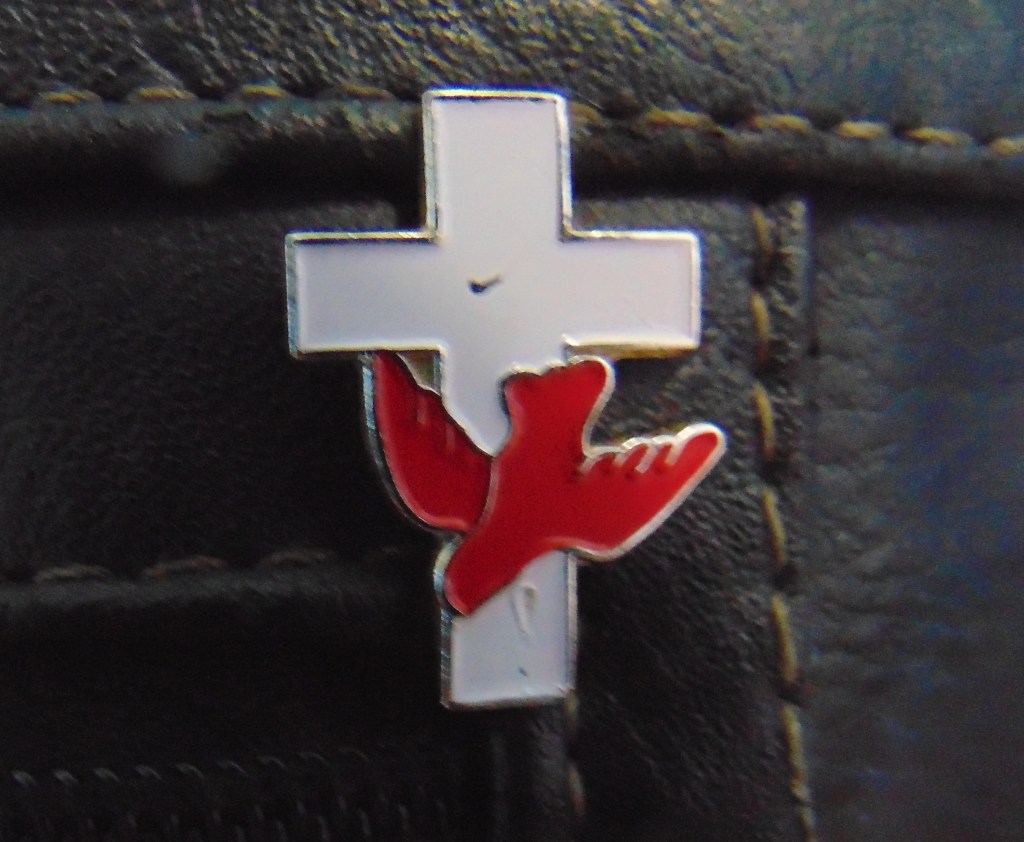
Pentecost this Sunday, Living the Church on Earth

This Sunday – 50 days after Easter – is Pentecost.

In the year of Christ’s death and resurrection, the Holy Spirit descended upon Christ’s Apostles 50 days after Christ’s resurrection (i.e., Pentecost). Pentecost is the anniversary of the Apostles’ new role, with the breath of the Holy Spirit, to be the post-resurrection deliverers of Christ’s message to the people – the day of Christianity’s founding.

I carry this visual representation of Pentecost – the Holy Spirit (represented as a dove) – on my purse (it’s a pin); an ongoing reminder for me to live Church daily. Do I “Love God and love my neighbor” every day? How? What do I do on any given week to spread the message of God’s love in my community? How well I “Love God and love my neighbor” and spread the message of God’s love is my measure of how I help to spread the message of Church – of God’s love for us – in the world.

Do you celebrate Pentecost? How?

Kim Burkhardt blogs about faith at A Parish Catechist.

Faith and (re)growth: Mt. St. Helen’s anniversary

For those of us who lived close enough to Mt. St. Helens to hear its’ powerful explosion on Sunday, May 18, 1980, today’s anniversary evokes memories (it wasn’t heard within the closest proximity).

While news of the event joined the explosion’s ash in the travelling the world, those of us who lived in some measure of close proximity were living in in real trepidation. I lived in the county of another nearby volcano (Mt. Baker); we were hearing from seismologists about what would happen to us if Mt. Baker – which was “overdue to blow” – followed in Mt. St. Helen’s footsteps (Mt. St. Helens and Mt. Baker are in the same chain of active volcanoes).

When Mt. St. Helen’s blew at 8:32 am on Sunday, May 18, 1980, our family was heading into church for Sunday morning services. My mother responded to the sound by saying, “That sounded like a canon being shot on Sehome Hill” (Bellingham, Washington). I replied, “I bet it was Mt. St. Helens” (the world had been waiting for the mountain to blow). We found out later that morning that I was correct. In the days and weeks that followed, there was local and international news coverage of the momentous event. I still remember hearing about the hermit who refused to evacuate from Mt. St. Helens and therefore died in the explosion.

In the years since 1980, the volcano has been an active field of exploration for scientists. In the days and months after the explosion, immediate study of the volcano was international news. In the years since, scientists have been amazed at how quickly life – vegetation, the return of animal life – has literally bloomed on the comparatively calm mountain.

What about us? In 1980, the date of Pentecost came a week after Mt. St. Helen’s “blew.” I don’t recall our pastor’s homily (sermon) that week; I now reflect in the possibility that the homily spoke in analogy about death and rebirth; the death and devastation caused when Mt. St. Helen’s blew, the measurable trepidation we had been experiencing in Washington State about the explosion, Christ’s death and our opportunity for new life; Pentecost and the birth of Christianity.

As a contemplative, I ponder what happens below the surface. Volcanoes explode outwardly as a result of the geological forces at work inside and underneath the mountain’s surface. Likewise, the outward fruits of our faith – visible faith, our degree of “peace that passeth all understanding,” how well we love our neighbor – are a product of our internal workings, our internal relationship with our God. The mystic John of the Cross spoke of the Dark Night of the Soul; a time of quiet when change sometimes happens imperceptibly even to ourselves rather than necessarily a reference to darkness meaning difficulty within our soul. Certainly, our transitions during a dark night of the soul can move us out of times of personal darkness, but our transition toward God from our own fallen state doesn’t always have to be akin to a volcanic explosion.

For all of us, though, there is a question. How willing are we to engage with the machinations of our internal emotional state that “lie beneath the surface” to let God transform us into a new creation? Some people prefer outward distractions….. I have personally mucked around beneath the surface and was given a grace that led to letting God change me; that change continues and I’m becoming happier for it.

Today on the anniversary of the Mt. St. Helen’s explosion, we have decades of knowledge that new life has blossomed on the mountain.

Kim Burkhardt blogs at A Parish Catechist.

Fear rather than faith, whereas perfect love casts out fear

I have observed that fear exists too often in the lives of individuals, inhibiting the full and joyous expression of who God intends for us to be.

Fears are expressed in a myriad of forms:

  • Afraid of being alone
  • Fear of giving up being single
  • Fear of not having enough…….(money, love, etc.)
  • Afraid of not being enough
  • Fear of trying something new
  • Afraid of confrontation
  • Fear of failing
  • Ad infinitum

Further, how often do we not trust God in matters we fear? Too often. In such cases, we allow our fears to be bigger than our perception of God. In essence, we perceive whatever we fear to be bigger than God’s power to work in our life. We give our fears a bigger presence in our lives than the room we make for God.

God is all powerful and all loving. Perfect love casts out fear.

Truly believing that God is all powerful and all loving requires us to give up any notion of control…..to truly surrender to God’s loving care.

Kim Burkhardt blogs at A Parish Catechist.

Do you see God’s love for the people you dislike?

Every person alive is a child of God.

When we disagree with someone – or dislike what they do – how often we look at them as a child of God? How often, rather, do we look at them – and engage with them – with the sentiment expressed in this photo of my cat (Mr. Zip)?

Every one of us is a beloved child of God. This fact can permeate how we interact with each person we encounter.

Mary said Yes to God. Ponderings about that yes….

God, who is infinite love, loves us.

In creating humanity, God made us to love us. And, hopefully, for us to love God in return. This reciprocity of love requires free will. Our return of love of God must be done freely; forced love is not truly love.

We first hear about humanity’s free will with Adam and Eve. God gave Adam and Eve the opportunity to live in a perpetual state of grace in which humanity would happily live in right relationship with God. Adam and Eve upended that opportunity by eating of the forbidden fruit – thus initiating humanity’s fall from grace.

Later, God the Father planned to send Jesus the son to earth in the form of a human person. This required a biological mother. Mary was asked by God – via the Angel Gabriel – to be the mother of Jesus. Again, free will. She had the option of saying yes or no to God’s request; her “Yes to God” is our highest example of submitting to what God asks of us.

Thus, a question that didn’t occur to me until recently. Prior to Mary “saying yes to God,” had another potential mother “said no” to God’s request of becoming the mother of Jesus?

This is a stunning question. A question for which we likely don’t have a historical answer. Yet, the question deepens our consideration of historical faith questions.

We would like to think God only had to ask once that a potential mother agree to be the mother of Jesus (who would say no to God?!?! Actually, how often do we not follow the prompts of the holy spirit in our more mundane circumstances?). Historically, however, we likely don’t know whether another potential mother of Jesus said no before Mary said yes. It’s possible that another woman who had all the right demographics – of humble circumstances in the same geographic region, with an intended husband who was of the Line of David, provided an immaculate conception, etc. – but who said no.

The idea that another potential mother may have said no to God’s request would seem to be theologically uncomfortable. It would be more comfortable to think that God only had to make such a request – via the Angel Gabriel – once. Yet, it’s also historically interesting to ponder whether another potential mother may have said no. It also brings us poignantly to the question of how often we say no to the promptings of the Holy Spirit. How much more often could we say yes to God? When we sense those promptings of the spirit….to be loving to another person, to “do the right thing” is a difficult situation, to be more involved in church, and…..how about saying yes to God more often….

.

Honey-Cinnamon-Candles, Love God, Love Your Neighbor

I wrote recently about my Christmas Cactus in which I reflected upon The Trinity (post: Out of One, Three).

….I bought a large scented candle a couple months ago. As the candle started to melt with use, I began re-purposing the scented wax toward another candle in an empty honey jar that had held honey I received at Christmas. I continued on; I have now re-purposed scented wax in one honey jar and two cinnamon jars.

Another Trinity story, somehow.

There’s going to be enough wax to fill another cinnamon jar, when I empty another small jar (continuing with the Trinity symbolism, we humans came along after the Trinity….).

The catechism of the Catholic church indicates that God had to be Trinitarian in nature. God is love; love by its’ very nature has to be shared. Before God had us to love, God shared love amongst God’s self in the trinity.

Today, God has us – God’s created and adopted daughters and sons – to love.

For us, experiencing God in the transcendent often seems beyond-the-ordinary; extraordinary.

Yet, God is Emmanuel – “God is with us.” I’ve experienced the transcendent, beginning with a grace-given God encounter in 2016 (there was an Irish homily and a broken ankle involved in the story….). …..We are also to encounter God in the ordinary course of our days. To the degree that we to learn to live the way God wants us to live – in right relationship with God – perhaps we could feel God’s love for us as being very, well, ordinary. Perhaps some people do.

These jars that are becoming re-purposed as scented candles are an example of experiencing God in the ordinary. An initial three jars (a honey jar and two cinnamon jars), bringing to mind the Trinity, to be joined later by a fourth jar – a cinnamon jar – that brings to mind that I as God’s adopted daughter received a jar of honey at Christmas and who also uses cinnamon in homemade muffins that I make for family and friends; giving and receiving, the senses of smell and taste. God is love, we are in turn called to love one another…. (“If anyone says they love God but hates their neighbor, they are a liar.” 1 John 4:20. “Which of the commandments is greatest?…..Love God and love your neighbor” Matthew 22:36-40 )

How do you see God in the ordinary, the every day aspects of your life?

Do you allow yourself to be still and experience those moments when God invites us to the transcendent?

How do you love your neighbor?

Kim Burkhardt blogs about faith at A Parish Catechist.

Out of one, three

I considered getting a festive table-top tree this last Christmas. No Christmas trees for the previous sixteen Christmases due to a four-legged monster-in-residence who could be reasonably relied upon to destroy a Christmas tree. I loved Snoopy Grumpy Monkey Monster (Snoopy has since passed on at the age of eighteen-and-a-half); most years I accepted not having a Christmas tree. This last Christmas, I thought maybe I could set a small tree on a table – beyond the reach of the then-elderly cat AKA “Grumpy Monkey Monster.” When I looked at table-top trees, however, I realized that they were too small to adorn with my long-ignored Christmas ornaments that are stored in a closet. So, I settled for a Christmas Cactus.

Fast-forward to Lent. During Lent, I observed that my Christmas Cactus was “more vibrant” than when I’d brought it home from a nearby grocery store…..but that it would perhaps be more vibrant still if I transplanted it into a bigger pot. As I began the transplanting process, I discovered that my “one” plant was actually three. Thus, I now have three cactuses.

Out of one, three.

Similarly, there is “more than a lifetime” of discoveries that make themselves apparent to us as we grow and mature in our faith. These discoveries – as one priest observed to me – only hint-around-the-edges of God’s supreme reality. We can’t ever quite get at the full brilliance of God’s omnipotence.

Growing up in church, I was always puzzled by Jesus’ aspect of the Trinity. “Why,” I thought, “did God send his son to earth? I don’t need to see God incarnate to believe in God. I don’t need a tangible human aspect of God to belief in the intangible.” I completely missed the part about “God so loved the world that he sent his only son….”

Growing up, I absolutely “heard” the words communicated in church about “Jesus loves me, this I know” and “For God so loved the world….,” but I “heard” this something like the children in the Charlie Brown movies hearing their teacher’s words as “wah…wah…wah…” I completely missed the love part!

I grew up believing in God and wanted a personal relationship with God. Yet, there was a complete void in my perception (fyi, a very lonely void!) !!!!

It wasn’t until my mid-forties that I experienced that God loves me. There was a whole story around how that came to pass – a priest’s homily at a mass (and a broken ankle after mass….I tell that story elsewhere), along with a subsequent and unexpected gift of a sustained period of contemplative prayer……

I was then reading the Catholic Catechism later (yes, a few of us read it from cover to cover) and discovered WHY the Trinity exists as a three-in-one. It had nothing to do with my misconception of humans needing to see God incarnate in order to believe (how did I ever make that up?)…… RATHER, GOD IS LOVE. Love functions in such a way that love must inherently be shared. Before God had people to love, it was inherently necessary that LOVE ITSELF, meaning the Trinity – the Father, Son, and Holy Ghost – share love amongst itself (paragraph 221 of the Catechism: “God himself is an eternal exchange of love, Father, Son, and Holy Spirit, and he has destined us to share in that exchange.”).

Yes, God loves us.

Kim Burkhardt blogs about faith at A Parish Catechist.