Advent: hope, peace, joy, love

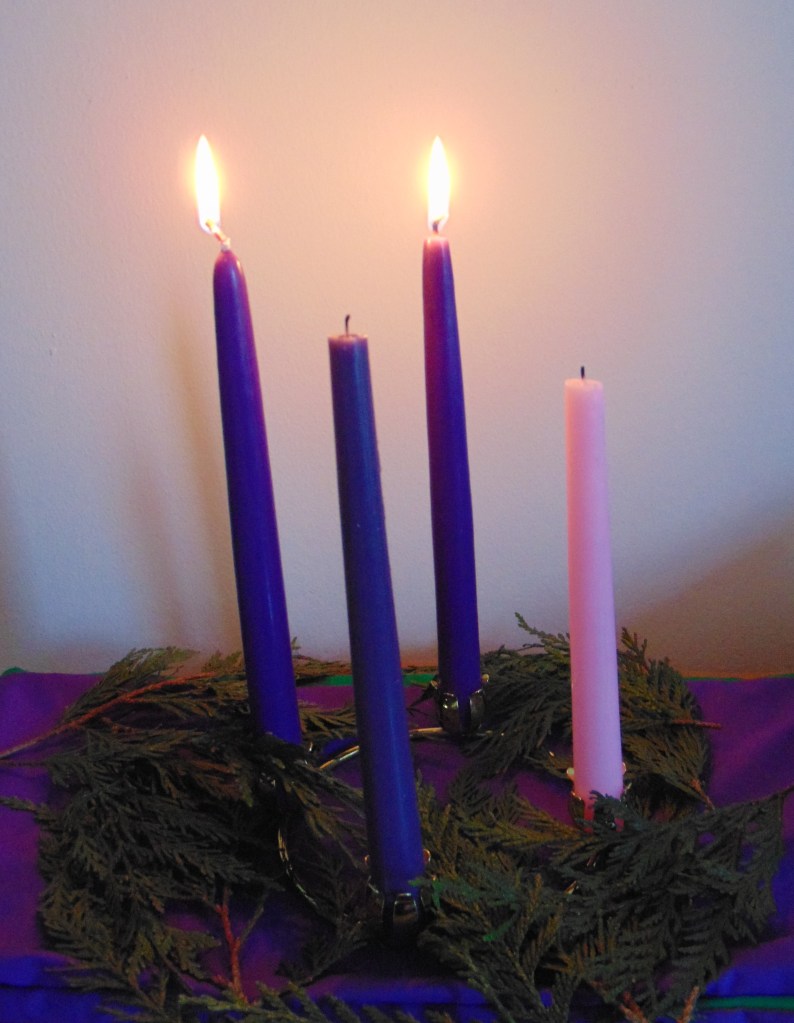
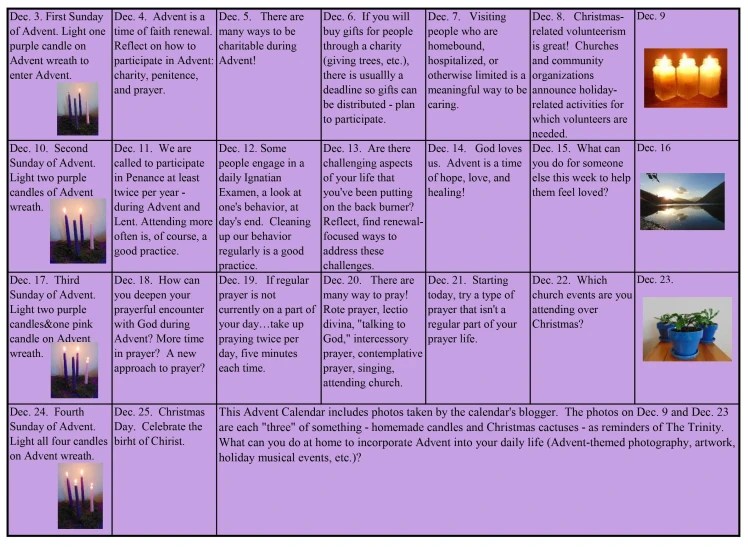
A home Advent wreath This Sunday – Dec. 17th – is the Third Sunday of Advent. This Sunday (and each day this week, if you are doing this at home), we light two purple candles and a pink candle on our Advent wreaths. Advent is a time for us to reflect upon, engage in, and renew our faith. There are four topics associated with Advent (i.e., faith-renewing reflections):
  • Hope: Hope is one of the three theological virtues – hope, faith, and charity – which are viewed by Catholics and Episcopalians as being infused in us by God at baptism (read more about theological and cardinal virtues here).  Read Pope Francis’ suggestions about cultivating hope here.  During Advent, we light candles of hope (light) during a season of darkness (northern hemisphere).
  • Peace: On a personal level, peace is more than “quiet, harmony, internal balance” that can be sought or achieved “for its’ own sake.”  Rather than seeking personal peace as an end in itself, peace is the result of sacrificial love – Christ’s sacrificial love for us and our sacrificial love for other people.  Pope Francis thoughts on this idea can be read about here.  Peace is a consequence of a faith well lived rather than something we can achieve for its’ own sake.
  • Joy: Joy “is the fruit of living all the virtues.”  In addition, joy comes from knowing “the love God has for us” (1 John 4:16) and from being of service to other people.  In short, joy comes from a life well-lived rather than a state of being that we can – or should – cultivate for its’ own sake (living for others helps produce joy rather than the self-focused activity of us seeking joy for our own sake).
  • Love (another of the three theological virtues!):Perfect love casts out fear” (1 John 4:18). In a world where we need more peace, casting away fear – via love – could go a long way toward achieving more peace (many ill human behaviors driven by fear.  Not just societal level wars – how many times have each of us made personal/localized decisions based on fear when we could have made better decisions?).  Love, therefore, is important for us to put into practice and to seek to cultivate in others.  When Jesus was asked by the Pharisees which of the commandments is greatest, he said “Love the Lord your God with all your heart, with all your soul, and with all your mind.’ This is the greatest and most important commandment. The second is like it: ‘Love your neighbor as you love yourself.’ All of Moses’ Teachings and the Prophets depend on these two commandments” (Matthew 22: 34-40).  Do you love the Lord your God with all your heart?  Do the people around you see in your behavior that you love them?  What goal could you set this Advent to be more loving?
Kim Burkhardt blogs at A Parish Catechist and The Books of the Ages (and a “Content Creator/Individual” member of the Association of Catholic Publishers). If you are a new visitor, it would be great to have you follow this blog (thank you!). If you know someone who would like this blog post, please share it with them (thank you!). You can also support this blog by clicking here when you are going to shop on Amazon (that lands A Parish Catechist a commission on Amazon sales).


Geography of Faith (poetic ponderings)

river

I heard recently that Thomas Merton used the phrase Geography of Grace. That phrase inspired me to try some poetic faith-geography imagery of my own, posted below:

Where do we travel in our faith journeys?

  • We move – seemingly unaware of the mechanics our own locomotion – toward new journeys of the soul prompted by the Holy Spirit
  • We wander unknown paths, exploring new faith terrain
  • We walk with others along their paths, supporting their faith journey
  • We head with belligerence, certainty, confusion, or uncertainty toward a dead end
  • We sing with joy and weightlessness toward the upper mountain heights of God’s love
  • We run along stream-side paths, delighting in the company of fellow faith travellers
  • We trod down dirt roads toward – or into the depths of – despair
  • We take joy in love-filled spaces of caring for one another
  • We wander down detours, looking for any useful lessons from the experience
  • We find our way out of detours!
  • We rest in grace-filled meadows
  • We explore “monasteries of the spirit” (such joy when these come along!)
  • We wonder when happening upon liminal places

May your faith journey be wonder-filled.

Kim Burkhardt blogs at A Parish Catechist and The Books of the Ages. If you are a new visitor, it would be great to have you follow this blog (thank you!). If you know someone who would like this blog post, please share it with them (thank you!). You can also support this blog by clicking here when you are going to shop on Amazon (that lands A Parish Catechist a commission on Amazon sales).
Second Sunday of Advent….Faith Renewal

A Home Advent Wreath

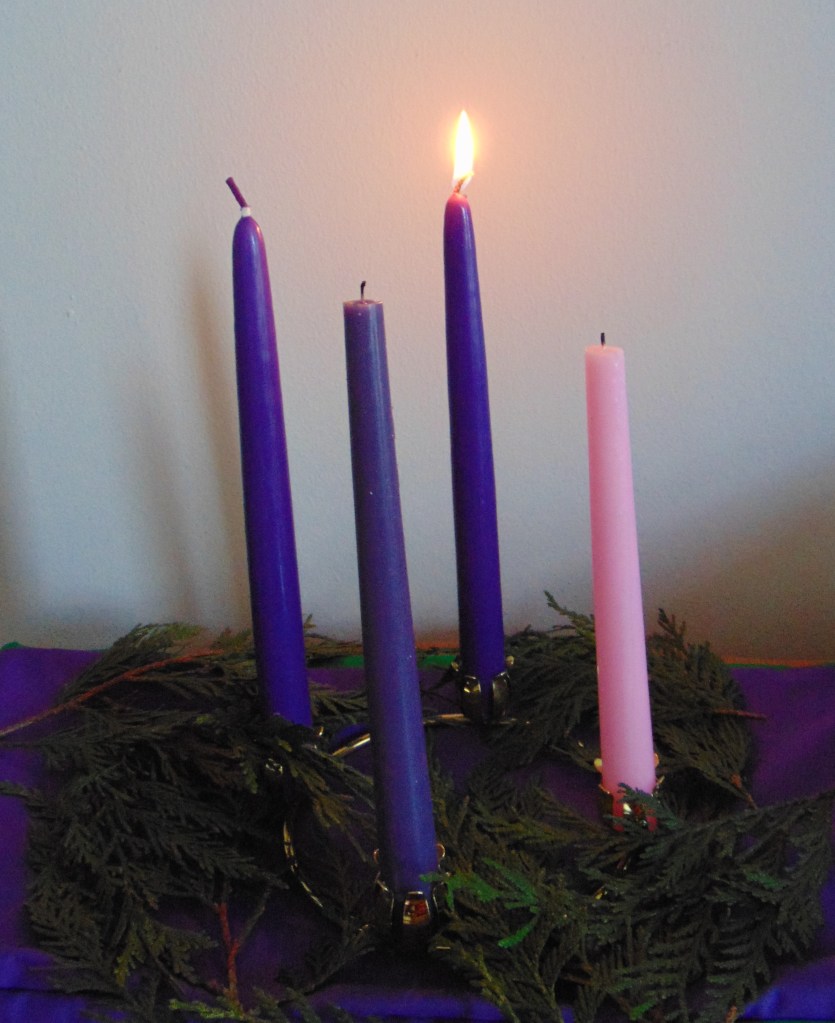
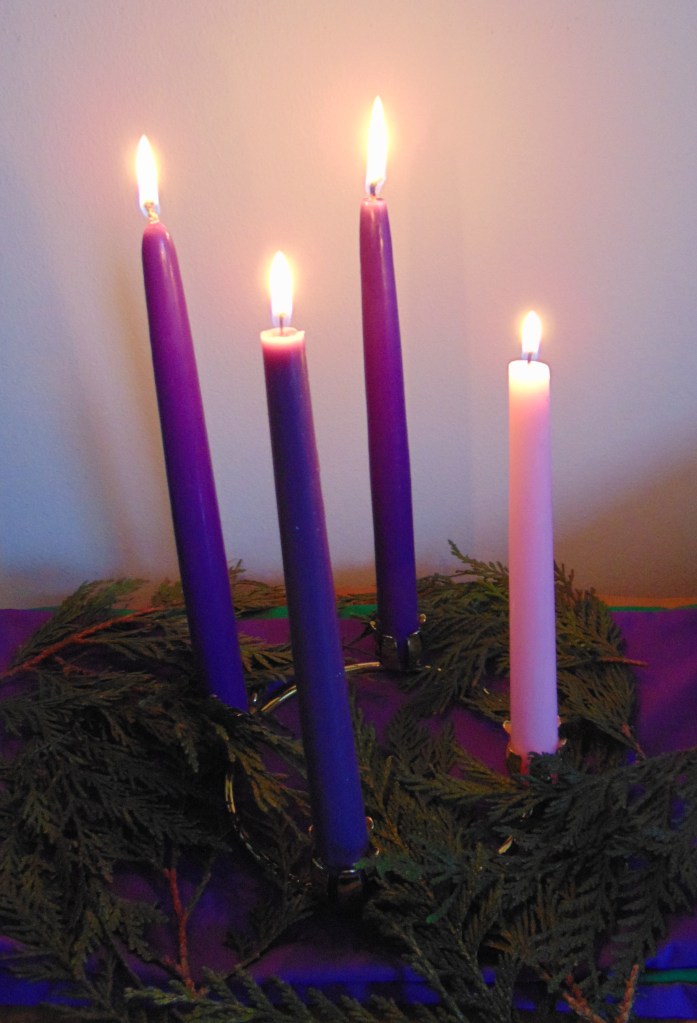
This Sunday – Dec. 10th – is the Second Sunday of Advent. This Sunday (and each day during Advent’s second week), we light two purple candles on our Advent wreaths (we can have an Advent wreath at home by getting one from one’s church, ordering one online, or finding one in local stores).

Participating in major liturgical seasons – Advent and Lent – is a great reminder to renew our faith lives! During Advent:

  • We anticipate the anniversary of Christ’s birth at Christmas (hope)
  • We recognize in the four candles of the Advent wreath the topics of hope, peace, joy, love
  • Reflect on deepening our faith and put this into practice in our lives. The four topics associated with the Advent wreath candles – hope, peace, joy, and love – are great topics to cultivate. We receive these from a relationship with Christ (a relationship cultivated in prayer!); we learn to radiate these to the people we encounter.
  • Engage in penance-charity-prayer
  • Engage more actively (more often, with more reflection) in church services and church activities
  • Consider how to be more caring to the people in our lives

Looking for ways to renew your life of faith? Here are a few tips:

  • Participate in acts of charity, prayer, and penitential reflection of how we can become better people (I’m currently asking God to improve an aspect of my life in which I’m seeing I need to become a better person). In prayer, focus particularly on hope, peace, joy, and love.
  • An printable pdf copy of our Advent calendar – with daily Advent reflections – is still available at A Parish Catechist’s Advent portal.
  • Looking for reading material to help renew your faith this Advent? Check out our list of our favorite faith books on the A Parish Catechist website.

Kim Burkhardt blogs at A Parish Catechist and The Books of the Ages (and a “Content Creator/Individual” member of the Association of Catholic Publishers). If you are a new visitor, it would be great to have you follow this blog (thank you!). If you know someone who would like this blog post, please share it with them (thank you!). You can also support this blog by clicking here when you are going to shop on Amazon (that lands A Parish Catechist a commission on Amazon sales).
Book Review: This is My Body, A Call to Eucharistic Revival

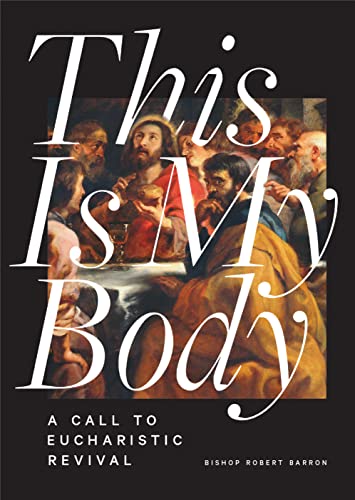
Book: This is My Body

I was recently given Bishop Robert Barron’s book This is My Body: A Call to Eucharistic Revival. When I started reading it, I quickly found it as readable and engaging as Henri Nouwen’s book With Burning Hearts.

The author, Bishop Robert Barron, wrote this book as part of a U.S. “call to Eucharistic renewal” (he helped initiate a U.S. call to Eucharistic renewal while the Chair of the Committee on Evangelization and Catechesis for the United States Conference of Catholic Bishops, USCCB). This book is engaging because it takes readers to the deeper meaning of faith concepts we’re meant to learn; he does so in an easily readable and interesting manner – plenty of “ah ha” moments. At the risk of reviewing this book with too much hyperbole, I stopped earmarking interesting pages after a few pages because I was earmarking most pages.

Here are two excerpts from This is My Body, A Call to Eucharistic Revival:

….”The opening line of the book of Genesis tells us that ‘in the beginning, God created the heavens and the eart’ (Gen. 1:1). Why did God, who is perfect in every way and who stands in need of nothing outside himself, bother to create at all? There are mythologies and philosophies galore – both ancient and modern – that speak of God needing the universe or benefiting from it in some fashion, but Catholic theology has always repudiated these approaches and affirmed God’s total self-sufficiency….God created the heaven and earth ‘of his own goodness and almighty power, not for the increase of his own happiness.'”

“Love, in the theological sense, is not a feeling or a sentiment, though it is often accompanied by those psychological states. In its essence, love is an act of the will, more precisely, the willing of the good of the other as other. To love is really to want what is good for someone else and then to act on that desire.”

This book is intentionally priced affordably to get it into the hands of readers. I am passing along copies to fellow readers who live in my community. If you are looking for something to read, you can order it online here.

Kim Burkhardt blogs at A Parish Catechist and The Books of the Ages (and a “Content Creator/Individual” member of the Association of Catholic Publishers). If you are a new visitor, it would be great to have you follow this blog (thank you!). If you know someone who would like this blog post, please share it with them (thank you!). You can also support this blog by clicking here when you are going to shop on Amazon (that lands A Parish Catechist a commission on Amazon sales).

Welcome to Advent (with a free calendar!): A time of anticipation

Home Advent Wreath

Welcome to the Christian new year (the new liturgical year starts at the beginning of Advent).

The Christian year has two anticipatory liturgical seasons – Advent anticipates Christmas and Lent anticipates Easter. Advent is the four weeks leading up to the fixed-date day when we celebrate the anniversary of Christ’s birth (December 25). Lent, on the other hand, is the forty-day period leading up to celebrating the anniversary of Christ’s death and resurrection (Easter). Easter, rather than being celebrated on a fixed date, is celebrated on the first Sunday following the first full moon after the Spring equinox (any date from late March to late April).

We don’t know the actual date of Christ’s birthday (Christmas). We’d like to think that Christ is more interested in us recognizing him than being hung up on a specific date. We celebrate his birthday on December 25, the story goes, because there was a time when Christians were looking to convert pagans who already had a winter solstice celebration; adding a Christian celebration at about the same time would “make it comfortable or natural” for said pagans to celebrate a holiday of a new-to-them religion at a time when they were already in a festive period…… As for additional relevant dates on Christian calendar, Christ’s mother is said to have visited a relative – Sarah, who was pregnant with John the Baptist – when Mary was about three months pregnant; we celebrate John the Baptist’s feast day on June 24 (thus, thinking of John as being six months older than Jesus). Likewise, we celebrate the feast day of the Annunciation (the date when the Archangel Gabriel came to Mary with the request that she consent to being the mother of God’s son) on March 25 – nine months before the date we celebrate Christ’s birth.

Advent is a time of renewal. We focus on our faith, finding ways to enrich it. We focus on charity (supporting the improved well-being of our neighbors and communities), penance (a reflective recognition of what we’ve done wrong with a view toward being better people), and prayer (an interactive relationship with God). You are invited to engage in these activities this Advent season. To that end, A Parish Catechist is providing this custom Advent calendar (2023). You are invited to print the pdf copy (below) and use it to reflect on ways to engage during this Advent season (see the calendar image below for a visual preview of the pdf calendar). Also, visit A Parish Catechist’s Advent Portal (updates throughout the 2023 Advent Season).

Advent calendar

Welcome to Advent 2023!

Kim Burkhardt blogs at A Parish Catechist and The Books of the Ages. If you are a new visitor, it would be great to have you follow this blog (thank you!). If you know someone who would like this blog post, please share it with them (thank you!). You can also support this blog by clicking here when you are going to shop on Amazon (that lands A Parish Catechist a commission on Amazon sales).

Faith Challenges: there are lessons in faith’s strivings

Understanding and accepting the tenets of one’s faith tradition can sometimes be a challenge. How can one God be a trinity of three persons? How could Jesus have been conceived by a virgin? What about ascensions into heaven? Are non-Christians excluded from heaven? Why do babies need to be washed clean of original sin in baptism (babies don’t act sinfully!)? Why do bad things happen to good people? Are some parts of the Old Testament religious metaphor rather than literal fact?

I have struggled with some of the questions listed above. I have journeyed with people who have struggled with some of the other questions listed above. I have talked to pastors who say they struggle to deliver sermons about the Trinity.

One of the lessons I have learned is that unexpected faith lessons come to light in the process of trying to make sense of religious tenets that don’t readily make sense. I don’t only mean figuring out that which we’re trying to understand – rather, unexpected faith lessons become apparent to us as we work to make sense of matters that don’t yet make sense to us. Beyond the unexpected lessons that we discover in trying to understand topics that challenge us, we sometimes find answers to the topics we set out to understand. Other times, we may not find answers or explanations to what challenges us. However, genuine effort to find answers to challenging questions can – in time – help us to “make peace” with remaining in one’s faith tradition. We find that a faith tradition as a whole can be true even if one (or a few) topics in that faith tradition don’t readily make sense to us. In addition, I find great value in the homilies (sermons) of pastors who readily communicate their own struggles and talk about their own efforts to understand specific topics they haven’t yet figured out.

The academic and theologian James Fowler did groundbreaking work on how we understand and navigate faith throughout our life stages in his book Stages of Faith. In that book, Fowler lays out six faith stages that people can progress through from early childhood into the more mature stages available as we move through life. The first three developmental stages are readily available by high school. Entering into the subsequent stages require us to actively engage in our faith in an “I am choosing to grow up in faith” manner – including making an intentional personal effort to make sense of faith in deeper ways and to work through life’s difficulties with a faith lens.

Kim Burkhardt blogs at A Parish Catechist and The Books of the Ages. If you are a new visitor, it would be great to have you follow this blog (thank you!). If you know someone who would like this blog post, please share it with them (thank you!).

Advent: prepare now – Advent wreath, our Advent portal

A home Advent wreath

The Advent season will soon be here. The First Sunday of Advent is going to be Sunday, December 3rd.

Many churches light an Advent wreath on each Sunday of Advent (one purple candle the first Sunday, two purple candles the second week, two purple candles and the pink candle on the third Sunday, all four candles on the fourth Sunday). It is a popular custom for church attendees to do likewise at home – lighting the corresponding weeks’ candles for a few moments each day, perhaps with prayer and reflection.

Some local churches make home-use Advent wreath kits available to parishioners to take home – round candle holders, four tapered candles of the appropriate colors (three purple candles, one pink candle), and instructions for picking up wreath material and prayer instructions (often, the candle holders can be kept to be used again in future years). Home Advent kits can also be purchased online.

As you start your Black Friday shopping, I encourage you to order a home Advent wreath during your online shopping or pick up a wreath kit from your local church if your church makes home Advent kits available. If you are going to order an Advent kit online, consider ordering one this weekend so that you will receive it in time for Advent. I set up my home Advent wreath today to take the photo shown here.

As I write this blog post, I am preparing a follow-Advent-from-home guide for those of you reading this blog and for visitors to the A Parish Catechist website (if you haven’t visited the website lately, it’s had a visual make-over!). Having an at-home Advent wreath will help you to participate in the Advent-at-home guide that will be posted next weekend (with an email reminder sent to you) at A Parish Catechist’s on the under-development Advent portal.

Participating in major liturgical seasons from home – Advent and Lent – is a great way to bring Church seasons into our daily lives. I hope you’ll join us, starting next weekend, in engaging in Advent at home!

A home Advent wreath

Kim Burkhardt blogs at A Parish Catechist and The Books of the Ages (and a “Content Creator/Individual” member of the Association of Catholic Publishers). If you are a new visitor, it would be great to have you follow this blog (thank you!). If you know someone who would like this blog post, please share it with them (thank you!).

Book Review: Playing with Dragons – Living with Suffering and God

I heard of this book recently while watching a “Great Course” about the history of the Old Testament. The Great Courses presenter who mentioned this book was discussing the cultural context of how dragons came to be mentioned in the Hebrew Bible; in the context of that presentation, he referred to this book Playing with Dragons in the same sense of the book’s Goodreads summary, saying (in effect): “This is a book for those want to go beyond standard discussions of faith and suffering.”

There are multiple layers of opportunity for understanding the depths of religious meaning. The academic/sociologist/theologian James Fowler chronicles in his book Stages of Faith the six stages we have the opportunities to progress through in faith as we age; too often, we adults settle for remaining perpetually in a high-school level of a stage three faith (as described by Fowler). In hindsight, I got stuck for some years as an adult in a transition moving from a stage three faith to stage four faith (a common occurrence, according to Fowler). It took time for me to begin growing in faith again; once I did, I was happy to discover new depths of religious insight – such as metaphors provided to us in Biblical texts and religious ritual. Therefore, I looked forward to Andy Angel’s book Playing with Dragons, Living with Suffering and God when I found recently found the book. I, as the Goodreads summary for this book mentions, “find standard discussions of faith and suffering frustrating” – I often find such discussions inadequate.

Personally, I accept that suffering is “part of the human condition” and a consequence of original sin. God gave us humans the opportunity to have a naturally happy time of it on earth; that opportunity was destroyed through free will via “original sin.” I don’t find the concept of original sin to be a limiting and heavy weight put on humanity; rather, we are provided with the opportunity to move beyond it through baptism and by nurturing a right relationship with God and the people around us.

In this Playing with Dragons book, I am hoped for discussion about how dragons are provided as a metaphor for us to wrestle on a human level with the challenges we must contend with during this lifetime.

This book is summarized on Goodreads as follows: “There be dragons all over the Bible. From the great sea monsters of Genesis to the great dragon of Revelation, dragons appear as the Bible opens and closes, and they pop their grisly heads up at various junctures in between. How did they get there and what on earth (or indeed in heaven) are they doing there? This is a book for those who find standard discussions of faith and suffering frustrating. Andy Angel opens up the rich biblical tradition of living with God in the midst of suffering. He takes the reader on a journey of exploration through biblical texts that are often overlooked on account of their strangeness–texts about dragons. He shows how these peculiar passages open up a language of prayer through suffering in which people share their anger, weariness, disillusionment, and even joy in suffering with God. Angel explores how such “weird” Scriptures open up a whole new way of praying and reveal a God who approves of honest spirituality, a spirituality that the Bible holds open but too many of its interpreters do not.”

What I found in the book was a cultural and religious context of the Old Testament – how and why dragons were symbolic representations of the challenges we wrestle with and – importantly – that metaphor provides us with a way to “wrestle with life’s challenges” in ways that literal vocabulary fails us. Epic dramas are useful.

Kim Burkhardt blogs at A Parish Catechist and The Books of the Ages (and a “Content Creator/Individual” member of the Association of Catholic Publishers). If you are a new visitor, it would be great to have you follow this blog (thank you!). If you know someone who would like this blog post, please share it with them (thank you!).

Book Review: C.S. Lewis’ ‘The Screwtape Letters’

I am not sure how I feel about reviewing a book that many people have already read (i.e., it’s so widely read that it perhaps doesn’t need much of an introduction!)…. With that said, I ended up choosing to review this timeless classic for anyone who hasn’t yet found and read this must-read book.

A friend – and spiritual guide – gave me a copy of The Screwtape Letters when I was in high school. Because it’s such a well-written and insightful spiritual classic, the book’s insights practically inform my faith life. I return to the book periodically, though I don’t ever need to re-read the entire book because the book’s contents impacted me enough the first time for its’ content to leave a lasting impression.

This book is well-described on Goodreads: “The Screwtape Letters by C.S.  Lewis is a classic masterpiece of religious satire that entertains readers with its sly and ironic portrayal of human life and foibles from the vantage point of Screwtape, a highly placed assistant to ‘Our Father Below.’ At once wildly comic, deadly serious, and strikingly original, C.S. Lewis’s The Screwtape Letters is the most engaging account of temptation — and triumph over it — ever written.”

When I first read this book (high school), I was just old enough to grasp what C.S. Lewis was getting at in this insightful, informing, and at the same time entertaining read. I had moved beyond Lewis’ Chronicles of Narnia (my third grade teacher introduced us to that wonderful series of children’s books, which I read six times in elementary school) and was ready to start having my faith challenged on a maturing level. The Screwtape Letters helped me grasp – in an immensely readable way – that temptation comes to us in subtle and psychologically powerful ways in order to tempt us effectively.

I’ve still got the copy of The Screwtape Letters that I was given in high school. I recently came upon another copy in a Little Free Library – I brought it home because I want to pass it on to another reader (if I can find someone who hasn’t yet read it!)… (note: that second copy led to this book review). This book’s writing style makes it a worthwhile read for Christians and non-Christians alike – it tells us as much about our own psychological makeup and how we humans surrender to temptation’s allure as it does about the devils who are out to outwit us. A book for all ages (chronological ages and eras).

Kim Burkhardt blogs at A Parish Catechist and The Books of the Ages (and a “Content Creator/Individual” member of the Association of Catholic Publishers). If you are a new visitor, it would be great to have you follow this blog (thank you!). If you know someone who would like this blog post, please share it with them (thank you!).

Book Reviews: Books about “The Creed”

When I was in college, I found myself unable to describe what beliefs made my denomination distinct when talking to people who belonged to other denominations. “I just know my denomination, I don’t know how to explain it” (I have since heard other people say the same thing, usually said with dismay similar to what I felt). I was surprised by my inability to articulate the beliefs of my denomination. So, I bought and read Fr. John A. Hardon’s Pocket Catholic Catechism to be better able to articulate denominational beliefs (I still have that book).

More recently, I came upon – and started reading – Fr. Peter J. Vaghi’s The Faith We Profess: A Catholic Guide to the Apostles’ Creed.

Both of these books – and any number of books like them – provide a line-by-line explanations of the Apostles Creed and/or the Nicene Creed. These types of books are worth reading for church-attendees and non-church goers alike – these books inform us about the basic beliefs that many Christian denominations profess (the two books I mention here are written from a denomination-specific stance). While my reading of The Pocket Catholic Catechism in college may have broadly more Christian than the denomination-specific book I sought, there was certainly Catholicism within it…..

It’s worth providing a historical context about the Nicene Creed and the Apostle’s Creed. Christianity grew out of a Jewish context, Jesus’s presence and his teachings. Following Jesus’ time on earth, the faith tradition that became Christianity was initially a Jewish sect that began attracting non-Jewish converts – then becoming a distinct religion named after Jesus Christ (i.e., “Christ-ianity”). As Christianity became a distinct – and non-Jewish – religion, it took time for Christianity to fully develop the contours that we now recognize. In the early 300’s, church leaders recognized that any number of groups and individuals were communicating their own ideas and beliefs about what defines Christianity; not all those ideas were compatible with one another, nor were all ideas what we now call orthodox (“mainstream” if you like) – some ideas were viewed as heretical. Therefore, church leaders met in Nicea (in modern-day Turkey) in the year 325 (i.e., the first “Council of Nicea”) and established the Nicene Creed – laying out the core beliefs of Christianity. The Apostle’s Creed – which is of very similar content – is likewise accepted as Christianity’s “Creed” of beliefs. Many Christian denominations accept and profess one or both of these Creeds. These Creeds are often professed by congregations at church services.

These worthwhile books provide thoughtful discussion of exactly what the Apostle’s Creed and the Nicene Creed mean. Simply reciting one of these Creeds at church can be a rote activity; really understanding the Creeds requires thoughtful study. It can be worth taking a fresh look periodically at The Creeds – and these types of books – to see how our perspective and reflections on The Creed changes as we move through life.

Kim Burkhardt blogs at A Parish Catechist and The Books of the Ages (and a “Content Creator/Individual” member of the Association of Catholic Publishers). If you are a new visitor, it would be great to have you follow this blog (thank you!). If you know someone who would like this blog post, please share it with them (thank you!).