Advent and Christmas: Being Present to One Another

Candle

I visited a friend yesterday. She’s terminally ill and is aware that “this is probably her last Christmas.” She and I have a storied bond. Our mothers were friends since they were four years old. Then, our mothers brought her and I into the world three days apart. Now that she’s entering the final phase of her life, I’ve thought of something said two or three years ago by another friend – a triplet (two identical sisters and a third fraternal sister). One of the identicals was dying, the other identical said “I don’t know how to do this” (i.e., how to be “alone” – she’s never “not had” her identical). In my own measured way, I understand – I’ve never “not had” the friend who was born three days before me.

I was lying awake in the early hours of this morning, unable to sleep and pondering yesterday’s visit. These ponderings relate to a host of other recent ponderings – there’s a lot to unpack. Bottom line, being present in people’s lives matters.

Yesterday – for those of us in the Northern Hemisphere – was the first day after the Winter Solstice. The day after the shortest day of the year. Yesterday had a brief more amount more of daylight that the day before.

When we are truly present in each other’s lives, that presence matters. Being consciously present brings light and joy into people’s lives.

During this morning’s 2:00 am hour, I laid awake in bed listening to my cat’s breath (she finally sleeps with me, two years after I adopted her). I thought of the times when either someone has been present in my life or when I have been present in someone’s life. All of us remember such moments in our lives. We can all bring to mind stories of people who have present to us and times we have been present for someone else.

There’s a Christmas lesson here.

Christ came into the world to be present with humanity. We celebrate this every Christmas (for those interested in liturgical seasons, since we celebrate Jesus’ birthday on December 25 we celebrate Jesus’s conception – the Feast of the Anunciation – nine months earlier on March 25. Further, we celebrate the Feast Day of John the Baptist – who “leapt in his mother’s womb” when Mary came to visit his pregnant mother – on June 24).

We are called by our faith to be present in people’s lives and to bring positivity where we can:

  • Churches are present in the community by providing social services (soup kitchens, food banks, etc.). We are all called to meet the needs in our communities through active volunteerism.
  • One of my friends has taken on leading a grief and loss support group – a great service.
  • We can all find ways to communicate the message of God’s loving presence. Through our baptism, we are called to be “priests, prophets, and kings.”

When I tell stories about being present to other people I become animated (at other times, I am occasionally told that my conversational tone is rather flat or monotone!). I am seeing that other people’s willingness to be present in my life and me being present to other people has been integral to the times when my life has been most transformed.

Please don’t get the idea that I always to do a great job of being present in other people’s lives. This blog post came to be because I am seeing the poignancy – both from being present and from having people be present with me – of how being present transforms lives. All of us have someone with whom we can be present. During this Advent and Christmas season, we can all share the joy of Christ’s love.

Kim Burkhardt blogs about faith at The Hermitage Within. Thank you for reading this faith blog and for sharing it with your friends. While you are here, please feel welcome to provide support to sustain this blog ($$).

Entering Advent, Entering Light

The life of faith turns our ideas upside down.

As we entered a new church year this past weekend, we moved out of the liturgical color of green. When I sit at traffic light and see the light turn green, I – in my impatience – start talking to the driver ahead of me: “Okay, driver who hasn’t  instantly accelerated (thereby slowing down my effort to get where I’m going), green means take your foot off your brake and put your foot on the accelerator.  Green means go.”

Instead of getting the green light to go full speed ahead during Lent, we shift into purple.

“Great,” we might be tempted to say.  “Purple is the color for royalty.  We shift into royal gear.”

Not so fast.  During Advent, we are invited to slow down.  Further, it is not us who is the royalty.

On the first Sunday of Advent, we heard in the second reading – Romans 13: 11-14 – to waken from our sleep.  We heard to throw off the works of darkness and to put on the armor of light.  We heard in the Gospel that we know neither the day nor the hour when Christ will return.  We await in watchfulness.

For all this upside-downness, turning to Christ and Christ’s royal return really does turn our life upside-down. A right-side-up, as we discover.

“For it is no longer I, but Christ who lives in me”- Galatians 2:20.  When we let Christ live in us, he transforms our very being (during this time of both waiting and living anew during the Catholic both/and!).  We become a new creation.  The light of Christ – during this darkest time of the geographic year (for those of us in the Northern hemisphere) – transforms our very being. 

We are a week past Christ the King.  It is Christ who is the royalty.  We, as servants, must learn to serve.  The more we learn to live in faith’s juxtapositions, the more God leads us into the fullness of life that God intends for us. (Also, the people who know me and who read this blog remind me occasionally that I sometimes grow into the concepts I write about slower than I write about them. Humility is good for us!)

Kim Burkhardt blogs about faith at The Hermitage Within. Thank you for reading this faith blog and for sharing it with your friends. While you are here, please feel welcome to provide support to sustain this blog ($$).

Religious liturgical seasons and the faith experiences of individuals

visual display of liturgical seasons

With Christmas just around the corner, I have been pondering how to follow up on my previous post about the liturgical year and our faith journeys as individuals (the image above is a visual representation of Christianity’s liturgical seasons). In my last post, I wrote “On a personal level, Church seasons and religious holidays provide opportunities for us to journey deeper into our faith experience. When we truly engage in the processes provided in the Church’s liturgical calendar, what I have heard called ‘the genius of Christianity’s processes’ brings us into a deeper relationship with God. Our own inner workings are stirred in such a way that our spirituality broadens, deepens, and matures.”

There is a deep spiritual beauty in the flow of the church’s liturgical seasons that stirs us.

There’s also a question of whether one’s faith journey is expected to be organized around the liturgical seasons. Is Advent automatically when we should be prompted toward anticipatory hope (i.e., us looking forward to the Saviour’s birth)? While the established liturgical seasons offer rich faith development opportunities for us, each of us are also experiencing our faith journey at times and in ways that are specific to our own lives. For example, I’ve written about my re-conversion experience here; my re-conversion experience began unexpectedly in October, 2015 – during Ordinary Time. Similarly, I meet people who arrive at churches because they feel compelling faith stirrings that propel them into church pews. In the last couple of years, I have journeyed with several individuals who arrived at churches because they felt stirrings in which God was reorganizing their emotional lives in fruitful and amazing ways. They arrived in churches at times when they felt prompted by the workings of the Holy Spirit – not in accordance with a specific liturgical season.

Journeying with people whose inner lives are being transformed by the Holy Spirit is a blessed journey. Individuals having such experiences can’t be identified by looking for some outer clue (i.e., “look for the person where a specific color shirt standing at X location”). Rather, encountering people having such experiences requires talking with people – often, strangers – and listening to what they have to say (and, being attentive in looking for people having such experiences). People often want to talk about these experiences (I did!). Often, efforts to talk about such experiences can involve clunky or disjointed communication. We are all on our own journey toward a deeper relationship with God and it can be hard to articulate our own person encounter with the divine – especially if someone is new to such experiences. What I am finding is that there are ways to “talk around” such experiences – verbally acknowledge a person’s experience (“I recognize that you are having a profound inner experience”) and being present with the person. Reflectively find ways – even if the ways feel superficial – to compare notes on their and your faith journeys. Communicate joy that a person is experiencing a spiritual transformation.

What matters about liturgical seasons and our individual faith journeys? It matters that each of us be intentional about being on a faith journey. It matters that we respond to promptings of the Holy Spirit (those unexplainable inner promptings that come along occasionally). It matters that we be attentive to our inner experiences and look toward an ever deeper relationship with God (it can be tempting in today’s frenzied world to avoid one’s inner experiences). It matters that we learn to better love God and love our neighbor (putting faith into practical action in the aspects of our lives beyond our own internal experience). Engaging with religious liturgical seasons provides a communal structure for deepening our faith experience and for walking with each other in faith.

Kim Burkhardt blogs at A Parish Catechist (and is a member of the Association of Catholic Publishers). Blogging is sustainable via blog readership (i.e. readers/subscribers). If you are a new visitor, it would be great to have you subscribe to follow this blog (thank you!). If you know someone who would like this blog, please share it with them and invite them to subscribe (thank you!).

Coming soon: a new church year. New step in one’s faith?

visual display of liturgical seasons

Just as the earth has annual weather seasons, schools have academic years, some organizations have fiscal years, and we individuals have seasons in our lives, the church has a liturgical year – with established seasons.

The church year begins at the beginning of Advent – four weeks before Christmas. The six seasons in the liturgical calendar (each having a corresponding liturgical color) are:

  • Advent (purple, with one week of pink)
  • Christmas (white)
  • Lent (again, purple)
  • Triduum (red)
  • Easter (white)
  • Ordinary Time (green)

The church year lays out a calendrical way to walk through important faith themes.

As we approach a new liturgical year – beginning with Advent – on December 1, how is this important for us as individuals? In watching the Church seasons, we learn about religious themes that have been woven together over Christianity’s history. We collectively travel through faith seasons together. On a personal level, Church seasons and religious holidays provide opportunities for us to journey deeper into our faith experience. When we truly engage in the processes provided in the Church’s liturgical calendar, what I have heard called “the genius of Christianity’s processes” brings us into a deeper relationship with God. Our own inner workings are stirred in such a way that our spirituality broadens, deepens, and matures.

As we enter a new Church year on this upcoming First Sunday of Advent, what aspects of faith can you reflect upon this Advent season? Learning more about Church liturgy? Re-committing to a regular prayer life? Surrendering some aspect of your life to being changed – and improved upon – by God? Being kinder to and of more active service to the people around you?

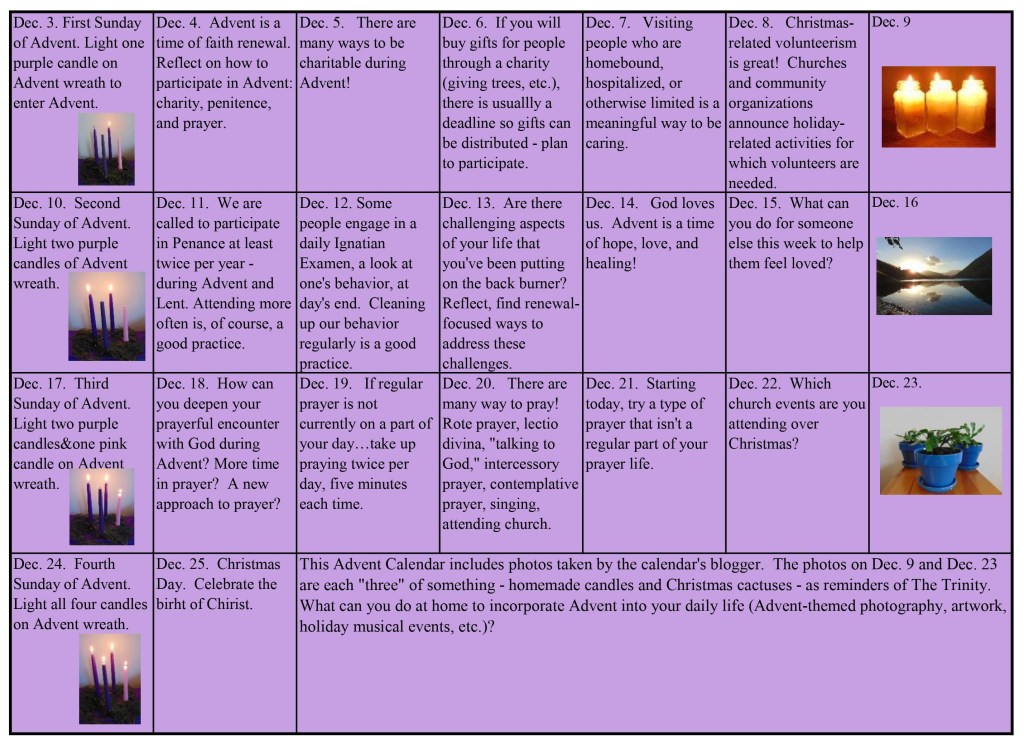
If you would like to connect with Advent at home this year, print out the Advent calendar provided below for daily Advent thoughts, reflections, and tips.

Kim Burkhardt blogs at A Parish Catechist (and is a member of the Association of Catholic Publishers). Blogging is sustainable via blog readership (i.e. readers/subscribers). If you are a new visitor, it would be great to have you subscribe to follow this blog (thank you!). If you know someone who would like this blog, please share it with them and invite them to subscribe (thank you!).

This Sunday: Fourth Sunday of Advent

A home Advent wreath

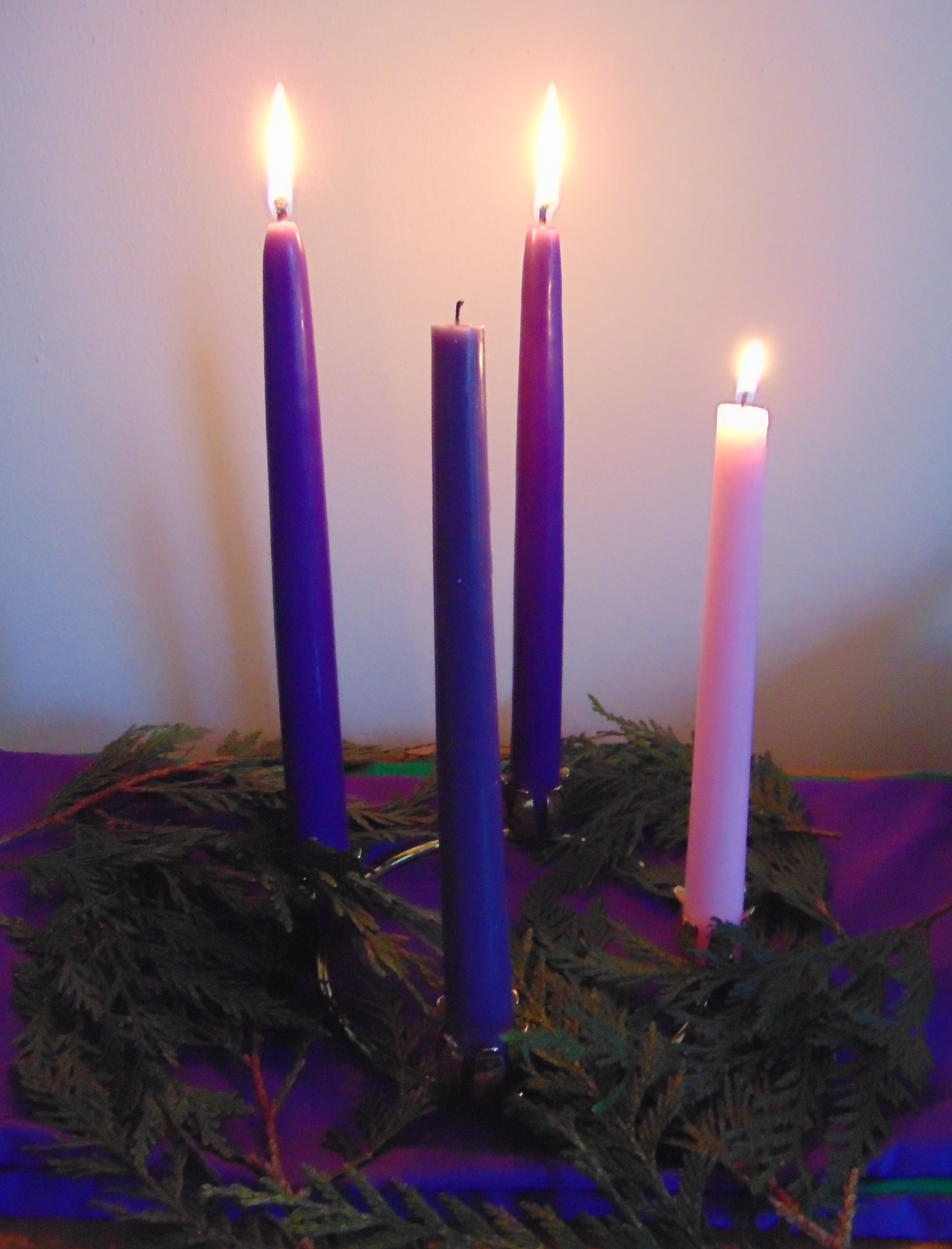
This Sunday – Dec. 24th – is the Fourth Sunday of Advent.  It is also Christmas Eve (and, three days after today, the darkest day in the Northern Hemisphere – a time to bring light into the world).  This Sunday, we light all four candles on our Advent wreaths.

Advent is a time for us to reflect upon, engage in, and renew our faith.

Four topics associated with Advent (i.e., faith-renewing reflections) are hope, peace, joy, and love.  Last week, I reflected broadly on these four topics in a blog post that can be viewed here.  This week, I reflect on these same topics, but in such a way to challenge each of us to personally and meaningfully engage with these topics:

  • Hope: What can you do this week to bring hope into someone’s life?  When I volunteered in the prison system, I co-led a study about people who successfully “left-crime-behind” following incarceration. 100% of the formerly-incarcerated people we interviewed who “left crime behind” after incarceration reported having someone in their life who made a difference in their life, a person who helped them change their lives change for the better (made time for them).  What tangible form of support can you provide for someone you know who is experiencing a challenge in their life?  Spend time with them?  Help them navigate a challenging situation?
  • Peace: What can you do this week to contribute to peace in the world? Contribute $$ to a charity that provides civilian relief in war zones?  Start volunteering at a local charity that serves challenged individuals (like volunteering at a local jail)?  Be the person “who gets off the merry-go-round” in a situation of endless and/or senseless discord (i.e., workplace disagreements, family disputes, etc.) and “take the high road” to support another person in that situation?  As indicated in last week’s post, peace is the result of sacrificial love – Christ’s sacrificial love for us and our sacrificial love for other people.
  • Joy: Be the joy in someone’s life this holiday season.  Drop off a surprise holiday gift, do someone’s task for them at work, bring Christmas cookies to the office, go Christmas caroling……  We can all find something to do to bring some joy into someone’s life!
  • Love:  Who can you bring some “loving care?”  When Jesus was asked which of the commandments is greatest, he said “Love the Lord your God with all your heart, with all your soul, and with all your mind.’ This is the greatest and most important commandment. The second is like it: ‘Love your neighbor as you love yourself.’” (Matthew 22: 34-40).  It’s easy to love the people we like and with whom we enjoy spending time.  It matters just as much that we bring love to the people who might seem harder to love – a relative or friend who is in a time of need (we’re busy!), the irritable relative, the difficult co-worker we’d rather not work with, the homeless person who perennially displays challenging behavior outside the grocery store, the socially-isolated person we know who doesn’t seem to be able to connect with the people around them….  Loving someone involves a time commitment – time well spent!

Kim Burkhardt blogs at A Parish Catechist and The Books of the Ages (and a “Content Creator/Individual” member of the Association of Catholic Publishers). If you are a new visitor, it would be great to have you follow this blog (thank you!). If you know someone who would like this blog post, please share it with them (thank you!). You can also support this blog by clicking here when you are going to shop on Amazon (that lands A Parish Catechist a commission on Amazon sales).


Advent: hope, peace, joy, love

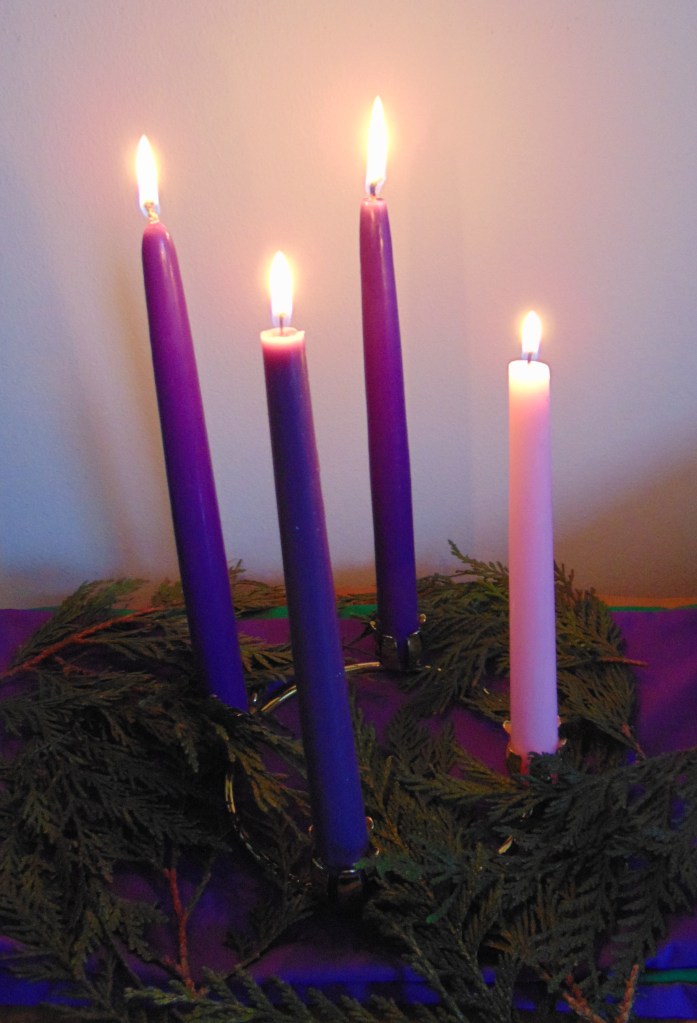
A home Advent wreath This Sunday – Dec. 17th – is the Third Sunday of Advent. This Sunday (and each day this week, if you are doing this at home), we light two purple candles and a pink candle on our Advent wreaths. Advent is a time for us to reflect upon, engage in, and renew our faith. There are four topics associated with Advent (i.e., faith-renewing reflections):
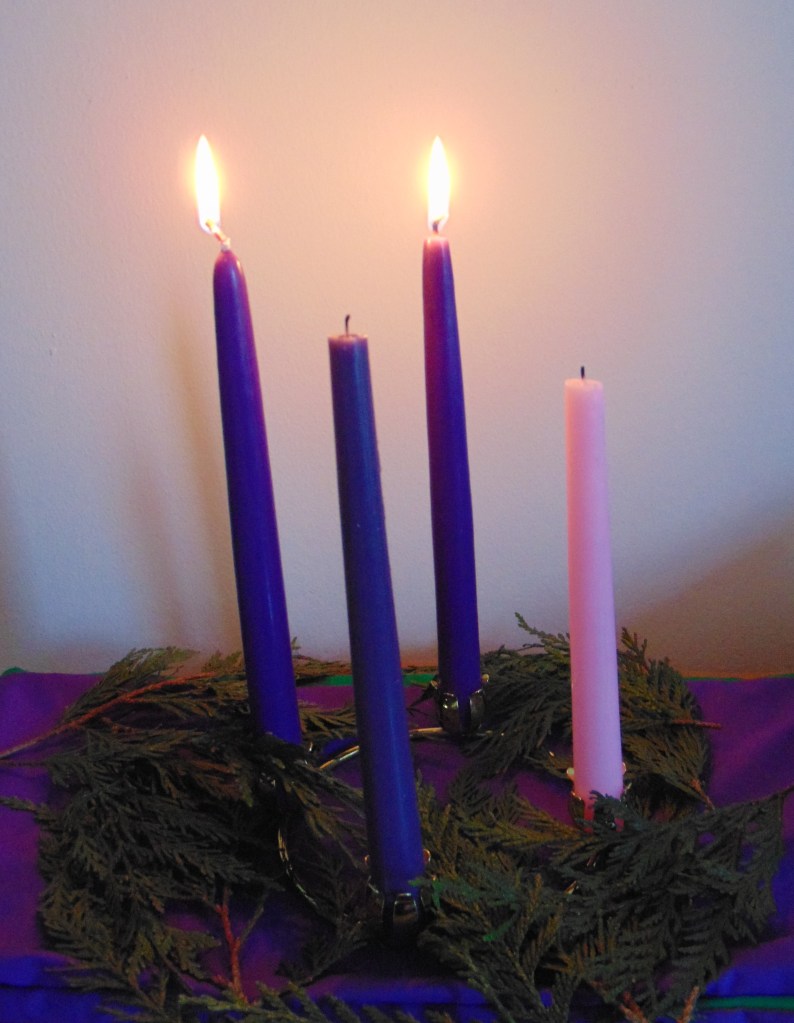
  • Hope: Hope is one of the three theological virtues – hope, faith, and charity – which are viewed by Catholics and Episcopalians as being infused in us by God at baptism (read more about theological and cardinal virtues here).  Read Pope Francis’ suggestions about cultivating hope here.  During Advent, we light candles of hope (light) during a season of darkness (northern hemisphere).
  • Peace: On a personal level, peace is more than “quiet, harmony, internal balance” that can be sought or achieved “for its’ own sake.”  Rather than seeking personal peace as an end in itself, peace is the result of sacrificial love – Christ’s sacrificial love for us and our sacrificial love for other people.  Pope Francis thoughts on this idea can be read about here.  Peace is a consequence of a faith well lived rather than something we can achieve for its’ own sake.
  • Joy: Joy “is the fruit of living all the virtues.”  In addition, joy comes from knowing “the love God has for us” (1 John 4:16) and from being of service to other people.  In short, joy comes from a life well-lived rather than a state of being that we can – or should – cultivate for its’ own sake (living for others helps produce joy rather than the self-focused activity of us seeking joy for our own sake).
  • Love (another of the three theological virtues!):Perfect love casts out fear” (1 John 4:18). In a world where we need more peace, casting away fear – via love – could go a long way toward achieving more peace (many ill human behaviors driven by fear.  Not just societal level wars – how many times have each of us made personal/localized decisions based on fear when we could have made better decisions?).  Love, therefore, is important for us to put into practice and to seek to cultivate in others.  When Jesus was asked by the Pharisees which of the commandments is greatest, he said “Love the Lord your God with all your heart, with all your soul, and with all your mind.’ This is the greatest and most important commandment. The second is like it: ‘Love your neighbor as you love yourself.’ All of Moses’ Teachings and the Prophets depend on these two commandments” (Matthew 22: 34-40).  Do you love the Lord your God with all your heart?  Do the people around you see in your behavior that you love them?  What goal could you set this Advent to be more loving?
Kim Burkhardt blogs at A Parish Catechist and The Books of the Ages (and a “Content Creator/Individual” member of the Association of Catholic Publishers). If you are a new visitor, it would be great to have you follow this blog (thank you!). If you know someone who would like this blog post, please share it with them (thank you!). You can also support this blog by clicking here when you are going to shop on Amazon (that lands A Parish Catechist a commission on Amazon sales).

Second Sunday of Advent….Faith Renewal

A Home Advent Wreath

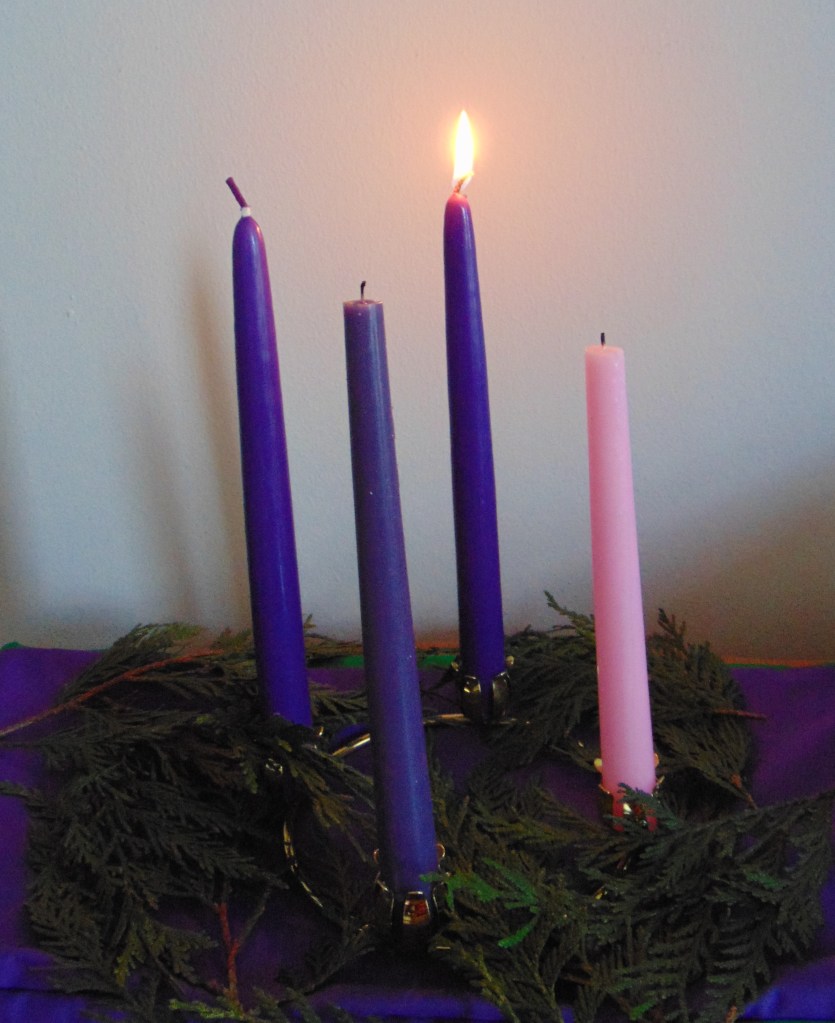
This Sunday – Dec. 10th – is the Second Sunday of Advent. This Sunday (and each day during Advent’s second week), we light two purple candles on our Advent wreaths (we can have an Advent wreath at home by getting one from one’s church, ordering one online, or finding one in local stores).

Participating in major liturgical seasons – Advent and Lent – is a great reminder to renew our faith lives! During Advent:

  • We anticipate the anniversary of Christ’s birth at Christmas (hope)
  • We recognize in the four candles of the Advent wreath the topics of hope, peace, joy, love
  • Reflect on deepening our faith and put this into practice in our lives. The four topics associated with the Advent wreath candles – hope, peace, joy, and love – are great topics to cultivate. We receive these from a relationship with Christ (a relationship cultivated in prayer!); we learn to radiate these to the people we encounter.
  • Engage in penance-charity-prayer
  • Engage more actively (more often, with more reflection) in church services and church activities
  • Consider how to be more caring to the people in our lives

Looking for ways to renew your life of faith? Here are a few tips:

  • Participate in acts of charity, prayer, and penitential reflection of how we can become better people (I’m currently asking God to improve an aspect of my life in which I’m seeing I need to become a better person). In prayer, focus particularly on hope, peace, joy, and love.
  • An printable pdf copy of our Advent calendar – with daily Advent reflections – is still available at A Parish Catechist’s Advent portal.
  • Looking for reading material to help renew your faith this Advent? Check out our list of our favorite faith books on the A Parish Catechist website.

Kim Burkhardt blogs at A Parish Catechist and The Books of the Ages (and a “Content Creator/Individual” member of the Association of Catholic Publishers). If you are a new visitor, it would be great to have you follow this blog (thank you!). If you know someone who would like this blog post, please share it with them (thank you!). You can also support this blog by clicking here when you are going to shop on Amazon (that lands A Parish Catechist a commission on Amazon sales).

Welcome to Advent (with a free calendar!): A time of anticipation

Home Advent Wreath

Welcome to the Christian new year (the new liturgical year starts at the beginning of Advent).

The Christian year has two anticipatory liturgical seasons – Advent anticipates Christmas and Lent anticipates Easter. Advent is the four weeks leading up to the fixed-date day when we celebrate the anniversary of Christ’s birth (December 25). Lent, on the other hand, is the forty-day period leading up to celebrating the anniversary of Christ’s death and resurrection (Easter). Easter, rather than being celebrated on a fixed date, is celebrated on the first Sunday following the first full moon after the Spring equinox (any date from late March to late April).

We don’t know the actual date of Christ’s birthday (Christmas). We’d like to think that Christ is more interested in us recognizing him than being hung up on a specific date. We celebrate his birthday on December 25, the story goes, because there was a time when Christians were looking to convert pagans who already had a winter solstice celebration; adding a Christian celebration at about the same time would “make it comfortable or natural” for said pagans to celebrate a holiday of a new-to-them religion at a time when they were already in a festive period…… As for additional relevant dates on Christian calendar, Christ’s mother is said to have visited a relative – Sarah, who was pregnant with John the Baptist – when Mary was about three months pregnant; we celebrate John the Baptist’s feast day on June 24 (thus, thinking of John as being six months older than Jesus). Likewise, we celebrate the feast day of the Annunciation (the date when the Archangel Gabriel came to Mary with the request that she consent to being the mother of God’s son) on March 25 – nine months before the date we celebrate Christ’s birth.

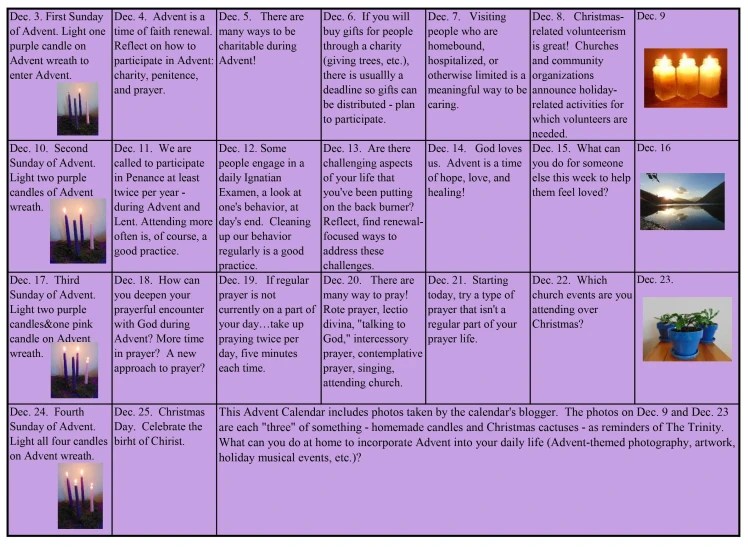
Advent is a time of renewal. We focus on our faith, finding ways to enrich it. We focus on charity (supporting the improved well-being of our neighbors and communities), penance (a reflective recognition of what we’ve done wrong with a view toward being better people), and prayer (an interactive relationship with God). You are invited to engage in these activities this Advent season. To that end, A Parish Catechist is providing this custom Advent calendar (2023). You are invited to print the pdf copy (below) and use it to reflect on ways to engage during this Advent season (see the calendar image below for a visual preview of the pdf calendar). Also, visit A Parish Catechist’s Advent Portal (updates throughout the 2023 Advent Season).

Advent calendar

Welcome to Advent 2023!

Kim Burkhardt blogs at A Parish Catechist and The Books of the Ages. If you are a new visitor, it would be great to have you follow this blog (thank you!). If you know someone who would like this blog post, please share it with them (thank you!). You can also support this blog by clicking here when you are going to shop on Amazon (that lands A Parish Catechist a commission on Amazon sales).

Advent: prepare now – Advent wreath, our Advent portal

A home Advent wreath

The Advent season will soon be here. The First Sunday of Advent is going to be Sunday, December 3rd.

Many churches light an Advent wreath on each Sunday of Advent (one purple candle the first Sunday, two purple candles the second week, two purple candles and the pink candle on the third Sunday, all four candles on the fourth Sunday). It is a popular custom for church attendees to do likewise at home – lighting the corresponding weeks’ candles for a few moments each day, perhaps with prayer and reflection.

Some local churches make home-use Advent wreath kits available to parishioners to take home – round candle holders, four tapered candles of the appropriate colors (three purple candles, one pink candle), and instructions for picking up wreath material and prayer instructions (often, the candle holders can be kept to be used again in future years). Home Advent kits can also be purchased online.

As you start your Black Friday shopping, I encourage you to order a home Advent wreath during your online shopping or pick up a wreath kit from your local church if your church makes home Advent kits available. If you are going to order an Advent kit online, consider ordering one this weekend so that you will receive it in time for Advent. I set up my home Advent wreath today to take the photo shown here.

As I write this blog post, I am preparing a follow-Advent-from-home guide for those of you reading this blog and for visitors to the A Parish Catechist website (if you haven’t visited the website lately, it’s had a visual make-over!). Having an at-home Advent wreath will help you to participate in the Advent-at-home guide that will be posted next weekend (with an email reminder sent to you) at A Parish Catechist’s on the under-development Advent portal.

Participating in major liturgical seasons from home – Advent and Lent – is a great way to bring Church seasons into our daily lives. I hope you’ll join us, starting next weekend, in engaging in Advent at home!

A home Advent wreath

Kim Burkhardt blogs at A Parish Catechist and The Books of the Ages (and a “Content Creator/Individual” member of the Association of Catholic Publishers). If you are a new visitor, it would be great to have you follow this blog (thank you!). If you know someone who would like this blog post, please share it with them (thank you!).

Welcome to Advent (with a free calendar!): A time of anticipation

Home Advent Wreath

Welcome to Advent 2023!

Welcome to the Christian new year (the new liturgical year starts at the beginning of Advent).

The Christian year has two anticipatory liturgical seasons – Advent anticipates Christmas and Lent anticipates Easter. Advent is the four weeks leading up to the fixed-date day when we celebrate the anniversary of Christ’s birth (December 25). Lent, on the other hand, is the forty-day period leading up to celebrating the anniversary of Christ’s death and resurrection (Easter). Easter, rather than being celebrated on a fixed date, is celebrated on the first Sunday following the first full moon after the Spring equinox (any date from late March to late April).

We don’t know the actual date of Christ’s birthday (Christmas). We’d like to think that Christ is more interested in us recognizing him than being hung up on a specific date. We celebrate his birthday on December 25, the story goes, because there was a time when Christians were looking to convert pagans who already had a winter solstice celebration; adding a Christian celebration at about the same time would “make it comfortable or natural” for said pagans to celebrate a holiday of a new-to-them religion at a time when they were already in a festive period…… As for additional relevant dates on Christian calendar, Christ’s mother is said to have visited a relative – Sarah, who was pregnant with John the Baptist – when Mary was about three months pregnant; we celebrate John the Baptist’s feast day on June 24 (thus, thinking of John as being six months older than Jesus). Likewise, we celebrate the feast day of the Annunciation (the date when the Archangel Gabriel came to Mary with the request that she consent to being the mother of God’s son) on March 25 – nine months before the date we celebrate Christ’s birth.

Advent is a time of renewal. We focus on our faith, finding ways to enrich it. We focus on charity (supporting the improved well-being of our neighbors and communities), penance (a reflective recognition of what we’ve done wrong with a view toward being better people), and prayer (an interactive relationship with God). You are invited to engage in these activities this Advent season. To that end, A Parish Catechist is providing this custom Advent calendar (2023). You are invited to print the pdf copy (below) and use it to reflect on ways to engage during this Advent season (see the calendar image below for a visual preview of the pdf calendar).

Also, visit A Parish Catechist’s Advent Portal (updates throughout the 2023 Advent Season).

Advent calendar

Advent calendar with suggestions

Welcome to Advent 2023!

Kim Burkhardt blogs at A Parish Catechist and The Books of the Ages. If you are a new visitor, it would be great to have you follow this blog (thank you!). If you know someone who would like this blog post, please share it with them (thank you!). You can also support this blog by clicking here when you are going to shop on Amazon (that lands A Parish Catechist a commission on Amazon sales).