Coming soon: a new church year. New step in one’s faith?

visual display of liturgical seasons

Just as the earth has annual weather seasons, schools have academic years, some organizations have fiscal years, and we individuals have seasons in our lives, the church has a liturgical year – with established seasons.

The church year begins at the beginning of Advent – four weeks before Christmas. The six seasons in the liturgical calendar (each having a corresponding liturgical color) are:

  • Advent (purple, with one week of pink)
  • Christmas (white)
  • Lent (again, purple)
  • Triduum (red)
  • Easter (white)
  • Ordinary Time (green)

The church year lays out a calendrical way to walk through important faith themes.

As we approach a new liturgical year – beginning with Advent – on December 1, how is this important for us as individuals? In watching the Church seasons, we learn about religious themes that have been woven together over Christianity’s history. We collectively travel through faith seasons together. On a personal level, Church seasons and religious holidays provide opportunities for us to journey deeper into our faith experience. When we truly engage in the processes provided in the Church’s liturgical calendar, what I have heard called “the genius of Christianity’s processes” brings us into a deeper relationship with God. Our own inner workings are stirred in such a way that our spirituality broadens, deepens, and matures.

As we enter a new Church year on this upcoming First Sunday of Advent, what aspects of faith can you reflect upon this Advent season? Learning more about Church liturgy? Re-committing to a regular prayer life? Surrendering some aspect of your life to being changed – and improved upon – by God? Being kinder to and of more active service to the people around you?

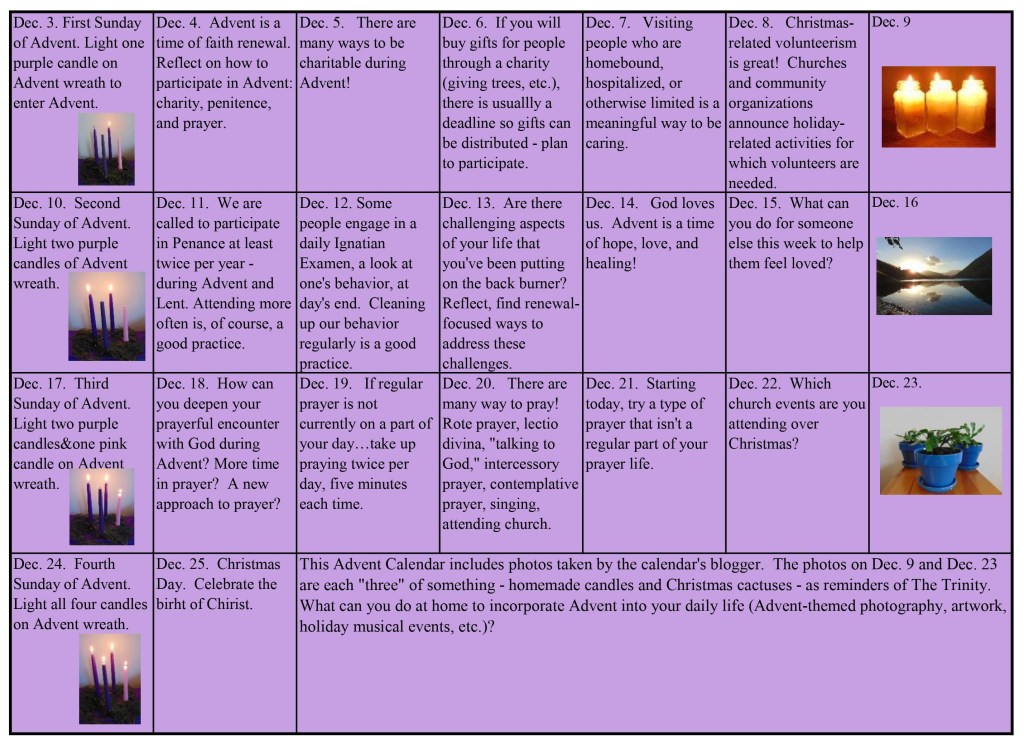
If you would like to connect with Advent at home this year, print out the Advent calendar provided below for daily Advent thoughts, reflections, and tips.

Kim Burkhardt blogs at A Parish Catechist (and is a member of the Association of Catholic Publishers). Blogging is sustainable via blog readership (i.e. readers/subscribers). If you are a new visitor, it would be great to have you subscribe to follow this blog (thank you!). If you know someone who would like this blog, please share it with them and invite them to subscribe (thank you!).
Welcome to Advent (with a free calendar!): A time of anticipation

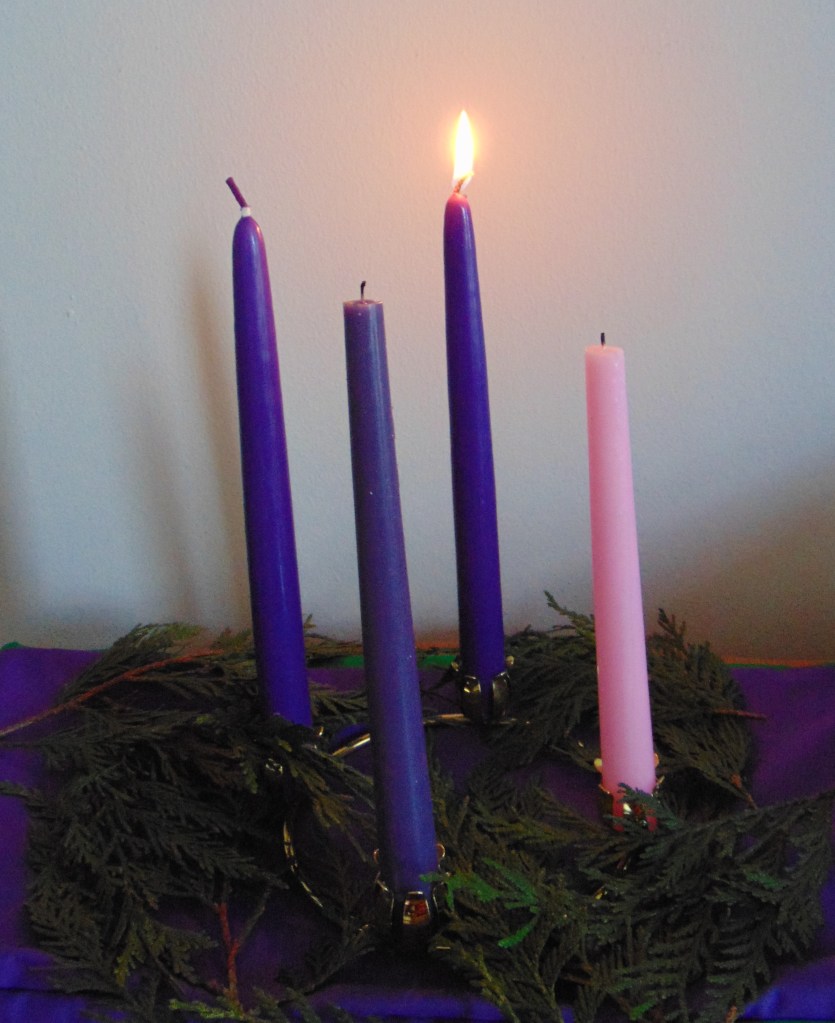
Home Advent Wreath

Welcome to the Christian new year (the new liturgical year starts at the beginning of Advent).

The Christian year has two anticipatory liturgical seasons – Advent anticipates Christmas and Lent anticipates Easter. Advent is the four weeks leading up to the fixed-date day when we celebrate the anniversary of Christ’s birth (December 25). Lent, on the other hand, is the forty-day period leading up to celebrating the anniversary of Christ’s death and resurrection (Easter). Easter, rather than being celebrated on a fixed date, is celebrated on the first Sunday following the first full moon after the Spring equinox (any date from late March to late April).

We don’t know the actual date of Christ’s birthday (Christmas). We’d like to think that Christ is more interested in us recognizing him than being hung up on a specific date. We celebrate his birthday on December 25, the story goes, because there was a time when Christians were looking to convert pagans who already had a winter solstice celebration; adding a Christian celebration at about the same time would “make it comfortable or natural” for said pagans to celebrate a holiday of a new-to-them religion at a time when they were already in a festive period…… As for additional relevant dates on Christian calendar, Christ’s mother is said to have visited a relative – Sarah, who was pregnant with John the Baptist – when Mary was about three months pregnant; we celebrate John the Baptist’s feast day on June 24 (thus, thinking of John as being six months older than Jesus). Likewise, we celebrate the feast day of the Annunciation (the date when the Archangel Gabriel came to Mary with the request that she consent to being the mother of God’s son) on March 25 – nine months before the date we celebrate Christ’s birth.

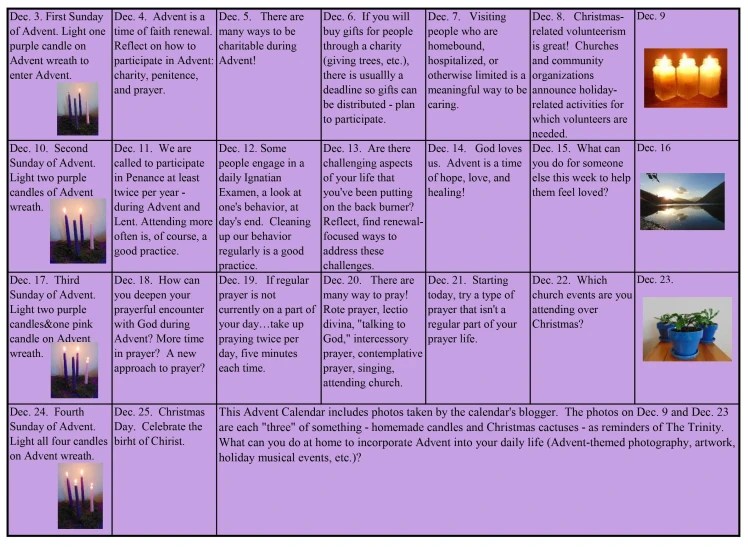
Advent is a time of renewal. We focus on our faith, finding ways to enrich it. We focus on charity (supporting the improved well-being of our neighbors and communities), penance (a reflective recognition of what we’ve done wrong with a view toward being better people), and prayer (an interactive relationship with God). You are invited to engage in these activities this Advent season. To that end, A Parish Catechist is providing this custom Advent calendar (2023). You are invited to print the pdf copy (below) and use it to reflect on ways to engage during this Advent season (see the calendar image below for a visual preview of the pdf calendar). Also, visit A Parish Catechist’s Advent Portal (updates throughout the 2023 Advent Season).

Advent calendar

Welcome to Advent 2023!

Kim Burkhardt blogs at A Parish Catechist and The Books of the Ages. If you are a new visitor, it would be great to have you follow this blog (thank you!). If you know someone who would like this blog post, please share it with them (thank you!). You can also support this blog by clicking here when you are going to shop on Amazon (that lands A Parish Catechist a commission on Amazon sales).

Welcome to Advent (with a free calendar!): A time of anticipation

Home Advent Wreath

Welcome to Advent 2023!

Welcome to the Christian new year (the new liturgical year starts at the beginning of Advent).

The Christian year has two anticipatory liturgical seasons – Advent anticipates Christmas and Lent anticipates Easter. Advent is the four weeks leading up to the fixed-date day when we celebrate the anniversary of Christ’s birth (December 25). Lent, on the other hand, is the forty-day period leading up to celebrating the anniversary of Christ’s death and resurrection (Easter). Easter, rather than being celebrated on a fixed date, is celebrated on the first Sunday following the first full moon after the Spring equinox (any date from late March to late April).

We don’t know the actual date of Christ’s birthday (Christmas). We’d like to think that Christ is more interested in us recognizing him than being hung up on a specific date. We celebrate his birthday on December 25, the story goes, because there was a time when Christians were looking to convert pagans who already had a winter solstice celebration; adding a Christian celebration at about the same time would “make it comfortable or natural” for said pagans to celebrate a holiday of a new-to-them religion at a time when they were already in a festive period…… As for additional relevant dates on Christian calendar, Christ’s mother is said to have visited a relative – Sarah, who was pregnant with John the Baptist – when Mary was about three months pregnant; we celebrate John the Baptist’s feast day on June 24 (thus, thinking of John as being six months older than Jesus). Likewise, we celebrate the feast day of the Annunciation (the date when the Archangel Gabriel came to Mary with the request that she consent to being the mother of God’s son) on March 25 – nine months before the date we celebrate Christ’s birth.

Advent is a time of renewal. We focus on our faith, finding ways to enrich it. We focus on charity (supporting the improved well-being of our neighbors and communities), penance (a reflective recognition of what we’ve done wrong with a view toward being better people), and prayer (an interactive relationship with God). You are invited to engage in these activities this Advent season. To that end, A Parish Catechist is providing this custom Advent calendar (2023). You are invited to print the pdf copy (below) and use it to reflect on ways to engage during this Advent season (see the calendar image below for a visual preview of the pdf calendar).

Also, visit A Parish Catechist’s Advent Portal (updates throughout the 2023 Advent Season).

Advent calendar

Advent calendar with suggestions

Welcome to Advent 2023!

Kim Burkhardt blogs at A Parish Catechist and The Books of the Ages. If you are a new visitor, it would be great to have you follow this blog (thank you!). If you know someone who would like this blog post, please share it with them (thank you!). You can also support this blog by clicking here when you are going to shop on Amazon (that lands A Parish Catechist a commission on Amazon sales).