Book Review: J.R.R. Tolkien’s Sanctifying Myth (Birzer)
Book cover: Tolkien's Sanctifying Myth
Book cover for book about Tolkien

This book – J.R.R. Tolkien’s Sanctifying Myth, Understanding Middle Earth by Bradley J. Birzer – is a book I’ve been wishing existed ever since I read The Fellowship: The Literary Lives of the Inklings: J.R.R. Tolkien, C.S. Lewis, Owen Barfield, Charles Williams (that book is also a good read).

When I read The Fellowship: The Literary Lives of the Inklings, I enjoyed getting more acquainted with the literary aspects of Tolkien, Lewis, and the people around them. Yet, as I also found myself deeply curious about the religious relationship – and what I was sure must have included strains – between a British (South African!) Catholic and an Ulster Protestant (that aspect wasn’t delved into particularly in The Fellowship: The Literary lives..).

Birzer’s book Sanctifying Myth takes a sociological look into Tolkien and mythology. Tolkien, for example, considers myth to by sociologically necessary for humanity and to be every bit as tangible as scientific learning. This book also provides a deep dive into the religious relationship and tensions between Tolkien and Lewis. For example, Tolkien considered his Hobbit books to be more Christian in nature than C.S. Lewis’ The Screwtape Letters! There are also other curious tidbits in this book. For example, when Tolkien’s son Christopher enlisted in WWII, an RAF form asked Christopher Tolkien to list his father’s occupation; he listed his father’s occupation as “wizard.”

Most evenings, I read a book for a few minutes before going to sleep. At present, I am reading Sanctifying Myth before going to sleep. However, I am finding that I need to read this book earlier in the day; there’s enough stimulation and tension in the book to keep a person awake…..

I will be reading more books by author Bradley J. Birzer.

Kim Burkhardt blogs at A Parish Catechist (and is a member of the Association of Catholic Publishers). Blogging is sustainable via blog readership (i.e. readers/subscribers). If you are a new visitor, it would be great to have you subscribe to follow this blog (thank you!). If you know someone who would like this blog, please share it with them and invite them to subscribe (thank you!).

Book Review: Be healed (Bob Schuchts)

I was given a copy of this book: Be healed – A guide to encountering the powerful love of Jesus in your life (author: Bob Schuchts).

Because the book came to me with a recommendation from someone I respect, I started reading it with positive anticipation. I then got a few pages into the book and wondered, “Is this book along the lines of the old revival meetings in big tents? Can I get through this book?” I set it aside while I read another book.

When I came back to the book, I found that yes – this book resonates, meaninfully. The thrust of this book is such:

  • God loves us and wants us to be healthy and whole.
  • Healing in our lives happens when we allow God to love us. This requires a relationship in which we allow God into our lives.

A book worth reading!

Kim Burkhardt blogs at A Parish Catechist (and a member of the Association of Catholic Publishers). Blogging is sustainable via blog readership (i.e. readers/subscribers). If you are a new visitor, it would be great to have you subscribe to follow this blog (thank you!). If you know someone who would like this blog, please share it with them and invite them to subscribe (thank you!).
Book Review: Gerald May’s The Dark Night of the Soul

Gerald May's book: The Dark Night of the Soul

Teresa of Avila and her protege John of the Cross – two 16th-century Spaniards – are my favorite mystics and two of my favorite faith writers. When I began reading their books in 2017 or 2018, they articulated my own (more modest!) experience with contemplative prayer.

Since then, I have tried to explain to people that John of the Cross’s book Dark Night of the Soul is not about tribulations or depression. It’s not.

More recently, I came upon Gerald May’s book of the same title. Gerald May is a physician, psychiatrist, and writer of faith books). Gerald May, in his book, accessibly explains John of the Cross’s ideas in today’s language. I am grateful that he makes John of the Cross’s ideas more understandable to people than I have been able to present.

Treading into the Spiritual Depths: The (not depressing!) Dark Night of the Soul

In his book Dark Night of the Soul, John of the Cross writes about how the sometimes unviewable-to-us aspects of our inner faith journey are part of where God works within us to transform us (rather than this title being about a depressive view on things!). Attentiveness to our inner journey can allow us some small glimpse of when this (at least somewhat) unviewable aspect of our spiritual growth is being wrought within us – particularly if we have an active relationship with God in prayer.

Gerald May’s book of the same title speaks to this idea about “The Dark Night of the Soul”: “May emphasizes that the dark night is not necessarily a time of suffering and near despair, but a time of deep transition, a search for new orientation when things are clouded and full of mystery. The dark gives depth, dimension and fullness to the spiritual life.”

While John of the Cross’s book Dark Night of the Soul is not about suffering, modern day writer Gerald May does touch on the fact of suffering from a useful perspective on page nine of his book Dark Night of the Soul . His is a perspective that occurred to me in some fashion several years ago: “….suffering does not result from some divine purgation….Instead, suffering arises from the simple circumstances of life itself.”

Teresa of Avila and John of the Cross’s books are very worth reading. Gerald May’s book is also worth reading.

Kim Burkhardt blogs at A Parish Catechist and The Books of the Ages (and a member of the Association of Catholic Publishers). If you are a new visitor, it would be great to have you follow this blog (thank you!). If you know someone who would like this blog, please share it with them (thank you!). You can also support this blog by clicking here when you are going to shop on Amazon (that lands A Parish Catechist a commission on Amazon sales).

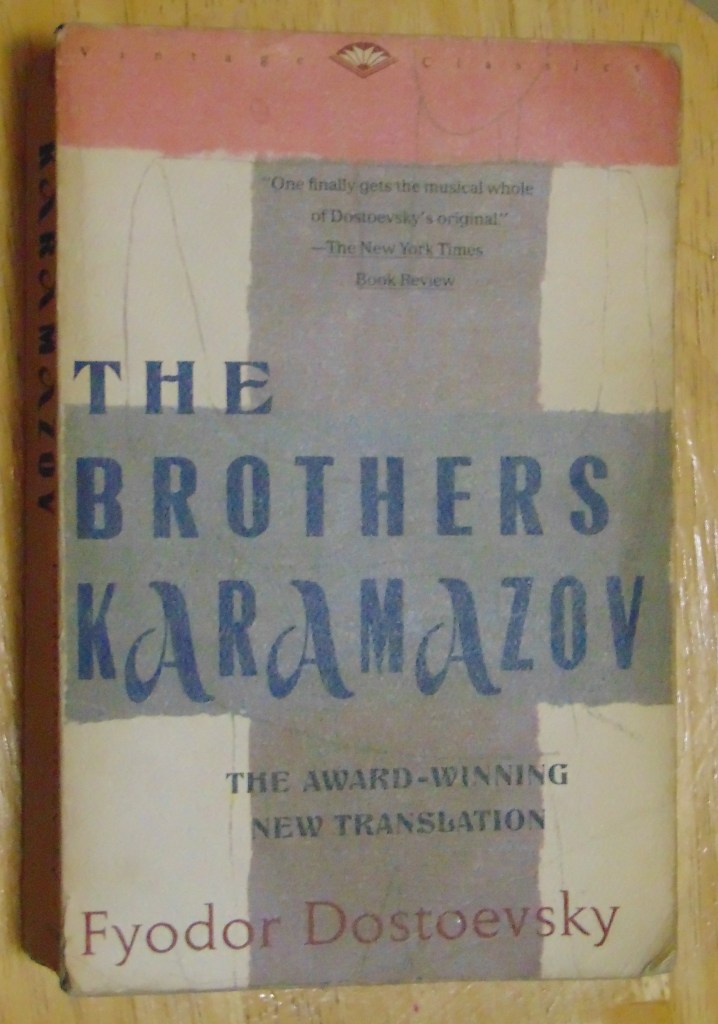
Faith Reading challenge: The Brothers Karamazov

The Brothers Karamazov

I took a literature class in college in which we read Dostoevsky’s The Brothers Karamazov.

I attended a state university and we read The Brothers Karamazov as secular literature. While we read the book as secular literature, I do remember our instructor posing a question about a particular point for one of the books’ characters. I found myself responding as seeing the character as analagous to a friend of mine who was serving as a spiritual guide for me at the time. My instructor and classmates found this odd and laughed as such. It was an awkward moment.

Since then, I have periodically heard reference to “The Brothers K” as being a book – in part – about faith. Goodreads (an online book portal) says of the book, “Through the gripping events of their story, Dostoevsky portrays the whole of Russian life, is social and spiritual striving, in what was both the golden age and a tragic turning point in Russian culture.”

Because I have repeatedly heard of the book as having spirituality dimensions, I am planning to read “The Brothers K” again, after I finish reading another book (a long book that I’m reading rather slowly). This time, I will read “The Brothers K” through the lens of spirituality. I invite each of you to join me in reading the book to consider its’ faith dimensions; we can then discuss the faith ideas in book.

Put May 1 on your calendar as the date to start reading The Brothers Karamazov through the lens of faith. I will post dates to begin discussing the book.

Kim Burkhardt blogs at A Parish Catechist and The Books of the Ages (and a member of the Association of Catholic Publishers). If you are a new visitor, it would be great to have you follow this blog (thank you!). If you know someone who would like this blog, please share it with them (thank you!). You can also support this blog by clicking here when you are going to shop on Amazon (that lands A Parish Catechist a commission on Amazon sales).