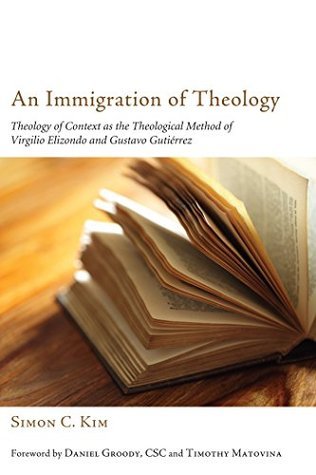
Book Review: An Immigration of Theology

Book Cover: An Immigration of Theology
Book: An Immigration of Theology

I recently came upon An Immigration of Theology by Fr. Simon Kim and am intrigued with what the author has done with this book.

Goodreads summarizes this book, in part, with the following: “The theological reflections of Virgilio Elizondo and Gustavo Gutiérrez are examples of the ecclesial fruitfulness of the second half of the twentieth century. Following the directives of Pope John XXIII and the Second Vatican Council, [they] present the Gospel message in relevant terms to their own people…. Inspired by this moment in Church history, while at the same time recognizing the plight of their people….. [they] discovered a new way of doing theology by asking a specific set of questions based on their local context. By investigating where God is present in [their local context], both theologians have uncovered a hermeneutical lens in rereading Scripture and deepening our understanding of ecclesial tradition…. a theological method that takes seriously the contextual circumstances of their locale. By utilizing the common loci theologici of Scripture and tradition in conjunction with context and their own experience, [they] illustrate…. how every group must embrace their own unique theological reflection.”

I find this interesting – there seems to be the option in this book of stating that we must make theological concepts relevant to our own circumstances while also stating that theological principles are universal. What I am hoping to read in this book – now that I have it sitting on my coffee table – is that theological principles are universal in principle and also local in adaptation.

Kim Burkhardt blogs about faith at The Hermitage Within. Thank you for reading this faith blog and for sharing it with your friends. While you are here, please feel welcome to provide support to sustain this blog ($$).
Easter: Resurrection, surrender, transformation

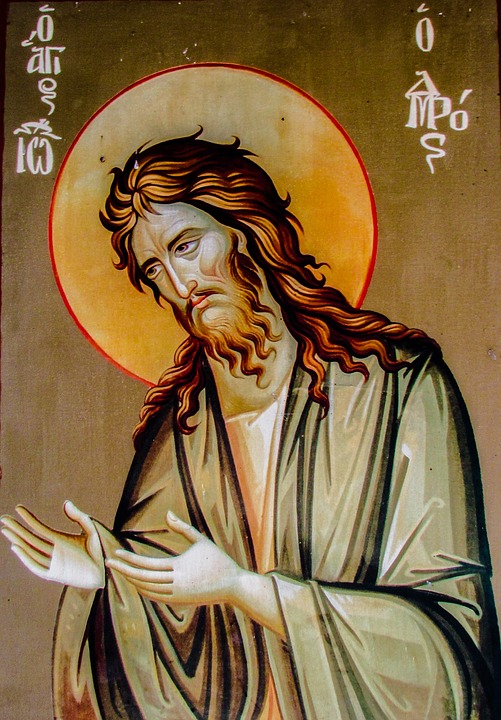
John the Baptist

Easter: Christ has risen!

In Christ’s resurrection, we are offered transformation. 

We – in and of ourselves – cannot transform ourselves into the fullness of who we are meant to be.

….This is the fourth Lenten season in a row when I have experienced medical challenges – surgeries, etc.   This year, I broke my left foot on March 19th.  

After March 19, I continued falling (mishaps with crutches, etc.).   In addition to a broken left foot, I subsequently sprained my right foot.  Ended up with medical boots on both feet.   Then….On the morning of April 6, I fell again (two boots makes navigation difficult).    I sent an email to a couple people about this, ending the email with “Anger doesn’t begin to describe…..”   One person replied with insightful observations about surrender.

It’s true.  I know it’s true – I reach such a point of surrender-to-God in 2016 with a subsequent transformation in 2016 (that surrender involved a homily at an Irish mass and a broken ankle!).

For Christ to truly transform us, we have to surrender ourselves and our greatest difficulties to God.

Surrendering doesn’t just mean some limited-scope prayer to God and “hoping” that something positive will happen.   It doesn’t mean we hang onto some aspect of what we supposedly surrender – as if what we surrender still somehow belongs to us.   No.   True surrender means that we no longer have possession (ownership) or control.

True surrender comes when we surrender our hardest challenges.  The challenges we don’t tell people about.  Challenges that we somehow feel tied to…..  Challenges that are eating away at our very being.

When we truly surrender these aspects of our lives to God and allow God to do whatever God wants to do (WE DON’T KNOW WHAT GOD’S GOING TO DO!), true and life-giving transformation of our very selves happens in and through God.  Galatians 2:20:  “I have been crucified with Christ; and it is no longer I who live, but Christ who lives in me. And the life I now live in the flesh I live by faith in the Son of God, who loved me and gave Himself for me.”

It’s Easter, Christ has risen!   A great time to surrender to experience transformation offered by the Risen Christ.

Kim Burkhardt blogs at A Parish Catechist (and is a member of the Association of Catholic Publishers). Blogging is sustainable via blog readership (i.e. readers/subscribers). If you are a new visitor, it would be great to have you subscribe to follow this blog (thank you!). If you know someone who would like this blog, please share it with them and invite them to subscribe (thank you!).

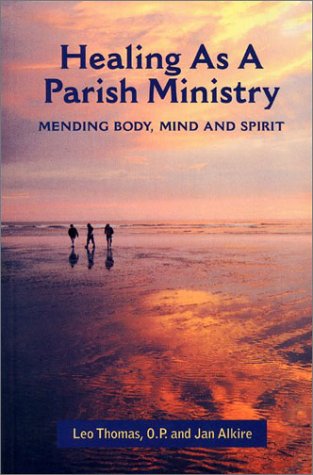
Book Review: Healing as a Parish Ministry

I was happy to stumble upon this book in a Little Free Library and to then discover that this practical and helpful book was locally written (i.e., Seattle, Washington).

The summary of this book on Goodreads states: “Jesus’ mandate to heal the sick is beginning to enter into faith communities today. In this sound and practical book, Father Leo Thomas and Jan Alkire show how this vital ministry is rooted in Christian scriptural and sacramental tradition. Pastors and lay leaders will benefit from the authors’ faith-filled, balanced wisdom. ‘Healing as a Parish Ministry’ will help all who read it become more effective channels of Christ’s healing to those who are hurting.”

Jesus healed the sick during his time on earth. Jesus instructed his disciples to heal the sick. Pope Francis talks today about the church being a “field hospital.” In a workshop I’m taking through Franciscan University’s Catechetical Institute, the instructor talks about church-goers sometimes preferring to go to their pastor/church for help before going to mental health providers. The message is communicated in many ways that church is meant to be a place where people can come for healing and direction. This book – Healing as a Parish Ministry – provides practical, front-line instruction to parishes – local churches – on how to provide healing ministries at one’s church.

In their book Healing as a Parish Ministry:

  • Leo Thomas and Jan Alkire write about faith healing does not mean curing natural consequences of what happens in life; rather, that faith healing is often about bringing us into the fullness of who God wants us to be – a very healing experience!
  • Thomas and Alkire write about how to set up a parish healing ministry – and why it is important.
  • The authors provide useful resources on how to connect meaningfully and usefully with parishioners who are in a time of need. Of equal importance, they also provide practical tips on what NOT to do so as to avoid alienating parishioners or causing ill will.

I read this book as a person who has found healing in church and who wants healing to be something that happens for many people in church. In my case, I returned to church – after a time away – with a painful neuropathic medical condition. That condition includes a hyper-stimulated sympathetic nervous system and associated physical pain. After returning to church, I found that contemplative prayer (and yoga, in my case) slowly calmed my over-stimulated nervous system – resulting in a reduction in physical pain. When I later came upon this book, I found that the book speaks to the type of healing I’ve experienced – I see the book having practical and real – real-world – insights and application.

This book is a great resource! I recommend this book to anyone who wants churches to be a place of healing.

Kim Burkhardt blogs at A Parish Catechist and The Books of the Ages (and a “Content Creator/Individual” member of the Association of Catholic Publishers). If you are a new visitor, it would be great to have you follow this blog (thank you!). If you know someone who would like this blog post, please share it with them (thank you!).