Book Review: Ars Celebrandi

Book
Ars Celebrandi: Celebrating and Concelebrating Mass

This book, written for priests to inspire artful presiding at mass, brings to life the nuts and bolts of how the Catholic mass brings liturgy – the work of the people – is celebrated. For the non-ordained among us, Ars Celebrandi: Celebrating and Concelebrating Mass provides insight into how the liturgy is designed to invigorate the faith of the faithful.

In practical terms, this book picks up where the General Instruction of the Roman Missal (the “GIRM”) ends….. The GIRM is the instruction manual of “how to do a Catholic mass,” whereas Ars Celebrandi gets into the art of how to preside.

Two examples of this book’s insights come from the foreward of Ars Celebrandi (written by Bishop Mark Seitz):

“The liturgy is the action of the entire people of God who are being more perfectly formed into the Body of Christ.  The Second Vatican Council’s seminal teaching that the people of God are called to full, conscious, and active participation is based upon this fundamental recognition.”

“The liturgy, as we know,  is a language and a certain style of communication that comes down to us from the ages but is also constantly adapting under the guidance of the Spirit in every age.  It a language of signs and symbols that are read universally by people in the church.  To be sure, there are regional and cultural aspects that are rightly represented as local communities worship, but these are secondary to the expressions that unite us across times and places.”

Then, we lay readers learn in this book about the complexity of presiding at church services. For example:

“[Presiding at a liturgy] involve a marriage of books and ministers. The liturgical norms [i.e., what is suppose to be done] encounter a real-time relationship with the individual persons ordained to carry them out….The relationship presumes that priests know the liturgical norms. However, the rules are complex. The books detailing them are many. Some laws keep changing….Furthermore, not every aspect of liturgy is prescribed. When presiding, a typical priest is suppose to do certain things, is free to do certain other things, and takes freedom to do even more….” [Subsequent paragraphs delve into specific examples of these “certain things” and “certain other things.}

Reading this book is of interest for we lay people in that we become more observant of the nuts and bolts of what happens at church. A book worth reading.

Kim Burkhardt blogs at A Parish Catechist. If you are a new visitor, it would be great to have you subscribe to follow this blog (it’s free – thank you!). If you know someone who would like this blog, please share it with them and invite them to subscribe (thank you!).

What Christians Believe

A woman I know started telling her co-workers that she attends church. She hadn’t told her co-workers about this in the two years she’d been working at her job. Her co-workers were surprised that a surprisingly normal and intelligent person such as her attends church. “So,” her co-workers would ask her, “Are you one of those Christians who believes that the Earth is only 3,000 – 6,000 years old?” and other such questions. “No,” she would reply, “Of course not.” She would point out in these conversations that The Big Bang Theory was formulated by a Catholic priest…..

So, what DO Christians believe? While some aspects of this question varies from one denomination to another, Christian leadership did come together in the year 325 in Nicea (a then-Greek city in what is now Iznek, Turkey) to specify precisely what Christian do believe. (I learned recently that ruins of some of the local Nicean architecture that existed at the time of the council in 325 still exists – I’d love to visit and see the remains of the architecture).

Christianity grew out of a historically oral tradition and Jesus’s followers thought in the decades following his death and resurrection that he was going to return in their lifetimes; thus, no one started writing what is now The New Testament for several decades. While it would be tempting to think now – 2,000 years later – that Christian belief in its’ current state has been statically known and accepted since the time Christ was alive, there was a lack of established Orthodoxy in the early days of Christianity. Thus, the need in the year 325 to communicate clearly what the Christian Church believes.

Join A Parish Catechist on Saturday, January 4th (8:00 am Pacific) or January 7th (7:00 pm Pacific) for a Zoom educational session about the specifics of “What Christians Believe” via the Nicene Creed. Sign up (register) here: https://www.signupgenius.com/go/10C084CA4A629A3F4C43-54130811-faith#/

Event flyer

Kim Burkhardt blogs at A Parish Catechist (and is a member of the Association of Catholic Publishers). Blogging is sustainable via blog readership (i.e. readers/subscribers). If you are a new visitor, it would be great to have you subscribe to follow this blog (thank you!). If you know someone who would like this blog, please share it with them and invite them to subscribe (thank you!).
Book Review: Dictionary of Early Christian Beliefs

Dictionary: Early Christian Beliefs

There was a time when I would have read this reference book from cover to cover (I am among the readers who believe that when I read a book, I should read the entire book…..).

This is a useful, scholarly book to have on one’s bookshelf as a reference to inform one’s study of any number of topics. I am reading some of it now and plan to refer to it on occasion as the reference book it is intended to be.

Christianity is 2,000 years old. In 2024, the majority of us – with the possible exception of those Biblical scholars who specialize in Early Christian Literature – are not going to be familiar with the ins and outs of the topics discussed in the early church. Nor are most of us current on the etymology of what every word meant 2,000 years ago (“dictionary definitions” of words and the cultural context of vocabulary changes over time…).

“Sure,” some will say, “We know what early Christians were talking about. They were talking about Jesus, the resurrection, the gospels, and how to be Christian.” Yes, that’s true. But how exactly did those conversations unfold in Palestine, Greece, Turkey, etc. in, say, the year 75, 125, or 300 AD?

The gospels weren’t written down until several decades after Christ’s death. Jesus said during his lifetime that he would return during “this generation;” thus, it initially seemed unnecessary to Jesus’ contemporaries to write down his life and teachings for future generations…. Eventually, it started to become clear that he wasn’t coming back imminently, so his narrative began to be written for posterity. It then took time for the early church to decide which gospels – from among the gospels that were written down – are canonical (accepted as church doctrine). It wasn’t immediately clear to the early church that “the Bible” was going to include (and only include) Matthew, Mark, Luke, and John.

Likewise, it took time for the early church to develop and “come together” on any number of topics that we recognize today as “Christianity.”

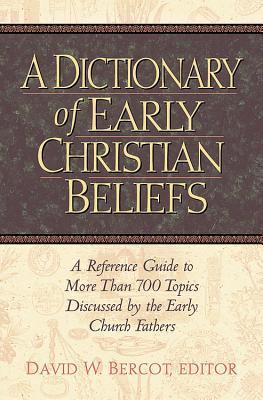
So, precisely which “Christian topics” were under discussion in the early days of Christianity? This book – A Dictionary of Early Christian Beliefs – provides useful insights in to this question. Having this reference on one’s bookshelf can inform our understanding in any number of settings – when studying Sunday’s readings at church, when we want to learn more about a specific aspect of Christianity, when studying church history, etc.

A sampling of several topical entries in this 704-page resource include:

  • Christ, Divinity (how the early church came to understand this one topic gets 25 pages!)
  • Descent into Hades
  • Gifts of the spirit
  • “Keys of the Kingdom”
  • Patriarchs
  • Paul, apostle
  • Prayer
  • Rapture
  • Schism
  • At the end of the book, there are “Quotable quotes from the Early Christians.”

I appreciate having this book on my bookshelf.

Kim Burkhardt blogs at A Parish Catechist and The Books of the Ages (and a member of the Association of Catholic Publishers). If you are a new visitor, it would be great to have you follow this blog (thank you!). If you know someone who would like this blog, please share it with them (thank you!). You can also support this blog by clicking here when you are going to shop on Amazon (that lands A Parish Catechist a commission on Amazon sales).

Legos, faith….Didn’t anticipate this outcome

A recent trip down memory lane led me to wanting a Lego set (my maternal grandmother had Legos for us to play with when we were children…..). So, it seems that I’ve joined the Legos craze. I wasn’t going to be satisfied with just any of the latest “Legos sets.” I drove across town this morning in search of a Legos store where one can find “anything Legos.” I ended up combing through several bins and tables of individual Legos pieces in search of the pieces and colors I wanted. After a time, I realized “perhaps I’ve been here awhile?” I checked the time, I’d been combing through bins for two hours in search of the individual types of Legos pieces I was there to find. A bit manic, perhaps! Perhaps the store clerk was a bit amused (I was the only customer in the store for most of that two hours, so my active hunting through piles of Legos was readily observable). The money I paid for my carefully-selected bag of Legos was perhaps justified simply by the enjoyment of two hours searching intently through piles of Legos!

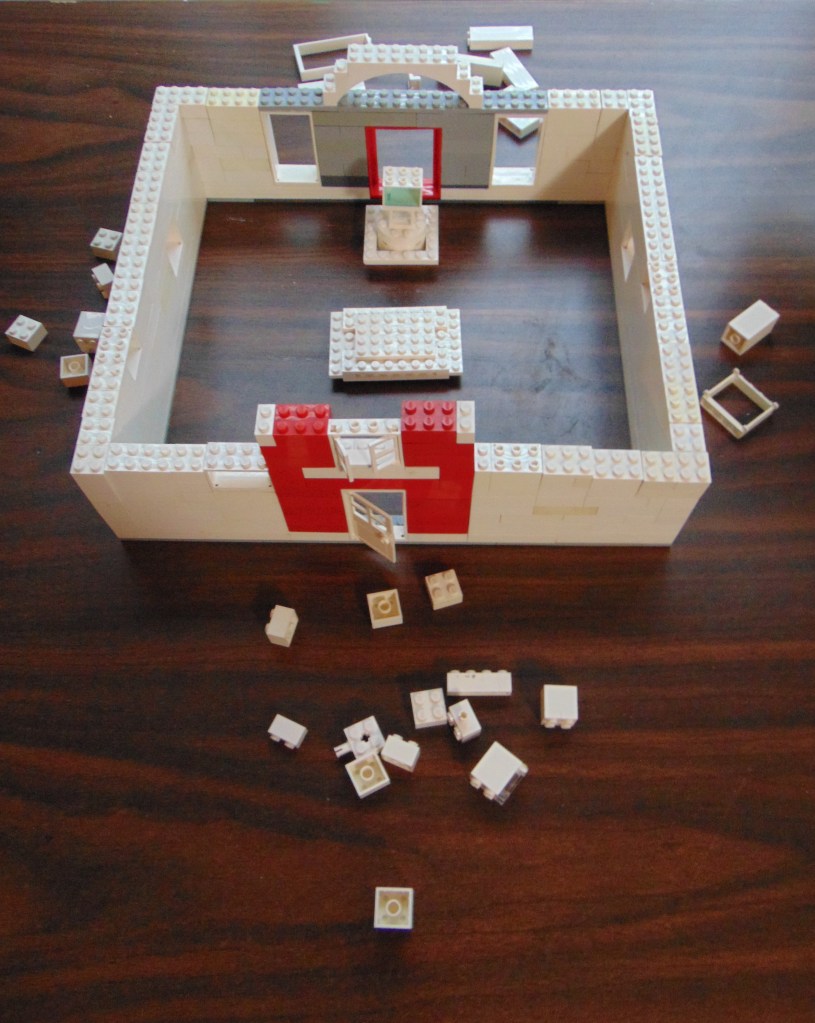
I subsequently spent much of the afternoon at home beginning to assemble the Legos creation I had envisioned – a Legos church. An unlikely way to spend my day off?

Then, disappointment. After so much effort to collect all the desired Legos pieces I could find, I found out at home (I rather suspected when leaving the store) that I don’t yet have enough pieces to finish erecting a church. I got the foundation laid, started the walls, installed doors and windows, and have something of an altar and tabernacle. Off to the side, I have Legos pieces for a steeple. There aren’t enough pieces, though, to complete the upper portion of the walls or a roof.

Perhaps, however, this is a case of art mimicking life. Or, more specifically, Legos mimicking how we experience faith. We can lay a foundation and start building a faithful life, but we’re really never done. Nor can we finish this on our own. We’ll likely never have all the pieces.

Perhaps I’ll never want a roof on this Legos church. If there were a roof, I’d never be able to see what’s inside. In faith, what’s inside needs to be made visible rather than hidden (i.e., the inside of this Legos church would be hidden to viewers if there were a roof) – we likewise lay ourselves (our insides) before God to be improved upon. We’re to take what we learn in church out into our lives and communities – our faith needs to be made visible by how we live (sometimes pastors say at the end of mass, ““Go forth, glorifying the Lord by your lives”).

In a sense, maybe my Legos church is as done as it is suppose to be. On with the continued building of life and faith.

Kim Burkhardt blogs at A Parish Catechist and The Books of the Ages. If you are a new visitor, it would be great to have you follow this blog (thank you!). If you know someone who would like this blog post, please share it with them (thank you!).

Another “church as a field hospital” week….

I wrote recently about being drawn to Pope Francis’s idea that church is a “field hospital” for the needs of humanity (see previous post).

There are times when I feel this in my own life. This week, I again needed the “field hospital” services of church – life’s hard knocks taking their toll. This time, as sometimes is the case, it’s self-inflicted challenges for which I need an emotional “field hospital.”

It’s always uncomfortable when we create our own difficulties.

Coming out of these times, though, it truly is heartening when God heals our hearts and prepares us better for life. This DOES require that we let God work within us (free will). In recent years, I have observed the inner work of God re-arranging my inner life so as to be on a better footing in life. Healthier, more functional – with a more mature place in the world than I would arrive at on my own. Christ came “that we might have life, and have it more abundantly” (John 10:10).

Kim Burkhardt blogs at A Parish Catechist and The Books of the Ages.