Book Review: In the Heart of the Desert
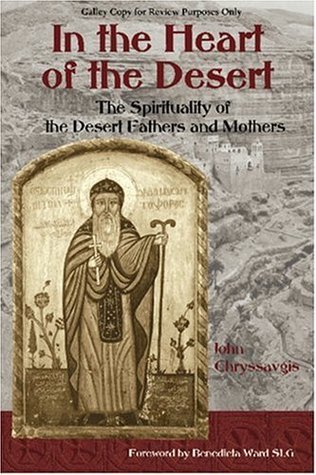
Book: Heart of the Desert
Heart of the Desert by John Chryssavgis

In the early centuries of Christianity, Christians seeking solitude and a focused relationship with God would sometimes head into the desert in small groups or as individual hermits – particularly into North Africa and Palestine. Enough ascetics did this at the time that non-hermits in villages and cities knew of this phenomenon. People would sometimes head into the desert to seek spiritual counsel from the desert dwellers. Some desert dwellers graciously provided this spiritual counsel. In other instances, visits from people seeking counsel (counsel of even just one word!) would drive the desert-living ascetics deeper into more isolated regions of the desert to more fully find the isolation they sought.

As people sought desert wisdom from the ascetic monastics, word spread throughout the region of the wisdom communicated by the self-isolating followers of God who were living in the desert. Quotes and phrases were shared and quoted by visitors to the desert monastics that developed into something of a a collective body of wisdom.

I discovered in reading In the Heart of the Desert: The Spirituality of the Desert Fathers and Mothers by John Chryssanvgis that any number of books have been written over the subsequent centuries about the lives, faith, and wisdom of these ascetic desert dwellers from early Christianity. In this particular book, Goodreads aptly describes the books’ content as “Words of spiritual counsel from the heart of early Christian monasticism.” For readers interested in reading more about desert mothers and fathers, In the Heart of the Desert provides a useful bibliography directing readers to additional books on this subject.

As an aside, one of my previous blog posts pondered the perceived relationship between types of geography – such as deserts – and how we perceive spiritual pursuits. That blog post can be read here.

Kim Burkhardt blogs about faith at The Hermitage Within. Thank you for reading this faith blog and for sharing it with your friends. While you are here, please feel welcome to provide support to sustain this blog ($$).
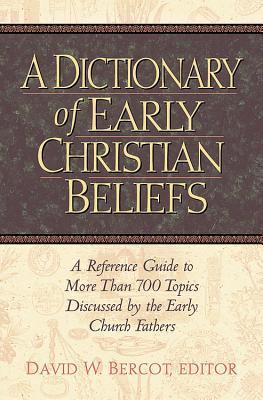
Book Review: Dictionary of Early Christian Beliefs

Dictionary: Early Christian Beliefs

There was a time when I would have read this reference book from cover to cover (I am among the readers who believe that when I read a book, I should read the entire book…..).

This is a useful, scholarly book to have on one’s bookshelf as a reference to inform one’s study of any number of topics. I am reading some of it now and plan to refer to it on occasion as the reference book it is intended to be.

Christianity is 2,000 years old. In 2024, the majority of us – with the possible exception of those Biblical scholars who specialize in Early Christian Literature – are not going to be familiar with the ins and outs of the topics discussed in the early church. Nor are most of us current on the etymology of what every word meant 2,000 years ago (“dictionary definitions” of words and the cultural context of vocabulary changes over time…).

“Sure,” some will say, “We know what early Christians were talking about. They were talking about Jesus, the resurrection, the gospels, and how to be Christian.” Yes, that’s true. But how exactly did those conversations unfold in Palestine, Greece, Turkey, etc. in, say, the year 75, 125, or 300 AD?

The gospels weren’t written down until several decades after Christ’s death. Jesus said during his lifetime that he would return during “this generation;” thus, it initially seemed unnecessary to Jesus’ contemporaries to write down his life and teachings for future generations…. Eventually, it started to become clear that he wasn’t coming back imminently, so his narrative began to be written for posterity. It then took time for the early church to decide which gospels – from among the gospels that were written down – are canonical (accepted as church doctrine). It wasn’t immediately clear to the early church that “the Bible” was going to include (and only include) Matthew, Mark, Luke, and John.

Likewise, it took time for the early church to develop and “come together” on any number of topics that we recognize today as “Christianity.”

So, precisely which “Christian topics” were under discussion in the early days of Christianity? This book – A Dictionary of Early Christian Beliefs – provides useful insights in to this question. Having this reference on one’s bookshelf can inform our understanding in any number of settings – when studying Sunday’s readings at church, when we want to learn more about a specific aspect of Christianity, when studying church history, etc.

A sampling of several topical entries in this 704-page resource include:

  • Christ, Divinity (how the early church came to understand this one topic gets 25 pages!)
  • Descent into Hades
  • Gifts of the spirit
  • “Keys of the Kingdom”
  • Patriarchs
  • Paul, apostle
  • Prayer
  • Rapture
  • Schism
  • At the end of the book, there are “Quotable quotes from the Early Christians.”

I appreciate having this book on my bookshelf.

Kim Burkhardt blogs at A Parish Catechist and The Books of the Ages (and a member of the Association of Catholic Publishers). If you are a new visitor, it would be great to have you follow this blog (thank you!). If you know someone who would like this blog, please share it with them (thank you!). You can also support this blog by clicking here when you are going to shop on Amazon (that lands A Parish Catechist a commission on Amazon sales).