Book Review: Bourgeault’s Centering Prayer and Inner Awakening

Book: Centering Prayer and Inner Awakening
Centering Prayer and Inner Awakening

I have been hearing for several years – mostly through Contemplative Outreach Northwest – about Episcopalian priest Cynthia Bourgeault. She is known for her active, thoughtful leadership within contemplative/mystical Christianity.

I finally got around to reading one of her books: Centering Prayer and Inner Awakening.

I am “beyond thrilled” to have come upon this book.

In 2016, I was gifted with a sustained period of contemplative prayer during which I had a solid sense of God loving me. This was “a gift I didn’t see coming.” The outline of that story is told here. A challenge I encountered was that I didn’t have the vocabulary to articulate my experience to people. A real challenge – I was experiencing something profoundly meaningful, but I had no means to talk to people about it (I’ve since seen a couple of other people wander into churches with a similar scenario – each time, a make an effort to “walk with them,” encouraging them as best I can along their journey…..). In time, through church attendance and involvement in Contemplative Outreach Northwest, I started grappling my way toward being more able to discuss the “outer contours” of my experience. A respected friend (who also happens to be Episcopalian, like Cynthia Bourgeault) pointed out that each of us has a different prayer relationship with God and that the best we can hope for is to find a few people with whom can share some basic aspects of our prayer experience in relating to God.

Then, I read Centering Prayer and Inner Awakening.

Actually, I skipped through several “how to” reflection portions of the book – that was information I didn’t need.

Early portions of the book, though, grabbed my attention. When Cynthia Bourgeault encountered “centering prayer” (i.e., how to learn to do contemplative prayer) groups as a priest, she said she immediately grasped the concept based on having grown up attending a Quaker school. I have periodically read about Quaker spirituality – this intrigued me.

Then, I got to later chapters of the book.

While God’s faith path for us within Christianity is a very different realm than the secular study of human psychology, Cynthia Bourgeault has artfully drawn from both in this book to discuss how we experience changes within our inner realm when Christ changes us via contemplative prayer. Of course, Bourgeault discusses within the book the very real differences between “doing Christianity” and “doing psychology.” I am currently reflecting – with an inner joy – upon Bourgeault’s artful communication within the later chapters of this book. It’s as if she put our inner human experience to poetry (I can’t take credit for this statement – I once heard someone else use this analogy in another context). In the next few weeks, I expect to be able to start talking more actively to people – based on this book – about my own inner changes and experience wrought by contemplative prayer.

And, I will be reading more of Cynthia Bourgeault’s books.

(For any reader who is interested, Teresa of Avila’s autobiography is also of tremendous interest regarding contemplative prayer.)

Kim Burkhardt blogs about faith at The Hermitage Within. Thank you for reading this faith blog and for sharing it with your friends. While you are here, please feel welcome to provide support to sustain this blog ($$).

Book Review: The Ecumenical Councils of the Catholic Church

Book: The Ecumenical Councils of the Catholic Church
Book: The Ecumenical Councils

This book – The Ecumenical Councils of the Catholic Church: A History (author: Joseph E. Kelly) – is anything but a dry read.  

More than just a book for religious historians, this book provides wide details and context on how church leaders came together – and sometimes didn’t come together – over the centuries to debate and articulate Christian theology.

I count myself among the bibliophiles who believe that every word of a book should be read to consider the book as having been read.   In the case of this book, there is so much historical detail about each council, and historical context surrounding each council, and absorbing trivia that I am finding myself selectively choosing how much to summarily read about each time period the first time through this book (I may satisfy myself with selectively reading the book once through and keeping it a reference book).   “Really?,” I found myself pondering.  “A, B, X, Y really happened at this or that council or during this or that period in Church history?!?!?”  As I read, I am scribbling trivia on sticky-notes to tell friends and fellow church folk about what I am learning about the history of the Christianity’s twenty-one ecumenical councils.  As many of us know, the first council was the Council of Nicea in 325 through to Vatican II in the 1960’s. 

Just this afternoon, I learned that an Empress was involved in the second council of Nicea in 786/7.   Some councils were more ecumenical than others – in some cases, the councils were more heavily attended by bishops from the east than bishops from the west; today, individual denominations decide for themselves which of these historical councils were “ecumenical” (of note, the book’s author provides a listing within the book of which denominations consider with councils to have been ecumenical).

For non-historians, reading this book seriously will take the reader into reading additional books to learn more about the history and context of what was happening at the time of each council. 

There’s plenty in this book for both historians and fans of religious trivia.   It’s a book that really needs to be read over time so as to really absorb the content covered for each time period.

Kim Burkhardt blogs about faith at The Hermitage Within. Thank you for reading this faith blog and for sharing it with your friends. While you are here, please feel welcome to provide support to sustain this blog ($$).

Faith resources – tools, not straight jackets

Divine Office
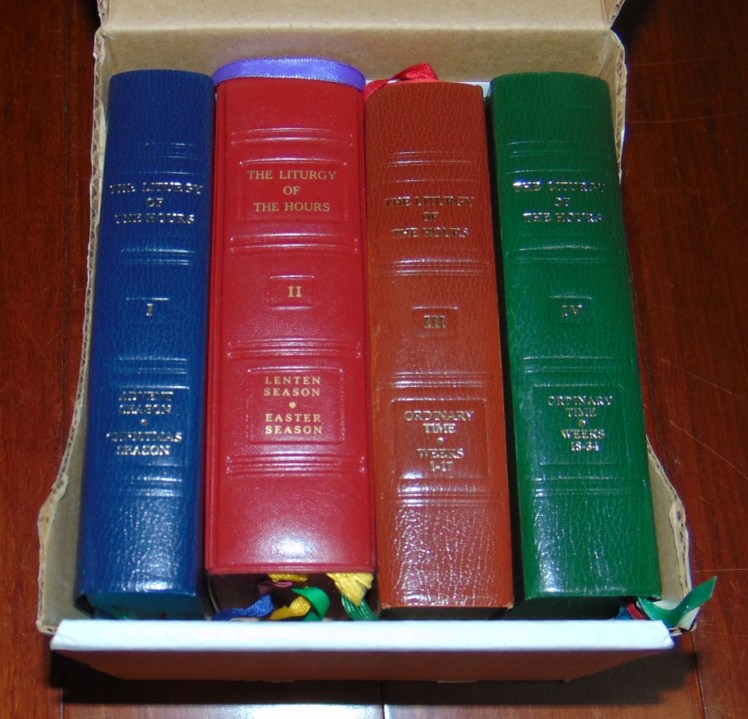
Liturgy of the Hours (Divine Office)

The ways through which we travel our faith journey – church attendance, types of prayer, etc. – are meant to nurture our faith journey. If anything we participate in feels as though it is constricting our faith journey, either something is amiss or we are ready for additional or different faith activities. Being attentive to any sense of constriction is an opportunity to look to adapt either ourselves or our situation. It is entirely good when we notice that we need to adjust – such observations mean we are engaged in our faith journey (or, sometimes, that we need to become more engaged). Our faith journey has developmental stages just as we experience stages in other aspects of our human development – stages in cognitive development (academics), stages in psychological and social development, etc.

By way of example, I am starting a Master’s in Theology in January (a “Masters in Theology Studies” or “MTS” for lay people rather than a Master’s in Divinity for pastors-in-training). At a recent meeting for registered MTS students, we were provided with the first of our faith formation sessions. We were told that Masters in Theological Studies degrees typically cover four academic subjects – scripture, ethics, systemic theology, and historical theology. In addition to academics, MTS programs – ours, at least – include the faith development of enrolled students (faith formation) because the degree should include our faith maturation in addition to a focus on academics (a whole person approach). During that day, we were instructed to start participating daily in Liturgy of the Hours (Divine Office) – the daily prescribed prayer life of the Church.

In recent years, my prayer life has principally been one of contemplative prayer – both at home and in small prayer groups via Contemplative Outreach. There are as many ways to pray as there are people; contemplative prayer has been personally fruitful for me. In contemplative prayer, I encounter periods of time in which I experience God loving me – which has been freeing me from difficult aspects of “the human condition.” As with anything else, I do also experience occasional dry periods in my experience with contemplative prayer. Therefore, I am now open to also praying Liturgy of the Hours (Diving Office).

Prior to being recently instructed to start participating in Liturgy of the Hours, I viewed the Divine Office remotely (“from afar”) as the prerogative of priests and avowed religious – a respected activity distant from my daily life. When we were recently told to start participating in this daily activity for the MTS program, part of me was intrigued. Another part of me was also relieved when we were told that Liturgy of the Hours is “a tool to help us pray, not a straight jacket to keep us from praying.” I am enjoying the journey into the Divine Office.

Kim Burkhardt blogs about faith at The Hermitage Within. Thank you for reading this faith blog and for sharing it with your friends. While you are here, please feel welcome to provide support to sustain this blog ($$).

Prayer: genuine engagement

Clonmacnoise window

On December 24, 2017, a pastor was driving me home from an evening Christmas Eve service. As we were winding through snowy roads, I was telling him about the angst I was feeling about a personal problem that was “eating up my insides” at the time. He asked if I had prayed about the matter. “No,” I replied, “I haven’t prayed about this. I have been having such a positive prayer relationship with God for the last year – I don’t want to ruin this positive prayer relationship by bringing my problems to God.” I can still feel this heavy weight of the subsequent silence in the car as the pastor’s face puckered. Finally – after a moment that lasted too long – he sternly replied, “You have to bring EVERYTHING to God.”

I got the point.

We are to bring our whole selves to God. Not just the parts we want to bring to prayer. There’s no point packaging ourselves – or our situations – to present to God as we would wish. Do we really think God doesn’t know the real dirt?

God doesn’t want to deal with any superficialities that we might “sugar coat” in prayer. Prayer becomes meaningful when we get real. God loves us, wants to have a real, meaningful relationship with us.

Prayer is also a long-haul relationship. Prayer doesn’t become meaningful when we pray as an equivalent to 30 second chats held in a busy hallway. Prayer becomes real when we make real and continuing time to be meaningfully present with God. The shape and form of being “meaningfully present” in prayer is going to be different for each of us. A faith person who I admire mentioned to me several years ago (after the Christmas Eve car ride mentioned above) that everyone one of us is going to have a different prayer relationship with God because of the different nature of who each of us is…. What matters for each of us is that we commit sustained, ongoing time to building personal “prayer”being present” time with God. The fruits of that prayer become clear and substantive when we continue such sustained, meaningful time in prayer.

Wondering about new ways to pray? Check out a ways-to-pray list in one of my previous blog posts.

Kim Burkhardt blogs about faith at A Parish Catechist. Thank you for reading this faith blog and for sharing it with your friends. While you are here, please feel welcome to provide support to sustain this blog ($$).
Book Review: Opening to God (David G. Benner)

I was hooked when I read the back cover of David Benner’s Opening to God: Lectio Divina and Life as Prayer.

I read these excerpts from the book’s back cover as poetry describing the best I have experienced in prayer: “Prayer is not just communication with God: it is communion with God. As we open ourselves to him, God does the spiritual work of transformation in us…….discover openness to God as the essence of prayer…..Move beyond words [in prayer] to become not merely someone who prays, but someone whose entire life is prayer in union with God.”

Okay, I haven’t yet gotten to living as “someone whose entire life is prayer,” but my prayer life has joyously moved beyond “words communicated to God” to prayer being a relationship – without the need for human language” (as I mention in several previous blog posts such as this one). In my case, such prayer was given to me as a grace.

I started reading this book last night. Happily, the book is living up to the book’s description – a descriptive book about the dynamics of prayer being a meaningful relationship with God. A worthwhile read about what prayer can be and is meant to be.

Kim Burkhardt blogs at A Parish Catechist and The Books of the Ages. If you are a new visitor, it would be great to have you follow this blog (thank you!). If you know someone who would like this blog post, please share it with them so they can subscribe (thank you!).