Faith resources – tools, not straight jackets
Divine Office
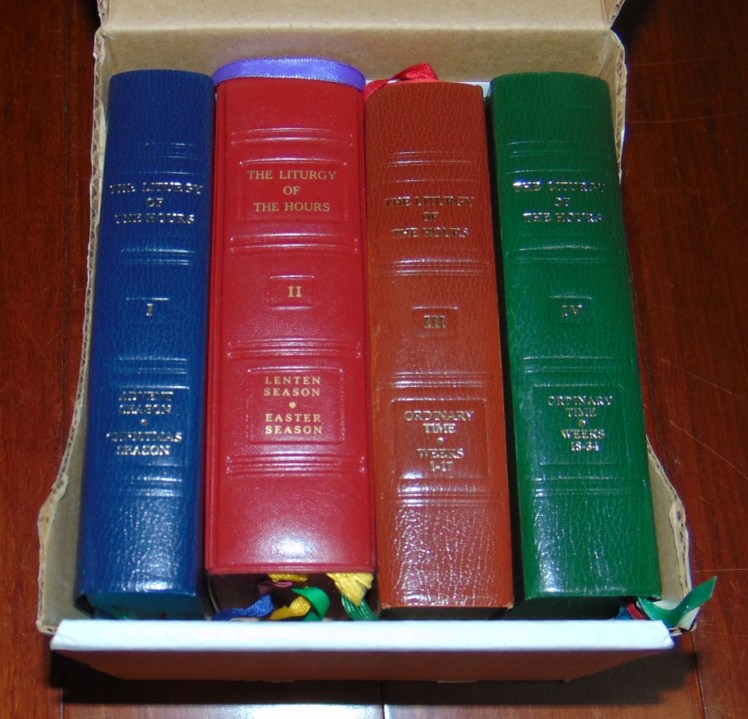
Liturgy of the Hours (Divine Office)

The ways through which we travel our faith journey – church attendance, types of prayer, etc. – are meant to nurture our faith journey. If anything we participate in feels as though it is constricting our faith journey, either something is amiss or we are ready for additional or different faith activities. Being attentive to any sense of constriction is an opportunity to look to adapt either ourselves or our situation. It is entirely good when we notice that we need to adjust – such observations mean we are engaged in our faith journey (or, sometimes, that we need to become more engaged). Our faith journey has developmental stages just as we experience stages in other aspects of our human development – stages in cognitive development (academics), stages in psychological and social development, etc.

By way of example, I am starting a Master’s in Theology in January (a “Masters in Theology Studies” or “MTS” for lay people rather than a Master’s in Divinity for pastors-in-training). At a recent meeting for registered MTS students, we were provided with the first of our faith formation sessions. We were told that Masters in Theological Studies degrees typically cover four academic subjects – scripture, ethics, systemic theology, and historical theology. In addition to academics, MTS programs – ours, at least – include the faith development of enrolled students (faith formation) because the degree should include our faith maturation in addition to a focus on academics (a whole person approach). During that day, we were instructed to start participating daily in Liturgy of the Hours (Divine Office) – the daily prescribed prayer life of the Church.

In recent years, my prayer life has principally been one of contemplative prayer – both at home and in small prayer groups via Contemplative Outreach. There are as many ways to pray as there are people; contemplative prayer has been personally fruitful for me. In contemplative prayer, I encounter periods of time in which I experience God loving me – which has been freeing me from difficult aspects of “the human condition.” As with anything else, I do also experience occasional dry periods in my experience with contemplative prayer. Therefore, I am now open to also praying Liturgy of the Hours (Diving Office).

Prior to being recently instructed to start participating in Liturgy of the Hours, I viewed the Divine Office remotely (“from afar”) as the prerogative of priests and avowed religious – a respected activity distant from my daily life. When we were recently told to start participating in this daily activity for the MTS program, part of me was intrigued. Another part of me was also relieved when we were told that Liturgy of the Hours is “a tool to help us pray, not a straight jacket to keep us from praying.” I am enjoying the journey into the Divine Office.

Kim Burkhardt blogs about faith at The Hermitage Within. Thank you for reading this faith blog and for sharing it with your friends. While you are here, please feel welcome to provide support to sustain this blog ($$).

Book Review: Spiritual Direction in the Early Christian East

Book cover
Authors: Irenee Halisherr, Foreward Bishop Kalistsos Ware

I very much enjoyed finding this book, Spiritual Direction in the Early Christian East. I was equally thrilled to discover that it was published by Cistercian Publications (I worked for a Cistercian monk-priest for a time……).

This is among books written on very specific topics – it’s great to find such books when they are written on a topic of personal interest. I take an interest in the history of religious thought in the Medieval period and earlier. I am also currently exploring spiritual direction. Thus, I was excited to order this book and read it.

A number of passages in the foreward prove tangible to the reader interested in spiritual direction:

  • “The ministry of the spiritual father is already foreshadowed in the New Testament; ‘Though you have countless guides in Christ, you do not have many fathers. For I became your father in Christ Jesus through the Gospel.’ (1 Cor 4:15)”
  • “He helps his children in Christ precisely because he is willing to share himself with them, identifying his own life with theirs.”

Within the book itself, any number of passages artfully describe spiritual direction:

  • “Desert fathers have, if not brought into being….at least, systemized this magnificent thing….’the divine art of healing another.'”
  • “We should examine ….[the qualities]…. the Byzantines deemed most necessary to the exercise of spiritual direction.” This section of the book starts with discussion of any would-be spiritual director needing to possess the quality of charity with the aspect of charity that involves being loving ( spoiler alert: read the book to discover the other deemed-necessary qualities!).
  • Later chapters of the book discuss how to enter into spiritual direction as a directee in such a way as to benefit from receiving spiritual direction – a useful topic of instruction.

In addition, any number of passages interestingly discuss Eastern Christianity:

  • “This book is addressed to Western Christians interested in the East: the main intention is to make them breathe the spirit of which animated the great spiritual masters of the past….”
  • “Almost all the documents [referenced in the main of the book] belong to monastic literature. It could not be otherwise. Spiritual direction was not taught and practiced to perfection except among monks.”
  • “….abba Elias and abba Dorotheos….devoted themselves to a large monastery of virgins in Antripe, upper Egypt…..Their role, which they assumed spontaneously out of compassion consisted in maintaining or re-establishing peace among the some three hundred ascetrie (women ascetics) who had been accepted there…..” [Note: I now find myself wondering what literature is available for learning more about ascetrie!]

Spiritual Direction in the Early Christian East is an important contribution to books on spiritual direction and literature about Eastern Christianity – particularly the practice of spiritual direction. I encourage anyone interested in one or both topics to pick up this book.

Kim Burkhardt blogs at A Parish Catechist. If you are a new visitor, it would be great to have you subscribe to follow this blog (it’s free – thank you!). If you know someone who would like this blog, please share it with them and invite them to subscribe (thank you!).

Faith Challenges: there are lessons in faith’s strivings

Understanding and accepting the tenets of one’s faith tradition can sometimes be a challenge. How can one God be a trinity of three persons? How could Jesus have been conceived by a virgin? What about ascensions into heaven? Are non-Christians excluded from heaven? Why do babies need to be washed clean of original sin in baptism (babies don’t act sinfully!)? Why do bad things happen to good people? Are some parts of the Old Testament religious metaphor rather than literal fact?

I have struggled with some of the questions listed above. I have journeyed with people who have struggled with some of the other questions listed above. I have talked to pastors who say they struggle to deliver sermons about the Trinity.

One of the lessons I have learned is that unexpected faith lessons come to light in the process of trying to make sense of religious tenets that don’t readily make sense. I don’t only mean figuring out that which we’re trying to understand – rather, unexpected faith lessons become apparent to us as we work to make sense of matters that don’t yet make sense to us. Beyond the unexpected lessons that we discover in trying to understand topics that challenge us, we sometimes find answers to the topics we set out to understand. Other times, we may not find answers or explanations to what challenges us. However, genuine effort to find answers to challenging questions can – in time – help us to “make peace” with remaining in one’s faith tradition. We find that a faith tradition as a whole can be true even if one (or a few) topics in that faith tradition don’t readily make sense to us. In addition, I find great value in the homilies (sermons) of pastors who readily communicate their own struggles and talk about their own efforts to understand specific topics they haven’t yet figured out.

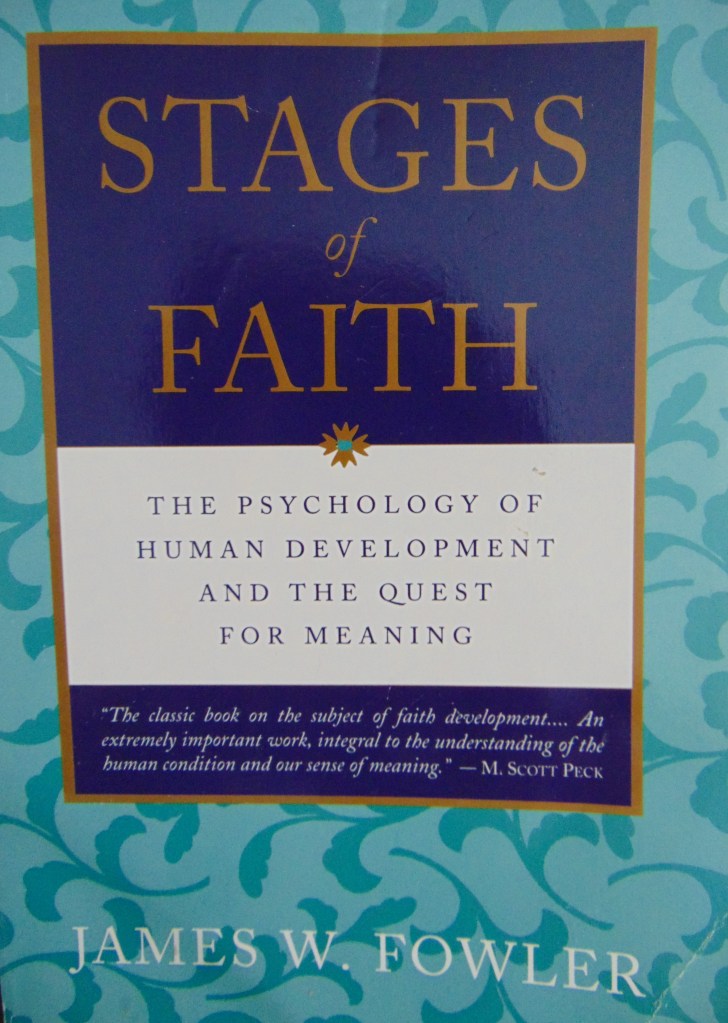
The academic and theologian James Fowler did groundbreaking work on how we understand and navigate faith throughout our life stages in his book Stages of Faith. In that book, Fowler lays out six faith stages that people can progress through from early childhood into the more mature stages available as we move through life. The first three developmental stages are readily available by high school. Entering into the subsequent stages require us to actively engage in our faith in an “I am choosing to grow up in faith” manner – including making an intentional personal effort to make sense of faith in deeper ways and to work through life’s difficulties with a faith lens.

Kim Burkhardt blogs at A Parish Catechist and The Books of the Ages. If you are a new visitor, it would be great to have you follow this blog (thank you!). If you know someone who would like this blog post, please share it with them (thank you!).

Book Review: Stages of Faith (spoiler – a useful read!)

I have found this book to be a tremendous value in my own faith journey specifically and in my overall psychological development generally.

When I returned to church in 2016 – after a 20-year hiatus – the pastor with whom I connected listened to my story about my experience with church and he made a comment about my “stage of faith.” He rather suggested that my “stage of faith” was younger than my chronological age of maturity. Ouch! But, okay, was he perhaps correct? I took an interest in his turn of phrase, “stage of faith.” I Googled the phrase, found my way to this book by academic-sociologist-theologian James Fowler (in later conversations, I found out that the pastor had read this book).

Fowler had interviewed hundreds of people – from young children to seniors – to hear about how their experience faith and a search for meaning within a western context. Fowler drew from these interviews and from existing theories of psychological development to profile six descriptive/normative stages of faith development. Most people, it turns out, grow to somewhere between stages three and five….. I looked for myself in this book; discovered – in re-reading parts of the book several times – that my “stage of faith” was pretty close to where the pastor had guessed I was at – I had gotten stuck in the transition between stages three and four (a common place to get developmentally detoured, according to James Fowler).

When I read this book, I had known for some time that I had been “stuck” in my effort to grow further in faith; I wasn’t sure how to get “unstuck.” This book provided tremendous value in this regard. Once I identified “where I was” (i.e., 3.5), I re-read the next stage – stage four – to get an idea of where to head next. Once I saw a roadmap of the direction to head in (without this book being tied to a particular denomination), this helped me to begin moving forward, thankfully (the particulars of moving forward are guided by my denomination, as are each of us).

In addition to finding faith assistance from this book, I found in this book that various aspects of my faith-mental-emotional “developmental stages” weren’t entirely lined up in one neat age-chronology phase. Life wasn’t “tidy.” This book helped me to grow and mature various aspects of my self-hood to get my “various aspects” closer to one chronological age. I come back to this book occasionally to monitor my ongoing progress…. On the whole, a worthwhile read that I often recommend to people I meet.

Since I read this book, I have also sought-out and found additional topic-relevant books for follow up. For example, Jane Regan’s book Toward an Adult Church is a worthwhile read.

Kim Burkhardt blogs at A Parish Catechist and The Books of the Ages.