Book Review: Healing as a Parish Ministry
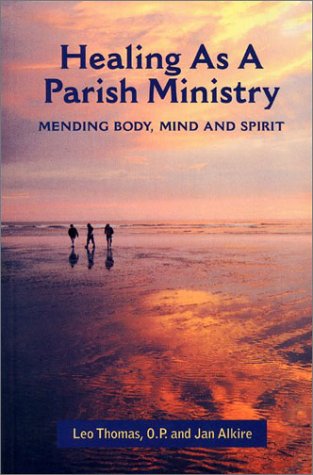
I was happy to stumble upon this book in a Little Free Library and to then discover that this practical and helpful book was locally written (i.e., Seattle, Washington).

The summary of this book on Goodreads states: “Jesus’ mandate to heal the sick is beginning to enter into faith communities today. In this sound and practical book, Father Leo Thomas and Jan Alkire show how this vital ministry is rooted in Christian scriptural and sacramental tradition. Pastors and lay leaders will benefit from the authors’ faith-filled, balanced wisdom. ‘Healing as a Parish Ministry’ will help all who read it become more effective channels of Christ’s healing to those who are hurting.”

Jesus healed the sick during his time on earth. Jesus instructed his disciples to heal the sick. Pope Francis talks today about the church being a “field hospital.” In a workshop I’m taking through Franciscan University’s Catechetical Institute, the instructor talks about church-goers sometimes preferring to go to their pastor/church for help before going to mental health providers. The message is communicated in many ways that church is meant to be a place where people can come for healing and direction. This book – Healing as a Parish Ministry – provides practical, front-line instruction to parishes – local churches – on how to provide healing ministries at one’s church.

In their book Healing as a Parish Ministry:

  • Leo Thomas and Jan Alkire write about faith healing does not mean curing natural consequences of what happens in life; rather, that faith healing is often about bringing us into the fullness of who God wants us to be – a very healing experience!
  • Thomas and Alkire write about how to set up a parish healing ministry – and why it is important.
  • The authors provide useful resources on how to connect meaningfully and usefully with parishioners who are in a time of need. Of equal importance, they also provide practical tips on what NOT to do so as to avoid alienating parishioners or causing ill will.

I read this book as a person who has found healing in church and who wants healing to be something that happens for many people in church. In my case, I returned to church – after a time away – with a painful neuropathic medical condition. That condition includes a hyper-stimulated sympathetic nervous system and associated physical pain. After returning to church, I found that contemplative prayer (and yoga, in my case) slowly calmed my over-stimulated nervous system – resulting in a reduction in physical pain. When I later came upon this book, I found that the book speaks to the type of healing I’ve experienced – I see the book having practical and real – real-world – insights and application.

This book is a great resource! I recommend this book to anyone who wants churches to be a place of healing.

Kim Burkhardt blogs at A Parish Catechist and The Books of the Ages (and a “Content Creator/Individual” member of the Association of Catholic Publishers). If you are a new visitor, it would be great to have you follow this blog (thank you!). If you know someone who would like this blog post, please share it with them (thank you!).

Getting to the best in prayer: relational, loving, healing

In the mainstream view of the general public, prayer is sometimes reduced to being viewed as “a uni-directional monologue of us making intercessory requests to God when we need something.”

If our human relationships were limited to uni-directional monologues, that would make for very dry relationships (i.e., transactional rather than interactional) – we likely wouldn’t have many engaging connections with people. Likewise, prayer in its’ fullness is also more than a uni-directional monologue. A rich prayer life is relational and interactive: a two-way communication in which we relate with God (with us as the junior communicator), both offering and receiving wide-ranging communication – including our sense of God’s loving presence.

What about prayer and our questions about why God allows suffering in the world? Isn’t prayer about asking God to fix our problems?

God didn’t create the world to be a world in which we suffer. God made us in order to have us to love. Love, by its’ nature, is two-way and interactional. Further, love – by definition – can’t be forced. Since love can’t be forced, we were given the option of whether or not to love God in return. Further, we have the option of whether to live in right relationship with God. Adam and Eve chose to break this right relationship with God by eating of the forbidden fruit. Since then, we humans haven’t always lived in right relationship with God (I’ve heard it argued that the root of sin is selfishness and/or disobedience). Thus, we live in a troubled, broken world.

Gerald May (a physician, psychiatrist, and writer of faith books) looks at the fact of suffering from another perspective on page nine of his faith book Dark Night of the Soul (May’s book is a reflection on John of the Cross’s original book of the same name). His is a perspective that occurred to me in some fashion several years ago: “….suffering does not result from some divine purgation….Instead, suffering arises from the simple circumstances of life itself.” In their book Healing as a Parish Ministry, Leo Thomas and Jan Alkire state – along a similar lines – about faith healing typically not curing natural consequences of what happens in life – that faith healing is often more of about bringing us into the fullness of who God wants us to be (a very healing experience!)

Personally, I don’t view prayer as only being about us bringing our list of problems to “Santa in the sky” to be fixed. Rather, the first focus of prayer is about entering into an ongoing – and interactive – relationship with God. When we let God into our hearts – when we surrender to letting God live within us (“It is no longer I, but God who lives in me,” Galatians 2:20), God can – and does – transform us into the people that God intended us to be. Then, we become better and emotionally/mentally happier people (at best, we experience a “peace that passeth all understanding”), people who contribute good in the world.

What about praying for healing and praying when we feel so challenged in life that we need God regarding our challenges? What about when we are seriously ill?

There absolutely are times when we need God. Ill health, life challenges. Having an active prayer relationship with God all the time – makes an interactive relationship with God more accessible to us much of the time (there are sometimes dry prayer periods). Just as human parents want to hear from their grown kids throughout the year – not just in times of need – God wants to have an ongoing, interactive relationship with us on an ongoing basis.

Sometimes, miraculous healing does occur through prayer. Jesus performed miracles and healed people. We hear stories today of miraculous healing. Other times, we pray in times of illness and we don’t experience direct healing of specific illnesses.

Sometimes there are ‘healing in prayer’ situations in prayer. We hear of medical healings. There are also cases of emotional and mental healing in difficult times.

Yes, there is healing in prayer

God loves us, wants to have a relationship with us and wants to heal us.

In their Healing as a Parish Ministry book (above), Leo Thomas and Jan Alkire quote Verla A. Mooth’s “Forgiveness and Healing” publication when stating on stating on page 43 of their book: “….The miracle of redemption is that God should change us……This transforming love is poured out in our hearts through the Holy Spirit who is given to us. It can only be a giving and forgiving love.” As such, we become more vibrant and able to live more fully – and, in many ways – healthier lives.

As an example of healing found in prayer, I returned to church in 2016. I returned with a painful neuropathic condition in which a stress response is involved (Complex Regional Pain Syndrome includes hyper-stimulation of the sympathetic nervous system). Prayer very slowly had a calming and healing effect, calming my sympathetic nervous system. I now have periods of being symptom-free from Complex Regional Pain Syndrome.

For more recent reflections about the fullness of prayer, see my previous post here.

Kim Burkhardt blogs at A Parish Catechist and The Books of the Ages. If you are a new visitor, it would be great to have you follow this blog (thank you!). If you know someone who would like this blog post, please share it with them (thank you!).
Another “church as a field hospital” week….

I wrote recently about being drawn to Pope Francis’s idea that church is a “field hospital” for the needs of humanity (see previous post).

There are times when I feel this in my own life. This week, I again needed the “field hospital” services of church – life’s hard knocks taking their toll. This time, as sometimes is the case, it’s self-inflicted challenges for which I need an emotional “field hospital.”

It’s always uncomfortable when we create our own difficulties.

Coming out of these times, though, it truly is heartening when God heals our hearts and prepares us better for life. This DOES require that we let God work within us (free will). In recent years, I have observed the inner work of God re-arranging my inner life so as to be on a better footing in life. Healthier, more functional – with a more mature place in the world than I would arrive at on my own. Christ came “that we might have life, and have it more abundantly” (John 10:10).

Kim Burkhardt blogs at A Parish Catechist and The Books of the Ages.