List: examples of faith being hard work, path to joy

Stairs, moss

Living Christianity is both hard work and a path to joy and freedom.

Examples of having to work at living Christianity include:

  • “It is easier for a camel to pass through the eye of a needle than for a rich man to enter the kingdom of God” (Matthew 19:24). Putting faith into practice – such as giving up our attachment to worldly goods – is a challenge.
  • The bumper sticker “Love your neighbor means everybody” (a reflection on Matthew 22: 34-40: “The greatest commandments are…love the Lord your God….and….love your neighbor as you love yourself.”) speaks to the heart of Christianity and of the Christian faith being hard work.  It’s easy to love the people we like. It’s harder to love people who we are naturally inclined to dislike (the disheveled homeless person who went through our trash and left a mess, a political figure we disagree with, the difficult relative, an argumentative person at work, etc.). Yet, “love your neighbor” does mean “everybody” – we don’t get to pick and choose. Many or all aspects of living the Christian faith are required to practice treating everyone with dignity and grace. Loving people is a verb – a self-giving action. If we were all to practice this well (hard work!), the world would be a better place.
  • The pastor and writer L. Gregory Jones writes (in his book Embodying Forgiveness) ““Christian forgiveness involves a high cost, both for God and for those who embody it. It requires the disciplines of dying and rising with Christ, disciplines for which there are no shortcuts, no handy techniques to replace the risk and vulnerability of giving up ‘possession’ of one’s self, which is done through the practices of forgiveness and repentance.” Yes, there is a ‘high cost’ to doing forgiveness – but also high rewards.

While there are plenty of examples of how living one’s faith is a lifelong effort (an “ongoing conversion,” in challenging ways such as those noted above), there are also joys:

  • “And the peace of God, which surpasses all comprehension, will guard your hearts and minds in Christ Jesus (Phillipians 4:7).”
  • “Blessed are those who hunger and thirst for righteousness, for they will be filled (Matthew 5:6).”
  • Living faith principles – including surrender to allowing God to transform us – turns us into the people God intends for us to be. God wants us to be happy and will – if we allow it – adjust who we are to that purpose.
  • In living out the principles of faith, we contribute positively to our communities – helping to make the world a better place.
  • Living faith principles teaches us to bring joy into the lives of other people – which is among the primary reasons for us to be alive. We are all God’s children; bringing joy into the lives of God’s children is a wonderful thing!

The Christian path is a great, joyous path. A loving path that turns us into better people.

Kim Burkhardt blogs at A Parish Catechist and The Books of the Ages (and a member of the Association of Catholic Publishers). If you are a new visitor, it would be great to have you follow this blog (thank you!). If you know someone who would like this blog, please share it with them (thank you!). You can also support this blog by clicking here when you are going to shop on Amazon (that lands A Parish Catechist a commission on Amazon sales).
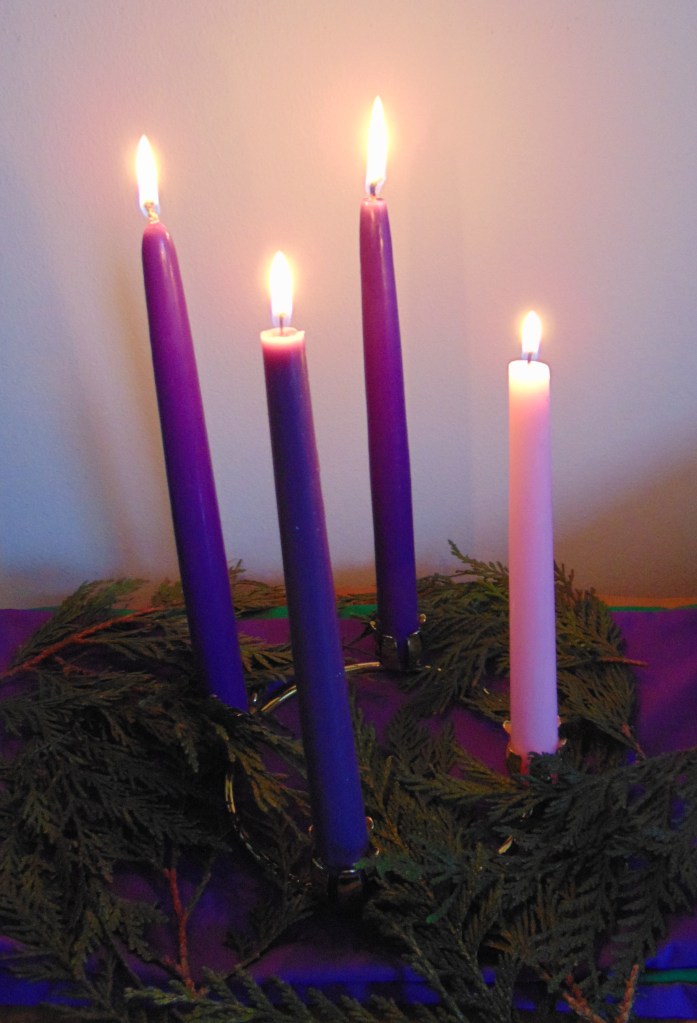
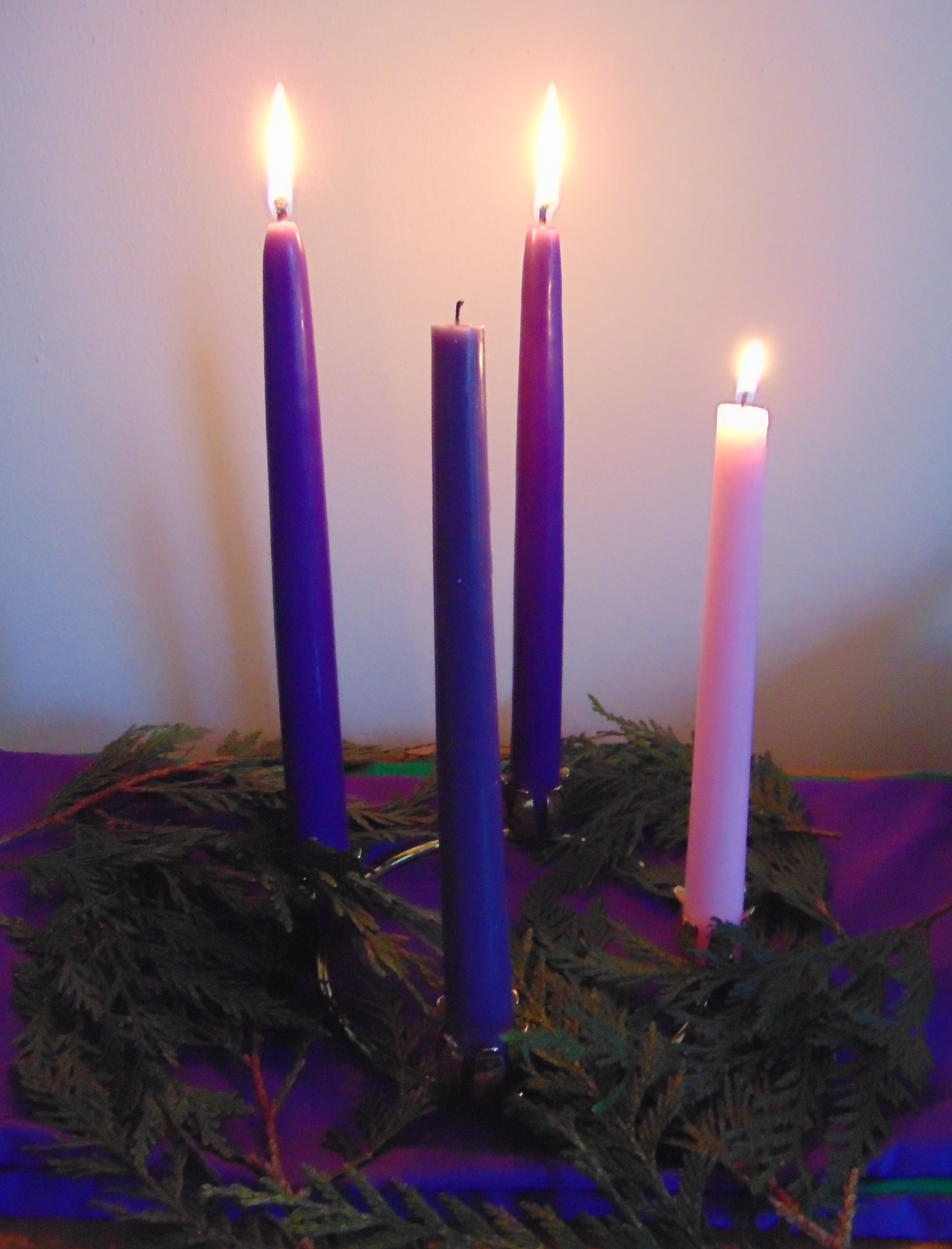
This Sunday: Fourth Sunday of Advent

A home Advent wreath

This Sunday – Dec. 24th – is the Fourth Sunday of Advent.  It is also Christmas Eve (and, three days after today, the darkest day in the Northern Hemisphere – a time to bring light into the world).  This Sunday, we light all four candles on our Advent wreaths.

Advent is a time for us to reflect upon, engage in, and renew our faith.

Four topics associated with Advent (i.e., faith-renewing reflections) are hope, peace, joy, and love.  Last week, I reflected broadly on these four topics in a blog post that can be viewed here.  This week, I reflect on these same topics, but in such a way to challenge each of us to personally and meaningfully engage with these topics:

  • Hope: What can you do this week to bring hope into someone’s life?  When I volunteered in the prison system, I co-led a study about people who successfully “left-crime-behind” following incarceration. 100% of the formerly-incarcerated people we interviewed who “left crime behind” after incarceration reported having someone in their life who made a difference in their life, a person who helped them change their lives change for the better (made time for them).  What tangible form of support can you provide for someone you know who is experiencing a challenge in their life?  Spend time with them?  Help them navigate a challenging situation?
  • Peace: What can you do this week to contribute to peace in the world? Contribute $$ to a charity that provides civilian relief in war zones?  Start volunteering at a local charity that serves challenged individuals (like volunteering at a local jail)?  Be the person “who gets off the merry-go-round” in a situation of endless and/or senseless discord (i.e., workplace disagreements, family disputes, etc.) and “take the high road” to support another person in that situation?  As indicated in last week’s post, peace is the result of sacrificial love – Christ’s sacrificial love for us and our sacrificial love for other people.
  • Joy: Be the joy in someone’s life this holiday season.  Drop off a surprise holiday gift, do someone’s task for them at work, bring Christmas cookies to the office, go Christmas caroling……  We can all find something to do to bring some joy into someone’s life!
  • Love:  Who can you bring some “loving care?”  When Jesus was asked which of the commandments is greatest, he said “Love the Lord your God with all your heart, with all your soul, and with all your mind.’ This is the greatest and most important commandment. The second is like it: ‘Love your neighbor as you love yourself.’” (Matthew 22: 34-40).  It’s easy to love the people we like and with whom we enjoy spending time.  It matters just as much that we bring love to the people who might seem harder to love – a relative or friend who is in a time of need (we’re busy!), the irritable relative, the difficult co-worker we’d rather not work with, the homeless person who perennially displays challenging behavior outside the grocery store, the socially-isolated person we know who doesn’t seem to be able to connect with the people around them….  Loving someone involves a time commitment – time well spent!

Kim Burkhardt blogs at A Parish Catechist and The Books of the Ages (and a “Content Creator/Individual” member of the Association of Catholic Publishers). If you are a new visitor, it would be great to have you follow this blog (thank you!). If you know someone who would like this blog post, please share it with them (thank you!). You can also support this blog by clicking here when you are going to shop on Amazon (that lands A Parish Catechist a commission on Amazon sales).


Advent: hope, peace, joy, love

A home Advent wreath This Sunday – Dec. 17th – is the Third Sunday of Advent. This Sunday (and each day this week, if you are doing this at home), we light two purple candles and a pink candle on our Advent wreaths. Advent is a time for us to reflect upon, engage in, and renew our faith. There are four topics associated with Advent (i.e., faith-renewing reflections):
  • Hope: Hope is one of the three theological virtues – hope, faith, and charity – which are viewed by Catholics and Episcopalians as being infused in us by God at baptism (read more about theological and cardinal virtues here).  Read Pope Francis’ suggestions about cultivating hope here.  During Advent, we light candles of hope (light) during a season of darkness (northern hemisphere).
  • Peace: On a personal level, peace is more than “quiet, harmony, internal balance” that can be sought or achieved “for its’ own sake.”  Rather than seeking personal peace as an end in itself, peace is the result of sacrificial love – Christ’s sacrificial love for us and our sacrificial love for other people.  Pope Francis thoughts on this idea can be read about here.  Peace is a consequence of a faith well lived rather than something we can achieve for its’ own sake.
  • Joy: Joy “is the fruit of living all the virtues.”  In addition, joy comes from knowing “the love God has for us” (1 John 4:16) and from being of service to other people.  In short, joy comes from a life well-lived rather than a state of being that we can – or should – cultivate for its’ own sake (living for others helps produce joy rather than the self-focused activity of us seeking joy for our own sake).
  • Love (another of the three theological virtues!):Perfect love casts out fear” (1 John 4:18). In a world where we need more peace, casting away fear – via love – could go a long way toward achieving more peace (many ill human behaviors driven by fear.  Not just societal level wars – how many times have each of us made personal/localized decisions based on fear when we could have made better decisions?).  Love, therefore, is important for us to put into practice and to seek to cultivate in others.  When Jesus was asked by the Pharisees which of the commandments is greatest, he said “Love the Lord your God with all your heart, with all your soul, and with all your mind.’ This is the greatest and most important commandment. The second is like it: ‘Love your neighbor as you love yourself.’ All of Moses’ Teachings and the Prophets depend on these two commandments” (Matthew 22: 34-40).  Do you love the Lord your God with all your heart?  Do the people around you see in your behavior that you love them?  What goal could you set this Advent to be more loving?
Kim Burkhardt blogs at A Parish Catechist and The Books of the Ages (and a “Content Creator/Individual” member of the Association of Catholic Publishers). If you are a new visitor, it would be great to have you follow this blog (thank you!). If you know someone who would like this blog post, please share it with them (thank you!). You can also support this blog by clicking here when you are going to shop on Amazon (that lands A Parish Catechist a commission on Amazon sales).