Prayers of Praise and Thanksgiving
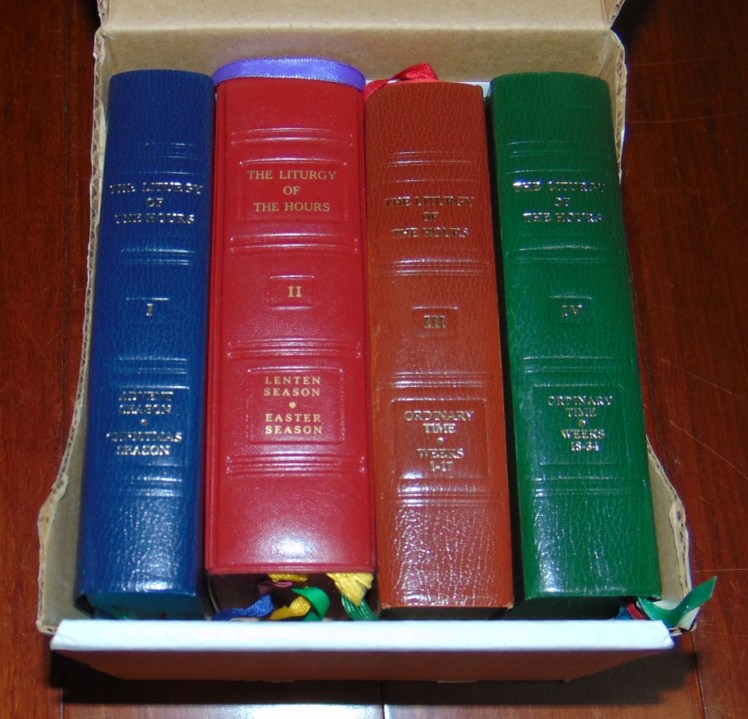
Divine Office
Liturgy of the Hours (Divine Office)

My prayer life in recent years began with a gifted period of contemplative prayer (as told here). Hands-down, my two favorite pray-ers are the contemplative mystics Teresa of Avila and John of the Cross (I still recall being at daily mass one day when Fr. Bryan Dolejsi mentioned Teresa of Avila being a Doctor of the Church. “What?” I wanted to know, “What is a Doctor of the Church and who is Teresa of Avila?” Those questions sent me off on a follow-up inquiry for which I am grateful). I experience joy within contemplative prayer and a movement toward becoming more of the person that God wants me to be.

An additional form of prayer recently entered my daily routine when I enrolled in theological studies. We were told to start daily participation in the morning and evening prayers of Liturgy of the Hours (see my previous post about this daily set of prayers that are prayed collectively by the Universal Church).

I am still finding my way into being consistently prayerful within the set daily structure of Liturgy of the Hours. In my previous post about Liturgy of the Hours, I mentioned being told that Liturgy of the Hours is meant to be a tool for prayer than a a straight jacket dictating how we are to pray (hmm…. I thrive prayerfully within a structured mass, why I am having to find my way within the structured Liturgy of the Hours?). I discussed this recently with a priest I see once a month – he told me to find one phrase in each day’s Liturgy of the Hours that I can grab onto and basically do Lectio Divina with that one phrase……

I recently took note that Liturgy of the Hours (also called “Divine Office”) starts with us asking God to come to our assistance – followed by the Glory Be and an Alelluiah.

Hmmm….. Within contemplative prayer, I experientially appreciate God’s loving presence and appreciate that God is acting to bring about positive change within me. Basically, adoration. A relational experience and receiving. I a starting to see a new opportunity within Liturgy of the Hours – learning a new way of appreciating God via the Glory Be and an Alelluiah. Contemplative adoration is a relationship, while the Glory Be and an Alelluiah are about praising God for God’s own sake. (Life’s not “all about us!!!”). Contemplative prayer and Liturgy of the Hours are complimentary – receiving in one, praising God for God’s own sake in the other. We hear at mass that God has no need of our praise, but that our praise is itself our gift to God.

There a good many ways to praise God. There are songs of praise, a thank you during the day, and – most importantly – thanking God by being of useful service to God’s children. Living a life of faith becomes living a life of gratitude. Alleluiah!

Kim Burkhardt blogs about faith at The Hermitage Within. Thank you for reading this faith blog and for sharing it with your friends. While you are here, please feel welcome to provide support to sustain this blog ($$).

Faith resources – tools, not straight jackets

Divine Office
Liturgy of the Hours (Divine Office)

The ways through which we travel our faith journey – church attendance, types of prayer, etc. – are meant to nurture our faith journey. If anything we participate in feels as though it is constricting our faith journey, either something is amiss or we are ready for additional or different faith activities. Being attentive to any sense of constriction is an opportunity to look to adapt either ourselves or our situation. It is entirely good when we notice that we need to adjust – such observations mean we are engaged in our faith journey (or, sometimes, that we need to become more engaged). Our faith journey has developmental stages just as we experience stages in other aspects of our human development – stages in cognitive development (academics), stages in psychological and social development, etc.

By way of example, I am starting a Master’s in Theology in January (a “Masters in Theology Studies” or “MTS” for lay people rather than a Master’s in Divinity for pastors-in-training). At a recent meeting for registered MTS students, we were provided with the first of our faith formation sessions. We were told that Masters in Theological Studies degrees typically cover four academic subjects – scripture, ethics, systemic theology, and historical theology. In addition to academics, MTS programs – ours, at least – include the faith development of enrolled students (faith formation) because the degree should include our faith maturation in addition to a focus on academics (a whole person approach). During that day, we were instructed to start participating daily in Liturgy of the Hours (Divine Office) – the daily prescribed prayer life of the Church.

In recent years, my prayer life has principally been one of contemplative prayer – both at home and in small prayer groups via Contemplative Outreach. There are as many ways to pray as there are people; contemplative prayer has been personally fruitful for me. In contemplative prayer, I encounter periods of time in which I experience God loving me – which has been freeing me from difficult aspects of “the human condition.” As with anything else, I do also experience occasional dry periods in my experience with contemplative prayer. Therefore, I am now open to also praying Liturgy of the Hours (Diving Office).

Prior to being recently instructed to start participating in Liturgy of the Hours, I viewed the Divine Office remotely (“from afar”) as the prerogative of priests and avowed religious – a respected activity distant from my daily life. When we were recently told to start participating in this daily activity for the MTS program, part of me was intrigued. Another part of me was also relieved when we were told that Liturgy of the Hours is “a tool to help us pray, not a straight jacket to keep us from praying.” I am enjoying the journey into the Divine Office.

Kim Burkhardt blogs about faith at The Hermitage Within. Thank you for reading this faith blog and for sharing it with your friends. While you are here, please feel welcome to provide support to sustain this blog ($$).