This Sunday: Fourth Sunday of Advent
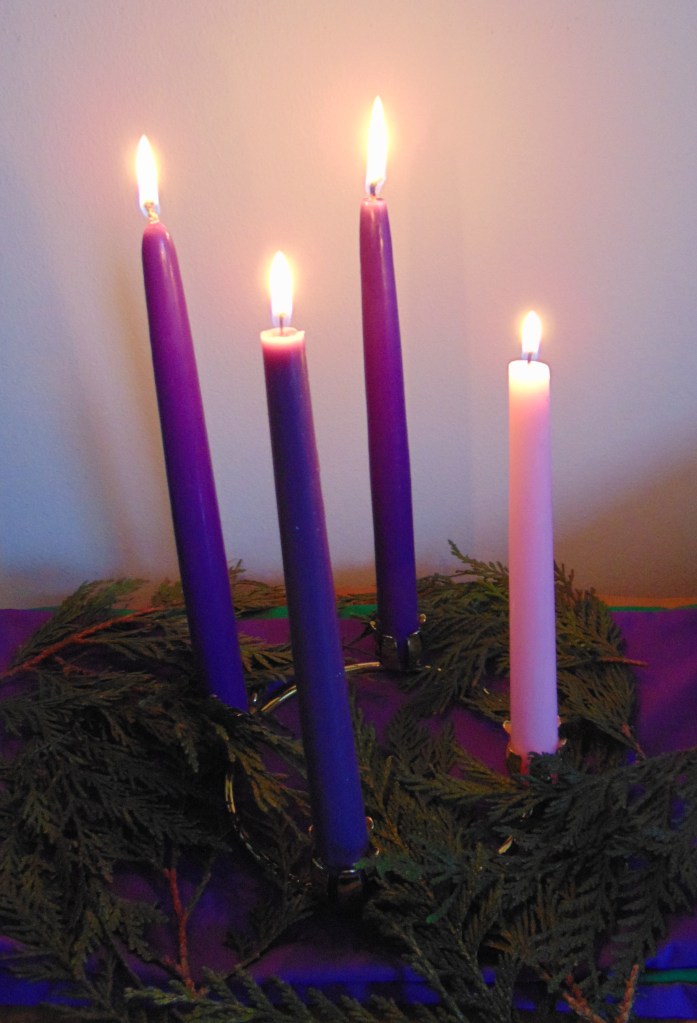
A home Advent wreath

This Sunday – Dec. 24th – is the Fourth Sunday of Advent.  It is also Christmas Eve (and, three days after today, the darkest day in the Northern Hemisphere – a time to bring light into the world).  This Sunday, we light all four candles on our Advent wreaths.

Advent is a time for us to reflect upon, engage in, and renew our faith.

Four topics associated with Advent (i.e., faith-renewing reflections) are hope, peace, joy, and love.  Last week, I reflected broadly on these four topics in a blog post that can be viewed here.  This week, I reflect on these same topics, but in such a way to challenge each of us to personally and meaningfully engage with these topics:

  • Hope: What can you do this week to bring hope into someone’s life?  When I volunteered in the prison system, I co-led a study about people who successfully “left-crime-behind” following incarceration. 100% of the formerly-incarcerated people we interviewed who “left crime behind” after incarceration reported having someone in their life who made a difference in their life, a person who helped them change their lives change for the better (made time for them).  What tangible form of support can you provide for someone you know who is experiencing a challenge in their life?  Spend time with them?  Help them navigate a challenging situation?
  • Peace: What can you do this week to contribute to peace in the world? Contribute $$ to a charity that provides civilian relief in war zones?  Start volunteering at a local charity that serves challenged individuals (like volunteering at a local jail)?  Be the person “who gets off the merry-go-round” in a situation of endless and/or senseless discord (i.e., workplace disagreements, family disputes, etc.) and “take the high road” to support another person in that situation?  As indicated in last week’s post, peace is the result of sacrificial love – Christ’s sacrificial love for us and our sacrificial love for other people.
  • Joy: Be the joy in someone’s life this holiday season.  Drop off a surprise holiday gift, do someone’s task for them at work, bring Christmas cookies to the office, go Christmas caroling……  We can all find something to do to bring some joy into someone’s life!
  • Love:  Who can you bring some “loving care?”  When Jesus was asked which of the commandments is greatest, he said “Love the Lord your God with all your heart, with all your soul, and with all your mind.’ This is the greatest and most important commandment. The second is like it: ‘Love your neighbor as you love yourself.’” (Matthew 22: 34-40).  It’s easy to love the people we like and with whom we enjoy spending time.  It matters just as much that we bring love to the people who might seem harder to love – a relative or friend who is in a time of need (we’re busy!), the irritable relative, the difficult co-worker we’d rather not work with, the homeless person who perennially displays challenging behavior outside the grocery store, the socially-isolated person we know who doesn’t seem to be able to connect with the people around them….  Loving someone involves a time commitment – time well spent!

Kim Burkhardt blogs at A Parish Catechist and The Books of the Ages (and a “Content Creator/Individual” member of the Association of Catholic Publishers). If you are a new visitor, it would be great to have you follow this blog (thank you!). If you know someone who would like this blog post, please share it with them (thank you!). You can also support this blog by clicking here when you are going to shop on Amazon (that lands A Parish Catechist a commission on Amazon sales).


The ultimate indicators of faith well lived

Being a person of faith has a two-fold objective. Sometimes, people only seek to cultivate the first half of this faith equation: developing a personal relationship with God (i.e., seeking one’s own salvation and freedom). While a personal relationship with God is absolutely part of the faith journey (i.e., there can be no faith without prayer)…..if our personal faith journey were all that we were to focus on, that would very much limit the scope of being a person of faith. Faith necessarily takes us to loving our neighbor. Sometimes, sociologists and mythologists observe that faith traditions provide us with a framework of how to live well in the world.

In Jesus’ day, he was asked, “Teacher, which is the great commandment in the law?”  Jesus replied, “‘You shall love the Lord your God with all your heart, with all your soul, and with all your mind.’  This is the first and great commandment.  And the second is like it: ‘You shall love your neighbor as yourself.’  On these two commandments hang all the Law and the Prophets.” (Matthew 22: 36-40)

When we grow in faith, our faith becomes visible to the degree that we begin living the seven virtues of Christianity: the four cardinal virtues of prudence, justice, temperance, fortitude and the three theological virtues of faith, hope, and charity. One of these outward signs of our faith is that we increasingly become loving, caring people (i.e., charity….”love your neighbor as yourself” is very much bound up with charity and justice). Loving our neighbor requires caring for the people around us – being upstanding citizens, taking care of our families, being nice to our friends and relatives (even when that’s difficult!), providing for our communities (soup kitchens, prisoner visitation programs, performing well at our jobs, etc.).

Living these concepts well is an ongoing learning aspect of our faith journey. How well do each of us “love God and love our neighbors?” It varies from person to person. While few of us will become like Mother Teresa, the degree to which we become loving should become increasingly visible over time. Fortunate are the individuals who are graced with a natural ability to be good and loving to everyone (or most everyone) they encounter. For all of us, we – and the people who know us – should be able to see incremental increases in our loving behavior over time. For those of us who have to work toward “love your neighbor,” we are fortunate that there are an abundance of lessons within Christianity that move us toward “love your neighbor.” An insightful aspect of how we experience pouring out love to the people around us was recently summed up by Fr. Tim Clark of Seattle: “The sacrificial nature of love saves us from ourselves.”

Kim Burkhardt blogs at A Parish Catechist and The Books of the Ages. If you are a new visitor, it would be great to have you follow this blog (thank you!). If you know someone who would like this blog post, please share it with them (thank you!).

Loving our neighbor as a measure of our faith

When Christ was asked which of the commandments is greatest, he indicated, “Love God and love your neighbor” ((Matthew 22:36-40).

Further, he said in 1 John 4:20: “Whoever claims to love God yet hates a brother or sister is a liar. For whoever does not love their brother and sister, whom they have seen, cannot love God, whom they have not seen.” (Yet, we also must contend with Matthew 10:37…”Whoever loves father or mother more than me is not worthy of me, and whoever loves son or daughter more than me is not worthy of me.” The lesson here seems to be that we have to put God first….then everything else falls into place.)

Every person alive is a beloved child of God. Each of us is made in God’s image. Thus, loving God inherently requires loving each of God’s children who is made in God’s image – a spiritual fact as well as a faith lesson meant to instruct us on living well with the people around us.

At daily mass this last Thursday (August 24, the feast day for St. Bartholomew the apostle), the priest reflected in his homily about loving one another and about us all being children of God. It all sounded great. I found myself wishing that I could take credit for having written the homily/reflection! Then (fast forward a couple of days), I was walking around a local lake this morning with a friend and a friend of hers. While conversing, I grumbled about various people – and/or groups of people – in less than charitable terms. Yikes. Part of “the human condition” is that most of us have “room for improvement” in how we live our lives.

When we disagree with someone – or dislike how they behave – how often do we look at them as a beloved child of God? How often, rather, do we look at them – and engage with them – with the sentiment expressed in the photo of my cat shown below? Given that there’s at least a flicker of God’s image in the people we dislike the most, how can we dare treat them negatively and say that we “love God?” Yikes (again!) – I can see ample opportunities for my own improvement in this regard (“double yikes” to the times when I’ve said, “At least God loves that easy-to-dislike person, somebody’s got to…”)…. This question of how we treat people applies both individually and collectively – societies also too often deteriorate into disruptive and divisive us-versus-them mentalities that don’t achieve anything positive.

This fact that every one of us is a beloved child of God can and should permeate how we interact with each person we encounter. There’s a bumper sticker that reads, “Love your neighbor means everybody.” Part of a determined discipline to continually live better is to be ever better toward others than we are naturally inclined to be.

Kim Burkhardt blogs at A Parish Catechist and The Books of the Ages. If you are a new visitor, it would be great to have you follow this blog (thank you!). If you know someone who would like this blog post, please share it with them so they can subscribe (thank you!).