Lent Challenge: 1700th Anniversary of Council of Nicea

This year, 2025, marks the 1700th anniversary of the Council of Nicea (the photo above shows architecture in Nicea that is still standing, was present in the days of the Council of Nicea). 

So, what’s the big deal about that?

The apostles were expecting Jesus’ second coming during their generation.  Also, Christ died at a time when the Jews were just starting to supplement their oral tradition with more written texts. Thus, it didn’t occur to the apostles and the early Christian communities to immediately, after Jesus’ death, write down the essentials of Christianity for future generations.  Why write down the essentials of Jesus’ faith when Jesus was coming back soon?

Thus, It took several decades for the gospels to start to be written.  The earliest church didn’t have the New Testament that we have today….

So, by the year 325, any number of things were being said to be Christian teachings that were theologically “all over the map.”  The Council of Nicea (the council happened in the then-community of Nicea, in what is now Turkey) was called by the Roman Emperor Constantine to definitively settle “What we believe.”   Bishops from both the Eastern and Western churches met over the summer to hammer out “What we believe” [between approximately 250 – 318 bishops attended. Bishops traveled to Nicea from across the Mediterranean, North Africa, Asia, Jerusalem, etc. without the benefits of automobiles or airplanes, though they did have ship travel).

Among the matters that came out of that Council was the Nicene Creed.

Today, 1,700 years later, we recite either the Nicene Creed or the Apostle’s Creed at every mass.   That’s our big deal about the 1700th anniversary of the Council of Nicea.

Have you taken time to reflect on our Creed?  If we were to read the Creed with strictly modern sensibilities, there’s enough to give just about anyone heartburn.  Jesus was born of a virgin?  Physically rose from the dead? 

I grew up believing in having a personal relationship with a monotheistic deity and I loved church ritual.  I struggled with what I would later call “biological implausibilities” (virgin birth, the Assumption, etc.).  It took me decades to work through these “implausibilities.”  Now that I am largely on the other side of working through these matters, I have a faith that is richer and deeper.   It turns out that developing a maturing faith requires that we really figure out how we personally relate to our Catholic faith.

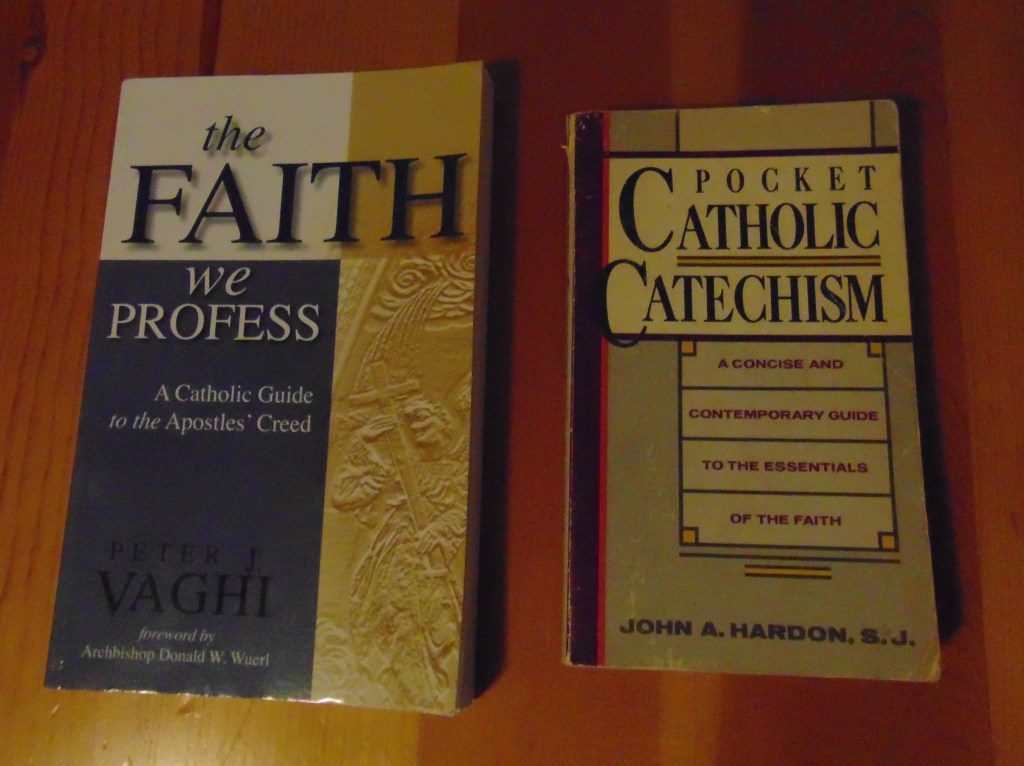
1700 years into the Creed, have you reflected on the Creed?  For Lent this year, maybe try writing a line-by-line explanation of what the Creed means (Lent starts on March 5th this year)   If you’d like resources to assist with this Lenten project, a book that I read in college might prove helpful – a book by Fr. John A. Hardon called ”Pocket Catholic Catechism.”

Kim Burkhardt blogs at A Parish Catechist (and is a member of the Association of Catholic Publishers). Blogging is sustainable via blog readership (i.e. readers/subscribers). If you are a new visitor, it would be great to have you subscribe to follow this blog (thank you!). If you know someone who would like this blog, please share it with them and invite them to subscribe (thank you!).

What Christians Believe

A woman I know started telling her co-workers that she attends church. She hadn’t told her co-workers about this in the two years she’d been working at her job. Her co-workers were surprised that a surprisingly normal and intelligent person such as her attends church. “So,” her co-workers would ask her, “Are you one of those Christians who believes that the Earth is only 3,000 – 6,000 years old?” and other such questions. “No,” she would reply, “Of course not.” She would point out in these conversations that The Big Bang Theory was formulated by a Catholic priest…..

So, what DO Christians believe? While some aspects of this question varies from one denomination to another, Christian leadership did come together in the year 325 in Nicea (a then-Greek city in what is now Iznek, Turkey) to specify precisely what Christian do believe. (I learned recently that ruins of some of the local Nicean architecture that existed at the time of the council in 325 still exists – I’d love to visit and see the remains of the architecture).

Christianity grew out of a historically oral tradition and Jesus’s followers thought in the decades following his death and resurrection that he was going to return in their lifetimes; thus, no one started writing what is now The New Testament for several decades. While it would be tempting to think now – 2,000 years later – that Christian belief in its’ current state has been statically known and accepted since the time Christ was alive, there was a lack of established Orthodoxy in the early days of Christianity. Thus, the need in the year 325 to communicate clearly what the Christian Church believes.

Join A Parish Catechist on Saturday, January 4th (8:00 am Pacific) or January 7th (7:00 pm Pacific) for a Zoom educational session about the specifics of “What Christians Believe” via the Nicene Creed. Sign up (register) here: https://www.signupgenius.com/go/10C084CA4A629A3F4C43-54130811-faith#/

Event flyer

Kim Burkhardt blogs at A Parish Catechist (and is a member of the Association of Catholic Publishers). Blogging is sustainable via blog readership (i.e. readers/subscribers). If you are a new visitor, it would be great to have you subscribe to follow this blog (thank you!). If you know someone who would like this blog, please share it with them and invite them to subscribe (thank you!).

We need one another in our faith journeys

None of us “has it all figured out.” In the words of Cardinal Timothy Radcliffe, “We are all radically incomplete. And, we need each other.”

For those of us who attend church, we do experience growth in faith by attending church services. However, church services – in and of themselves – are an “entry way” or vestibule that “get us in the door” toward growing in faith. At some point, we need more to grow in faith. “We need each other.” Faith sharing groups, reading books, one-on-one support from faith mentors, retreats, community service projects with one’s faith community – there are a myriad of ways to connect with people who nurture our faith.

As we approach a new calendar year, you are invited to join our Zoom faith-sharing sessions in January to help grow in your adult-level faith journey. There will be three topic-sessions: The Nicene Creed, Christian Liturgy, and Approaches to Prayer. Saturday morning and Tuesday evening sessions (Pacific Time) are both offered (the Tuesday evening sessions are a repeat of the Saturday morning sessions). You are welcome to attend!

Check out the flyer below and sign up (register) here: https://www.signupgenius.com/go/10C084CA4A629A3F4C43-54130811-faith#/

Register: https://www.signupgenius.com/go/10C084CA4A629A3F4C43-54130811-faith#/

~

Kim Burkhardt blogs at A Parish Catechist (and is a member of the Association of Catholic Publishers). Blogging is sustainable via blog readership (i.e. readers/subscribers). If you are a new visitor, it would be great to have you subscribe to follow this blog (thank you!). If you know someone who would like this blog, please share it with them and invite them to subscribe (thank you!).
“What We Believe”: believing the Nicene Creed

John the Baptist

Many Christians grow up reciting the Nicene Creed, Christianity’s central statement of belief.

A passing thought about the history might assume that Christian theology was fully and immediately self-evident as a result of Jesus’ time on earth. Yet, Christianity didn’t have the New Testament and a fully articulated theology in writing within weeks, months, or even decades following Christ’s death and resurrection.

By the early 300’s, the early church recognized that there was not full consensus of Christian belief. Therefore, church bishops met in 325 in the city of Nicea – in modern-day Turkey – to clearly articulate “what we believe” as Christians.  Thus, we now have the regularly-cited Nicene Creed (“The Council of Nicea”).

We also have the similarly worded Apostle’s Creed.

While many of us often recite the Creed at church, how many of us believe the Creed in its’ entirety?  The Creed IS “What we believe…..”

Growing up, I sat in pews believing in “God the Father” and “The Holy Spirit.”  I believed in having a personal relationship with God.   I believed in a historical Jesus Christ, but felt rather ambivalent about we humans needing a “God the Son.”  As a child who felt very orthodox in many ways, I flat-out questioned what I now call “biological implausibilities” – a virgin birth, Christ’s resurrection, Mary’s assumption into heaven.  For real?  These “biological implausibilities” simply didn’t square, in my mind, with our modern understanding of human biology….

In my mid-twenties, I determined that I needed to resolve these matters if I was going to remain in pews.  End result:  I wasn’t in the pews for twenty years.

A powerful re-conversion experience (told here) brought me back.  I knew then that God loves me; I still hadn’t made peace with the Nicene Creed.   I brought this challenge to a couple of pastors.  They both said, in essence, “We want you in a pew.  Come back, spend some time mulling over the things you’re struggling with.  Look for ways to make peace with these things.”  To a large degree, I’ve made peace…..  Further, my faith has matured.  I know that God loves me, God wants me to love other people, and trying to square with the Nicene Creed has brought me faith lessons that I couldn’t have anticipated.

What about you?

It’s easy to recite a creed when we’re in a pew on Sunday morning and everyone is reciting the Creed.  On a personal level, do you believe everything that we recite in the Creed?  Really? 

There’s plenty in the Nicene Creed to unsettle modern-day sensibilities.  I’ve met people who accept it all because “this is what our faith believes.”   Other people are like me: we wrestle with a topic before we “make it our own.”

Read through the Nicene Creed, shown below.  Reflect on what parts you believe, what parts challenge you.  Then, feel free to join A Parish Catechist Zoom call on Tuesday evening at 7:00 pm Pacific to discuss the Creed (Zoom sign in passcode: 898 322 8983).

The Nicene Creed

I believe in one God,
the Father almighty,
maker of heaven and earth,
of all things visible and invisible.

I believe in one Lord Jesus Christ,
the Only Begotten Son of God,
born of the Father before all ages.
God from God, Light from Light,
true God from true God,
begotten, not made, consubstantial with the Father;
through him all things were made.
For us men and for our salvation
he came down from heaven,
and by the Holy Spirit was incarnate of the Virgin Mary,
and became man.
For our sake he was crucified under Pontius Pilate,
he suffered death and was buried,
and rose again on the third day
in accordance with the Scriptures.
He ascended into heaven
and is seated at the right hand of the Father.
He will come again in glory
to judge the living and the dead
and his kingdom will have no end.

I believe in the Holy Spirit, the Lord, the giver of life,
who proceeds from the Father and the Son,
who with the Father and the Son is adored and glorified,
who has spoken through the prophets.

I believe in one, holy, catholic and apostolic Church.
I confess one Baptism for the forgiveness of sins
and I look forward to the resurrection of the dead
and the life of the world to come. Amen.

Join A Parish Catechist’s Zoom call on Tuesday evening at 7:00 pm Pacific to discuss the Nicene Creed. Zoom sign in passcode: 898 322 8983 .

Kim Burkhardt blogs at A Parish Catechist and The Books of the Ages (and a member of the Association of Catholic Publishers). If you are a new visitor, it would be great to have you follow this blog (thank you!). If you know someone who would like this blog, please share it with them (thank you!). Also, your support ($$) to help sustain this blog is welcome.

Book Reviews: Books about “The Creed”

When I was in college, I found myself unable to describe what beliefs made my denomination distinct when talking to people who belonged to other denominations. “I just know my denomination, I don’t know how to explain it” (I have since heard other people say the same thing, usually said with dismay similar to what I felt). I was surprised by my inability to articulate the beliefs of my denomination. So, I bought and read Fr. John A. Hardon’s Pocket Catholic Catechism to be better able to articulate denominational beliefs (I still have that book).

More recently, I came upon – and started reading – Fr. Peter J. Vaghi’s The Faith We Profess: A Catholic Guide to the Apostles’ Creed.

Both of these books – and any number of books like them – provide a line-by-line explanations of the Apostles Creed and/or the Nicene Creed. These types of books are worth reading for church-attendees and non-church goers alike – these books inform us about the basic beliefs that many Christian denominations profess (the two books I mention here are written from a denomination-specific stance). While my reading of The Pocket Catholic Catechism in college may have broadly more Christian than the denomination-specific book I sought, there was certainly Catholicism within it…..

It’s worth providing a historical context about the Nicene Creed and the Apostle’s Creed. Christianity grew out of a Jewish context, Jesus’s presence and his teachings. Following Jesus’ time on earth, the faith tradition that became Christianity was initially a Jewish sect that began attracting non-Jewish converts – then becoming a distinct religion named after Jesus Christ (i.e., “Christ-ianity”). As Christianity became a distinct – and non-Jewish – religion, it took time for Christianity to fully develop the contours that we now recognize. In the early 300’s, church leaders recognized that any number of groups and individuals were communicating their own ideas and beliefs about what defines Christianity; not all those ideas were compatible with one another, nor were all ideas what we now call orthodox (“mainstream” if you like) – some ideas were viewed as heretical. Therefore, church leaders met in Nicea (in modern-day Turkey) in the year 325 (i.e., the first “Council of Nicea”) and established the Nicene Creed – laying out the core beliefs of Christianity. The Apostle’s Creed – which is of very similar content – is likewise accepted as Christianity’s “Creed” of beliefs. Many Christian denominations accept and profess one or both of these Creeds. These Creeds are often professed by congregations at church services.

These worthwhile books provide thoughtful discussion of exactly what the Apostle’s Creed and the Nicene Creed mean. Simply reciting one of these Creeds at church can be a rote activity; really understanding the Creeds requires thoughtful study. It can be worth taking a fresh look periodically at The Creeds – and these types of books – to see how our perspective and reflections on The Creed changes as we move through life.

Kim Burkhardt blogs at A Parish Catechist and The Books of the Ages (and a “Content Creator/Individual” member of the Association of Catholic Publishers). If you are a new visitor, it would be great to have you follow this blog (thank you!). If you know someone who would like this blog post, please share it with them (thank you!).