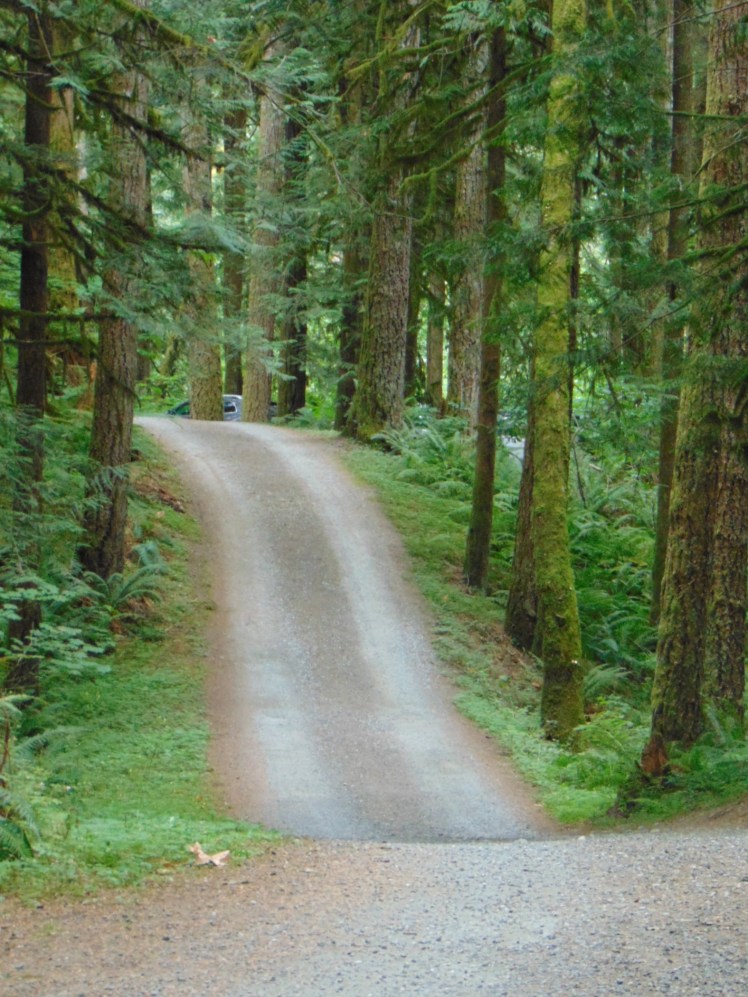
I was born in Colorado (a high-altitude, mountainous geography with some areas dry, flat, and/or farmland areas); I have spent most of my life in North America’s Pacific Northwest. When I periodically drive to Colorado to visit relatives, I am struck by the contrast of the lush geography of where I live and the simple beauty of the semi-arid geography found in parts of Wyoming located between Washington State/B.C./Oregon and Colorado. Wyoming’s dry stretches with layered, red cliffs and “red rocks” particularly attract my imagination.
We sometimes use our physical surroundings as an analogy for reflecting upon our spiritual, emotional, and intellectual lives. I am deeply rooted, for example, in the rainforest-esque rich landscape of where I live and I appreciate the opportunity to take photos such as the one above. I find it appealing to compare such geography to luscious experience of spiritual realms. Yet, arid geographies also have their beauty.
Deserts can be analogous to dry periods in one’s spiritual life. We all experience spiritual deserts at one time or another (sometimes, for long, perplexing, and/or difficult periods!). Finding out way out of such periods can be challenging (listening for the quiet voice of the spirit inviting us out of such deserts can be helpful!). With that said, the beauty – and simplicity – of semi-arid geography can also be an opportunity to focus on our spiritual life without distraction. Rather than being a barren or desolate experience, such times can be fruitful opportunities to clear away the clutter in our faith journeys. Times to focus on simplicity and directness with clarity of vision. What really matters in our lives? What do I need to clear out of my life? When feeling emotionally depleted or spiritually bankrupt, going to dry, arid geography can sometimes help to to cultivate a focused relationship with the divine. Such simplicity draws some people to contemplative prayer and/or to a life in which we focus more on the inner experience of faith and on being of service to other people – the aspects of faith that matter – rather than opting for the avoiding-what-matters (or, avoiding-what-I-don’t-want-to-deal-with) distractions available in more abundant geographies and in cities.
For anyone interested in exploring contemplative prayer, please feel welcome to check out Contemplative Outreach or the writings of mystics (such as Teresa of Avila, John of the Cross, or Julian of Norwich). For anyone interested in spirituality in dry geographic locations, I came upon an appealing blog: 11 Sacred Places in New Mexico.
Kim Burkhardt blogs at A Parish Catechist (and is a member of the Association of Catholic Publishers). Blogging is sustainable via blog readership (i.e. readers/subscribers). If you are a new visitor, it would be great to have you subscribe to follow this blog (thank you!). If you know someone who would like this blog, please share it with them and invite them to subscribe (thank you!).