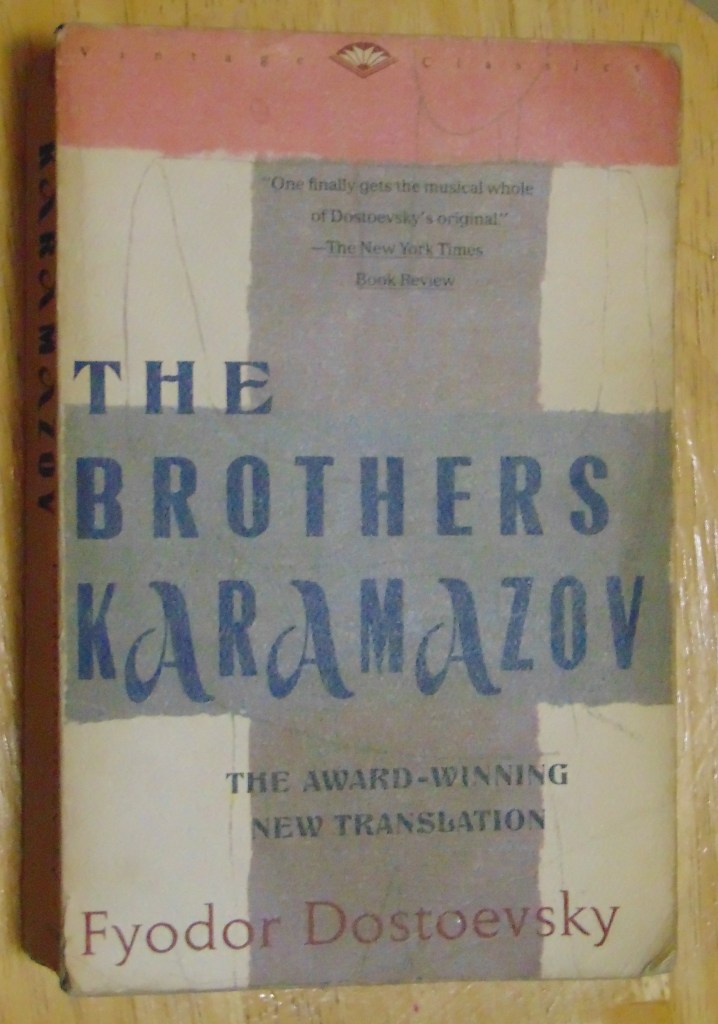
I took a literature class in college in which we read Dostoevsky’s The Brothers Karamazov.
I attended a state university and we read The Brothers Karamazov as secular literature. While we read the book as secular literature, I do remember our instructor posing a question about a particular point for one of the books’ characters. I found myself responding as seeing the character as analagous to a friend of mine who was serving as a spiritual guide for me at the time. My instructor and classmates found this odd and laughed as such. It was an awkward moment.
Since then, I have periodically heard reference to “The Brothers K” as being a book – in part – about faith. Goodreads (an online book portal) says of the book, “Through the gripping events of their story, Dostoevsky portrays the whole of Russian life, is social and spiritual striving, in what was both the golden age and a tragic turning point in Russian culture.”
Because I have repeatedly heard of the book as having spirituality dimensions, I am planning to read “The Brothers K” again, after I finish reading another book (a long book that I’m reading rather slowly). This time, I will read “The Brothers K” through the lens of spirituality. I invite each of you to join me in reading the book to consider its’ faith dimensions; we can then discuss the faith ideas in book.
Put May 1 on your calendar as the date to start reading The Brothers Karamazov through the lens of faith. I will post dates to begin discussing the book.
Leather-bound books can bring to mind monks hand-copying books in medieval monasteries (surviving copies of such books sometimes have page border notations such as “it is very cold”). Alternately, we may think of learned scholars in the earliest days of books who wandered from place to place via dirt roads with a leather-bound manuscript in their possession.
We sometimes connect such imagery with thoughts of more spiritual times. ”If I lived in a medieval monastery, I would have been more faith-focused than I am today in a technologically-advanced city in the twenty-first century.” Different times and places each have their own zeitgeist, certainly. And, of course, there are places specifically dedicated to faith pursuits.
We can all be people of faith.Teresa of Avila, a sixteenth-century mystic in Spain, took on reforming the Carmelite religious order (she was a Carmelite nun) to return it to a more religiously-focused character than it had been for a period of time. Just as specifically religious environments can undergo re-invigoration, we can work to make our own lives spiritually vigorous even if we live in a secular environment. A commitment to growing in faith, participating in a faith tradition, daily prayer, making time regularly for activities such as reading faith-focused books and participating in faith-sharing groups, sharing about our faith development efforts (with a friend, a prayer group, a spiritual director, a pastor, etc.), living one’s faith by being of service to others – we can be faith-filled through a combination of all these things.
Daily prayer is a critical component of a faith-filled life. There’s a saying: “There can be no faith without prayer” (source uncertain). Within a theistic vision of faith, a life of faith must involve a relationship with the divine. Our relationships with the people in our lives are defined by relationship: social interactions. This also applies in our faith life – there can be no faith without a relationship with God. Our relationship with God unfolds in two ways – through focused interaction with God (prayer!) and by being of service to God’s children (every human being is a child of God). In the Acts of the Apostles (Acts 1:14), we read that the apostles – following Jesus’ ascension – “all joined together constantly in prayer, along with the women and Mary the mother of Jesus, and with his brothers.”
Not sure how to pray? Not sure how to deepen one’s prayer life? The first thing to know is to pray daily. Relationships aren’t built sporadically – they develop and grow through sustained interaction. Further, relationships are two-way. I like the analogy of comparing prayer to a phone call. We don’t sustain relationships with the people in our lives by phoning someone and saying, “I’m calling to tell you X” – then hanging up. Rather, a phone call is a give-and-take, two-way interaction. Prayer is the same way. We don’t just send our communication to God in a one-way phone call. We both communicate to God in prayer and also rest in stillness to allow God to present to us.
There are many ways to pray:
Talking to God as we would talk to a friend (either verbally or through what’s often called “mental prayer”)
Lectio Divina (a method of praying the scriptures reflectfully)
Attending church services (church is itself a form of prayer)
Religious singing (“Those who sing pray twice”)
Contemplative prayer (for example, learn about this form of prayer through an organization called Contemplative Outreach)
Interested in reading more about prayer? A couple of great books include:
For many of us, we first conceptualize prayer as mentally talking to God. Mentally speaking in sentences, much like we would talk to a person. Telling God what we want to say, submitting prayer requests (intercessions, our “wish list”), hoping for “an answer.”
Such prayer is certainly one way to initiate a prayer life.
There are many more ways to pray. Prayer is meant to be communication, a relationship. An analogy I heard – and like – compares prayer to a phone call. We wouldn’t just call a person we know, tell them what we want to say, then hang up as if communication were complete. Such phone calls wouldn’t help us sustain relationships with the people in our lives. That approach to prayer wouldn’t produce a full prayer life, either. Communication is relational. Prayer is relational.
God hungers to have a relationship with us – more than “one way phone calls” from us.
God hungers to be present in our lives, to transform our lives. God hungers to share love with us in a relational way in which we feel and experience God’s love for us. In order for this to happen, we need to participate in a two-way relationship with God. Prayer can be a truly interactive, relational activity in which we allow God to transform our lives. More than just a one-way phone call.
There are a myriad of ways pray. Several ways to pray include:
Attending church is prayer
Rote prayer, prayers of the liturgy: Lord’s Prayer, etc.
Psalms (they are always sung!)
Lectio Divina (reading faith books reflectively to take in the book’s meaning prayerfully)
Talking to God the way we would talk to a person
Contemplative Prayer (resting in God’s presence – sitting with God)
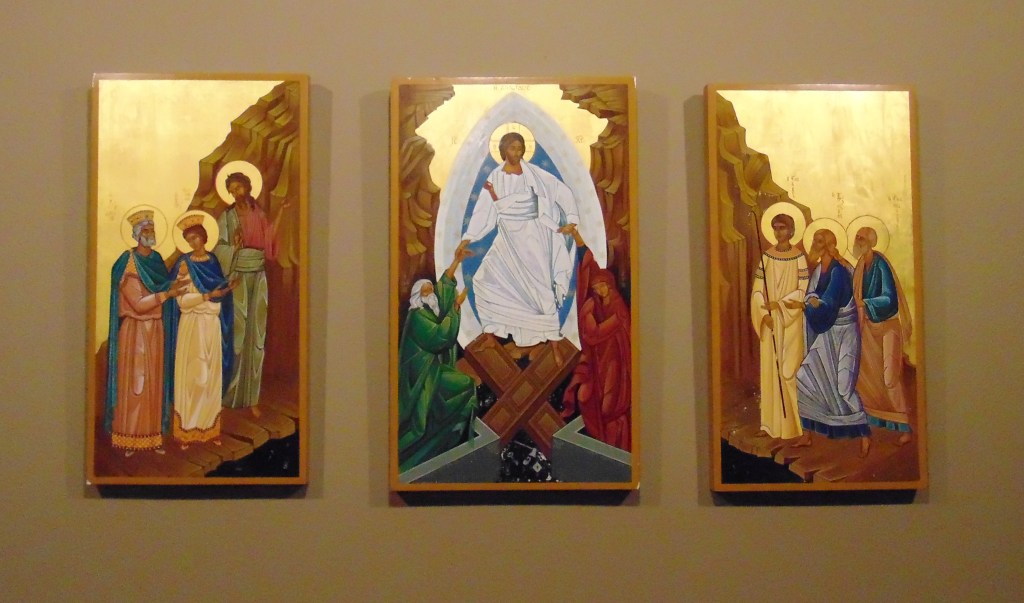
Personally, contemplative prayer is the type of prayer I find most meaningful – relationship-building. I have largely given up any “human language” in prayer (except for when I specifically do intercessory prayer); rather, my prayer life mostly consists of “resting in God’s presence.” I’m fortunate – I responded in 2016 to a “nudging of the Holy Spirit” in which I was gifted with a sustained period of feeling God’s presence in prayer. It was a life-transforming period of time; I found my way to Contemplative Outreach Northwest and now I talk to people about the power of God our lives. At present, my morning prayer consists of reflecting on the Anastasis icon above – an iconographic representation of the Harrowing of Hell; the Harrowing of Hell was Christ’s descent into Hell (between his death and resurrection) to free Adam and Eve from the result of The Fall. This particular version of Anastastis iconography is located in the chapel at St. Andrew’s Episcopal parish in Seattle, Washington. I find Anastasis to be a powerful depiction of God’s desire to free us, to transform us. God wants us to experience God’s love for us.
If prayer is unfamiliar to you or “less than what you’d like it to be,” consider taking on “prayer homework.” Pray twice per day for five minutes each time. Try out the various types of prayer listed above to find a style of prayer that you find to be of value. If you’d like to learn more about several types of prayer, my favorite book describing multiple types of prayer can be foundhere.