More on the trajectories of our faith journeys…..

I wrote in my last post that I am interested in people “exploring and sharing the trajectories of our (faith) lives” with one another….I am interested in Augustine’s “interiority.”….. I’ve been trying to figure out for several years how to get church people today to talk to each other in more depth about how we each experience our faith…..”
It can take a long time, it seems, to uncover how to speak to one another about what we experience inwardly……
…..More of how to speak of my inner journey seems to be coming to light. So, here goes an effort to articulate some of my own experience…..
At a point in life when I was particularly discouraged – swallowed up in a dark emotional abyss – social circumstances led me to attend a Friday evening mass. I avowed that I was there as a one-off, with no intention of returning to the faith tradition of my childhood. Much to my surprise, the priest’s faith “filled an empty hole I had been walking around with” during the homily. On my way home, I fell off a curb and broke my ankle – rendering me stuck on the couch at home with no way to distract myself from considering the impact of that homily. By Monday, I decided that perhaps I needed to talk to the priest about returning to church. By the end of the month, I was a parishioner at a nearby parish and “no one could get rid of me with dynamite” (that story is told here).
In the period that followed, I had an extended period of feeling God loving me. Directly.
An inner transformation unfolded. Over time, I told several people that an inner reorganization was taking place, but I had no words to describe it. I wanted to discuss the particulars of it, but had no way to talk about it…… As an aside, the priest at the parish I joined seemed rather puzzled to see me at mass at least twice on many weekends. I needed what was happening at mass – being at mass contributed to this inward transformation.
The following summer, I heard mention at daily mass of Teresa of Avila – a “Doctor of the Church.” What? What is a “Doctor of the Church?” I must find out about this Teresa of Avila…….
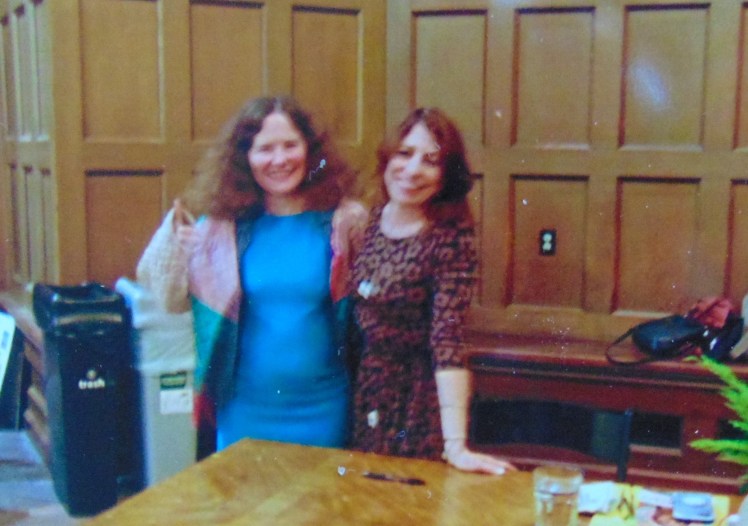
In the weeks that followed, I read Teresa of Avila’s autobiography. It provided me with much nourishment. I continued to read and re-read parts of it for a time. And, fortunately, I was able to meet the translator who had written the English copy I had read (Mirabai Starr came to Seattle on a book tour for one of her other books. I attended her presentation at St. Mark’s Episcopal Cathedral and she graciously signed my copy of her translation).
Later – perhaps another three or four years later – I was discussing Teresa of Avila with another nearby priest. This Trappist studied in Rome….. He said, “Oh, yes, I took a class once about Teresa of Avila.” I replied – simply – “Oh. I just understood her.” He looked at me and stammered. “You,” he said, “were given a GRACE.”
Yes, I had been given a grace that allowed me to “simply understand” Teresa of Avila. What was crucial to the story, however, was that the depth of the discouragement I had experienced (above) was such that God recognized my need for grace. Conditions dictate circumstances……
God loves us enough to offer us grace. Sometimes, that grace shows up when we particularly need it.
…..We have to be inwardly attentive enough to recognize this grace when it is offered. And, we have free will. It’s up to us whether or not we are going to accept this grace when it is offered…… Sometimes, I suppose, God may be very specific in these offers of grace to be sure we notice – I reference my “broken ankle story” as an example (I also acknowledge that I sometimes simply trip in the course of walking around….. I was born with faulty joints in my feet that render me physically clumsy. Make of that what you will…..).
…..”For God so loved the world that God gave his only son” for us (John 3:16). Absolute love for us – sacrificial love – is the only possible way that Jesus’ death on a cross and his resurrection makes any sense. The cross-and-resurrection story makes no sense at all when considered from a biology perspective. Self-sacrificing love, though – redeeming and loving beyond measure…… Such love is redemptive on a level that heals us……
So how does one go about describing an inner transformation of the sort I am writing about here? ……. I am currently reading Frederick Bauerschmidt’s Catholic Theology: An Introduction for one of my master’s in theology classes. In it, Bauerschmidt describes the differing Catholic and Protestant views on Justification by faith (i.e., do we experience justification by faith alone or by a combination of faith and our willingness to thus love people around us to therefore take care of the people around us), Bauerschmidt goes in depth about various theological ideas over the centuries about grace. There’s not simply the happening of “God’s grace and that’s that.” No. Rather, there are levels, types, degrees, and consequences of grace. For example (I’m gleaning this from Bauerschmidt’s book):
- There’s prevenience grace – God providing us with grace because we need it (we need it because of original sin. If you wonder if original sin actually happened or actually exists, just turn on the evening news. No other explanation – psychological or otherwise – fully explains the scope of human brokenness).
- There is “cooperative grace” in which we cooperate with God by allowing God to transform us when grace is offered. Oh, okay. Following the homily and broken ankle I mentioned earlier, it looks as though I participated in “cooperative grace” (it was the only good path forward at the time….).
- At the Council of Trent (1545 – 1563), Catholics reasserted the traditional teaching that we are justified in Christ by a faith that is shaped by love of God (fides caritate fomata), a love that manifests itself in good works. The council’s Decree on Justification summarizes this process as ‘a transition (translatio) from the state in which a person is born a child of the first Adam to the state of grace and of adoption as children of God through the agency of the second Adam, Jesus Christ our savior’ (c. 4 in D 124). This transition ‘consists not only in the forgiveness of sins but also in the sanctification and renewal of the inward being by a willing acceptance of the grace and gifts whereby from being unjust becomes just…. (ch. 7…..)……”
So, when we are sufficiently inwardly attentive to God’s grace and we allow that grace to unfold, God changes us. God makes of us a new creation.
That inner transformation of becoming a new creation is experienced as truly miraculous.
At the same time, while I found the period of time I experienced to be truly transformative I also found it to be painfully slow. God, I found, offers us grace and still allows us to experience our daily foibles and the day-to-day consequences of our choices amidst “the human condition.” The parish priest I had during that time heard in the confessional the “too slow and human foibles” aspects of what goes on during periods of transformative change (I feel for him for what he found himself hearing in the confessional).
What I do know for sure:
- We can experience God’s love for us.
- What we hear in church about being made a new creation is for real.
- God’s grace does happen.
- The implementation of God’s grace in our lives is dependent upon our observation of this grace and our cooperative grace (i.e., God doesn’t act in our lives without our cooperation).
- My day-to-day life today still has the very human hallmarks of the human condition (“saints we ain’t”). But, this “new creation” experience is yet transformative…. My prayer life is on a very different foundation than it was before “the homily and the broken ankle.”
- God expects us to learn to love other people and to learn how to put that into practice. That’s what we’re here to do……
I hope to continue toward finding ways to facilitate conversations about our interior faith journeys……
Kim Burkhardt blogs about faith at The Hermitage Within. Thank you for reading this faith blog and for sharing it with your friends. While you are here, please feel welcome to provide support to sustain this blog ($$).