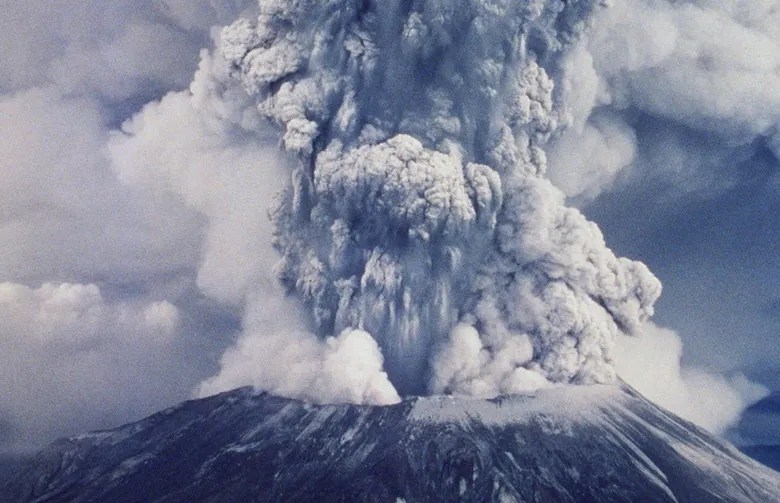
For those of us who lived close enough to Mt. St. Helens to hear its’ powerful explosion on Sunday, May 18, 1980, today’s anniversary evokes memories (it wasn’t heard within the closest proximity).
While news of the event joined the explosion’s ash in the travelling the world, those of us who lived in some measure of close proximity were living in in real trepidation. I lived in the county of another nearby volcano (Mt. Baker); we were hearing from seismologists about what would happen to us if Mt. Baker – which was “overdue to blow” – followed in Mt. St. Helen’s footsteps (Mt. St. Helens and Mt. Baker are in the same chain of active volcanoes).
When Mt. St. Helen’s blew at 8:32 am on Sunday, May 18, 1980, our family was heading into church for Sunday morning services. My mother responded to the sound by saying, “That sounded like a canon being shot on Sehome Hill” (Bellingham, Washington). I replied, “I bet it was Mt. St. Helens” (the world had been waiting for the mountain to blow). We found out later that morning that I was correct. In the days and weeks that followed, there was local and international news coverage of the momentous event. I still remember hearing about the hermit who refused to evacuate from Mt. St. Helens and therefore died in the explosion.
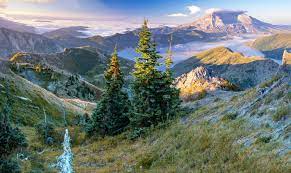
In the years since 1980, the volcano has been an active field of exploration for scientists. In the days and months after the explosion, immediate study of the volcano was international news. In the years since, scientists have been amazed at how quickly life – vegetation, the return of animal life – has literally bloomed on the comparatively calm mountain.
What about us? In 1980, the date of Pentecost came a week after Mt. St. Helen’s “blew.” I don’t recall our pastor’s homily (sermon) that week; I now reflect in the possibility that the homily spoke in analogy about death and rebirth; the death and devastation caused when Mt. St. Helen’s blew, the measurable trepidation we had been experiencing in Washington State about the explosion, Christ’s death and our opportunity for new life; Pentecost and the birth of Christianity.
As a contemplative, I ponder what happens below the surface. Volcanoes explode outwardly as a result of the geological forces at work inside and underneath the mountain’s surface. Likewise, the outward fruits of our faith – visible faith, our degree of “peace that passeth all understanding,” how well we love our neighbor – are a product of our internal workings, our internal relationship with our God. The mystic John of the Cross spoke of the Dark Night of the Soul; a time of quiet when change sometimes happens imperceptibly even to ourselves rather than necessarily a reference to darkness meaning difficulty within our soul. Certainly, our transitions during a dark night of the soul can move us out of times of personal darkness, but our transition toward God from our own fallen state doesn’t always have to be akin to a volcanic explosion.
For all of us, though, there is a question. How willing are we to engage with the machinations of our internal emotional state that “lie beneath the surface” to let God transform us into a new creation? Some people prefer outward distractions….. I have personally mucked around beneath the surface and was given a grace that led to letting God change me; that change continues and I’m becoming happier for it.
Today on the anniversary of the Mt. St. Helen’s explosion, we have decades of knowledge that new life has blossomed on the mountain.
Kim Burkhardt blogs at A Parish Catechist.