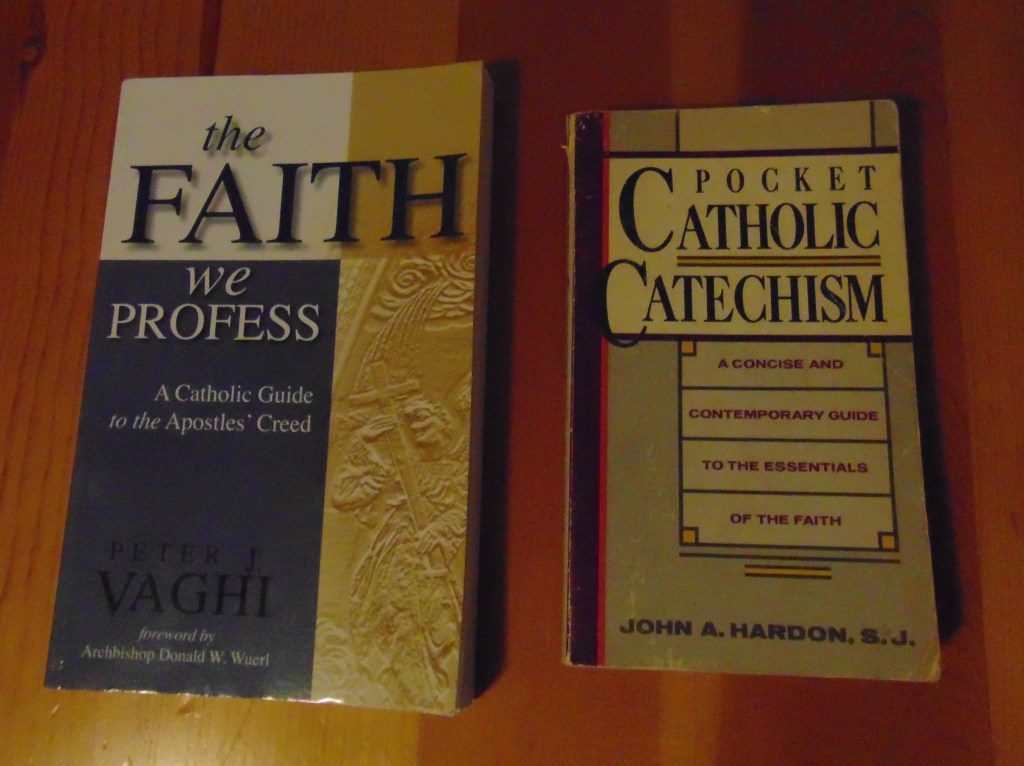
When I was in college, I found myself unable to describe what beliefs made my denomination distinct when talking to people who belonged to other denominations. “I just know my denomination, I don’t know how to explain it” (I have since heard other people say the same thing, usually said with dismay similar to what I felt). I was surprised by my inability to articulate the beliefs of my denomination. So, I bought and read Fr. John A. Hardon’s Pocket Catholic Catechism to be better able to articulate denominational beliefs (I still have that book).
More recently, I came upon – and started reading – Fr. Peter J. Vaghi’s The Faith We Profess: A Catholic Guide to the Apostles’ Creed.
Both of these books – and any number of books like them – provide a line-by-line explanations of the Apostles Creed and/or the Nicene Creed. These types of books are worth reading for church-attendees and non-church goers alike – these books inform us about the basic beliefs that many Christian denominations profess (the two books I mention here are written from a denomination-specific stance). While my reading of The Pocket Catholic Catechism in college may have broadly more Christian than the denomination-specific book I sought, there was certainly Catholicism within it…..
It’s worth providing a historical context about the Nicene Creed and the Apostle’s Creed. Christianity grew out of a Jewish context, Jesus’s presence and his teachings. Following Jesus’ time on earth, the faith tradition that became Christianity was initially a Jewish sect that began attracting non-Jewish converts – then becoming a distinct religion named after Jesus Christ (i.e., “Christ-ianity”). As Christianity became a distinct – and non-Jewish – religion, it took time for Christianity to fully develop the contours that we now recognize. In the early 300’s, church leaders recognized that any number of groups and individuals were communicating their own ideas and beliefs about what defines Christianity; not all those ideas were compatible with one another, nor were all ideas what we now call orthodox (“mainstream” if you like) – some ideas were viewed as heretical. Therefore, church leaders met in Nicea (in modern-day Turkey) in the year 325 (i.e., the first “Council of Nicea”) and established the Nicene Creed – laying out the core beliefs of Christianity. The Apostle’s Creed – which is of very similar content – is likewise accepted as Christianity’s “Creed” of beliefs. Many Christian denominations accept and profess one or both of these Creeds. These Creeds are often professed by congregations at church services.
These worthwhile books provide thoughtful discussion of exactly what the Apostle’s Creed and the Nicene Creed mean. Simply reciting one of these Creeds at church can be a rote activity; really understanding the Creeds requires thoughtful study. It can be worth taking a fresh look periodically at The Creeds – and these types of books – to see how our perspective and reflections on The Creed changes as we move through life.
Kim Burkhardt blogs at A Parish Catechist and The Books of the Ages (and a “Content Creator/Individual” member of the Association of Catholic Publishers). If you are a new visitor, it would be great to have you follow this blog (thank you!). If you know someone who would like this blog post, please share it with them (thank you!).
