Book Review: Ars Celebrandi

Book
Ars Celebrandi: Celebrating and Concelebrating Mass

This book, written for priests to inspire artful presiding at mass, brings to life the nuts and bolts of how the Catholic mass brings liturgy – the work of the people – is celebrated. For the non-ordained among us, Ars Celebrandi: Celebrating and Concelebrating Mass provides insight into how the liturgy is designed to invigorate the faith of the faithful.

In practical terms, this book picks up where the General Instruction of the Roman Missal (the “GIRM”) ends….. The GIRM is the instruction manual of “how to do a Catholic mass,” whereas Ars Celebrandi gets into the art of how to preside.

Two examples of this book’s insights come from the foreward of Ars Celebrandi (written by Bishop Mark Seitz):

“The liturgy is the action of the entire people of God who are being more perfectly formed into the Body of Christ.  The Second Vatican Council’s seminal teaching that the people of God are called to full, conscious, and active participation is based upon this fundamental recognition.”

“The liturgy, as we know,  is a language and a certain style of communication that comes down to us from the ages but is also constantly adapting under the guidance of the Spirit in every age.  It a language of signs and symbols that are read universally by people in the church.  To be sure, there are regional and cultural aspects that are rightly represented as local communities worship, but these are secondary to the expressions that unite us across times and places.”

Then, we lay readers learn in this book about the complexity of presiding at church services. For example:

“[Presiding at a liturgy] involve a marriage of books and ministers. The liturgical norms [i.e., what is suppose to be done] encounter a real-time relationship with the individual persons ordained to carry them out….The relationship presumes that priests know the liturgical norms. However, the rules are complex. The books detailing them are many. Some laws keep changing….Furthermore, not every aspect of liturgy is prescribed. When presiding, a typical priest is suppose to do certain things, is free to do certain other things, and takes freedom to do even more….” [Subsequent paragraphs delve into specific examples of these “certain things” and “certain other things.}

Reading this book is of interest for we lay people in that we become more observant of the nuts and bolts of what happens at church. A book worth reading.

Kim Burkhardt blogs at A Parish Catechist. If you are a new visitor, it would be great to have you subscribe to follow this blog (it’s free – thank you!). If you know someone who would like this blog, please share it with them and invite them to subscribe (thank you!).

How many people pray? How do people pray?

According to Pew’s most recent “religious landscape study” (2023-2024), 44% of U.S. residents indicate praying daily:

If you are among the people who pray regularly, how do you pray?

The question “how do you pray” really asks “how do you have an interactive relationship with God?” There are as many experiences of prayer as their are people.

A prayer style that works for one person may be very different than what works for the next person.

Personally, my most meaningful prayer – and preferred way to pray – is contemplative prayer. simply being in God’s presence. No language necessary. In 2016, I was gifted with an extended – and unexpected – period of contemplative prayer in which I felt God’s presence loving me (that story surround that experience is told here); the experience set me on a new footing.

Several approaches to prayer include:

  • Rote prayer (formal, memorized prayers – these are often provided to us by our houses of worship). Prayers such as the Lord’s Prayer are full of meaning and help us learn to pray. Such prayers give us ready prayer content that we can easily put to use.
  • Psalms. The Book of Psalms – which were meant to be sung – are summarized by Wikipedia thus: the Book of Psalms are “an anthology of Hebrew religious hymns…including hymns or songs of praise, communal and individual laments, royal psalms, imprecation, and individual thanksgivings.  The book also includes psalms of communal thanksgiving, wisdom, pilgrimage, and other categories.”
  • “Talking to God.” Our spontaneous thoughts and words directed to God. God wants to have a relationship with us; relationships are two-way, be open to feeling God’s presence in response.
  • Contemplative Prayer. Resting reflectively in prayer, without a need for words or any human language. Contemplative prayer can – and for some people, does – include a sense of God’s presence in prayer. For more information about contemplative prayer, visit Contemplative Outreach.
  • Praying the Rosary. The rosary is a reflective way of praying a set of rote prayers with a formulaic set of Catholic prayer beads (focusing time on specified topics). Instructions for praying the rosary is available here.
  • Lectio Divina. Lectio Divina “describes a way of reading the Scriptures whereby we gradually let go of our own agenda and open ourselves to what God wants to say to us” (this particular description provided by the Carmelites).
  • Singing at church. “Those who sing pray twice” (a popular phrase in churches).
  • Intercessory prayer. Intercessory prayer that we pray for other people. We come to God with the challenges of those who are in need of support.

My favorite pray-ers:

  • Teresa of Avila, (16th-century mystic, Doctor of the Church, Carmelite nun, reformer of the Carmelite religious order, Carmelite saint)
  • John of the Cross (16th-century mystic, Doctor of the Church, Carmelite monk and priest, co-reformer of the Carmelite religious order, Carmelite saint)
  • Edith Stein, Carmelite nun, Carmelite saint
  • Fr. Thomas Keating, founder of Contemplative Outreach

Books for further reading:

Clinging: The Experience of Prayer (Emilie Griffin)

The Tradition of Catholic Prayer (The Monks of Meinrad Monastery)

Kim Burkhardt blogs at A Parish Catechist (and is a member of the Association of Catholic Publishers). If you are a new visitor, it would be great to have you subscribe to follow this blog (it’s free – thank you!). If you know someone who would like this blog, please share it with them and invite them to subscribe (thank you!).

Book Review: Hope – Pope Francis’ Autobiography

Book
Pope Francis’ autobiography

Several weeks ago, a friend gave me a copy of Pope Francis’ autobiography.

I looked forward to reading it out of interest about Pope Francis and because I recently worked with a guy who had moved from Buenos Aires to Seattle and had known the Pope when he was the Buenos Aires archbishop.

When I started reading the book, Pope Francis was still Pope. I discovered on the inside cover that this is the first papal autobiography by a sitting pope. In our digital age, we want to know about our leaders in a way that makes an autobiography makes sense.

I am just a few pages into the book. Already, I learned that Pope Francis was the son of Italian ancestors – an insightful discovery about a pope not born in Italy. I look forward to reading the rest of the book.

Normally, I would wait to post a book review until I had finished reading the book. In this instance, it’s worth posting now that Pope Francis’ autobiography is available for readers who are interested in the new timeliness of this book. Certainly a book worth picking up for people interested in current affairs.

Kim Burkhardt blogs at A Parish Catechist (and is a member of the Association of Catholic Publishers). If you are a new visitor, it would be great to have you subscribe to follow this blog (it’s free – thank you!). If you know someone who would like this blog, please share it with them and invite them to subscribe (thank you!).

Our faith stages: developmental growth

Clonmacnoise window

Growing in our faith is meant to involve life-long growth. Our religious understanding isn’t meant to stop after completing Sunday School. Just as our growth in other aspects of life continue maturing into adulthood, so should our faith.

The U.S. Conference of Catholic Bishops (USCCB) says the following: adult faith formation “fosters a baptismal spirituality for adults…to embrace the invitation and challenge of an ever deepening faith in Jesus.”

On many levels, our human experience involves continuing emotional and mental development throughout our adult lives. Job training develops us for the workforce. Continuing education and book reading foster our intellectual development. Just as we learn adult levels of emotional maturity throughout our lives and train as adults for workforce competence, adult faith formation must move beyond an introductory level to mature. Our faith life can only continue to mature through intentional development.

Individuals who grow up in a faith tradition and then continue to develop their knowledge and perceptions about religion – and engagement with their faith – navigate maturing stages described by development psychologists and theologians such as James Fowler.

For those who grow up in a faith tradition, learning one’s faith tradition is experienced early in life with sacraments, attending services, learning prayers, learning basic tenet’s of one’s faith tradition. For those who come to a faith tradition later, on, faith formation happens….well, later. Teen years and/or the early twenties are often a time for faith reflection and perhaps struggle. Do I believe in and accept the faith tradition I have been raised in? Can I see a path to greater and deeper faith maturity in my current faith tradition or another tradition? For those who continue on within an organized faith tradition, the teen-to-early-adult period is also one of transition: figuring out religious meaning on new levels (what are the underlying concepts represented by the symbolism of my faith tradition?, etc.), taking a deeper level of new responsibility for one’s faith (i.e., “this faith tradition was given to me as a child, now I’m evaluating my decision about if and how to stay, how to participate.” “I was given A, B, or C religious concepts as a child….What do these concepts mean to me now? Am I seeing these concepts differently or on a new level??). beyond “taking things at face value” or just “reciting back what you’ve heard.”).

As we navigate an adult level of faith, some adults need to navigate the faith stages of youth if those stages were not navigated earlier in life. Then – if we continue to grow in faith as adults – we surrender into additional levels of understanding faith and finding our way to new levels of relationship with God (and, therefore, with one another!).

The opportunity for faith to continue to develop and mature, however, is often stunted when there is no continued connection as an adult to faith formation. Adults can be surprised – if they take time away from religion or don’t engage with “beyond Sunday” faith formation within their religious tradition – to find out that their faith tradition offers a deeper level of understanding faith on a level of “come to weekend services and take faith concepts literally.”

An adult faith is one that continues to mature developmentally – deciding to take personal responsibility for one’s faith path, thinking through the faith concepts one was taught while growing up (if one grew up in a faith tradition), surrendering to new levels of understanding of religious concepts, etc. Many individuals who live an active faith as adults engage in – and experience – such maturing faith stages. Pastors recognize parishioners who navigate through such stages. Authors such as Jane Regan write about cultivating the maturing faith of adults (check out her book, “Toward an Adult Church“).

Further, there is the need for “life-long learning” of what faith traditions have to offer. There are boundless amounts of religious content available for we lay people to lean into – and an endless amount of ways for us to learn to bring that content into our lives. I am glad to be journeying with you via this blog.

Kim Burkhardt blogs at A Parish Catechist (and is a member of the Association of Catholic Publishers). Blogging is sustainable via blog readership (i.e. readers/subscribers). If you are a new visitor, it would be great to have you subscribe to follow this blog (thank you!). If you know someone who would like this blog, please share it with them and invite them to subscribe (thank you!).

List: How many ways to pray (types of prayer)?

image of Christ
depiction of Christ

variety of prayer options available within Catholicism.

Catholic prayer is a vibrant and varied tradition, bringing to fullness a life-giving relationship between us and God. Jesus came “that we might have life, and have it more abundantly” (John 10:10). “…prayer is not merely an exchange of words, but it engages the whole person in a relationship with God the Father, through the Son, and in the Holy Spirit” (U.S. Conference of Catholic Bishops, USCCB).

How many ways are there to pray?

The essence of prayer is communication, a relationship with God, a being-with or being-in-the-presence-of. When we find a relationship with God – an interactive, two-way interaction rather than a one-way monologue (we wouldn’t relate to the people in our lives exclusively via uni-directional monologues!) – there comes a discovery that God is present with us in prayer.

A friend said to me, “prayer is a very personal communion with God that is meant to be personal, and unique to you….People are… very different in their personal experience in prayer, and that in itself is a beautiful thing.”

Just as we have many differing relationships with the various people in our lives – and a variety of ways that we communicate with the people in our lives – there are any number of ways of communicating with God. A prayer style that works for one person may be very different than what works for the next person. Here are several approaches to prayer:

  • Rote prayer (formal, memorized prayers – these are often provided to us by our houses of worship). Prayers such as the Lord’s Prayer are full of meaning and help us learn to pray. Such prayers give us ready prayer content that we can easily put to use.
  • Psalms. The Book of Psalms – which were meant to be sung – are summarized by Wikipedia thus: the Book of Psalms are “an anthology of Hebrew religious hymns…including hymns or songs of praise, communal and individual laments, royal psalms, imprecation, and individual thanksgivings.  The book also includes psalms of communal thanksgiving, wisdom, pilgrimage, and other categories.”
  • “Talking to God.” Our spontaneous thoughts and words directed to God. God wants to have a relationship with us; relationships are two-way, be open to feeling God’s presence in response.
  • Contemplative Prayer. Resting reflectively in prayer, without a need for words or any human language. Contemplative prayer can – and for some people, does – include a sense of God’s presence in prayer. For more information about contemplative prayer, visit Contemplative Outreach.
  • Praying the Rosary. The rosary is a reflective way of praying a set of rote prayers with a formulaic set of Catholic prayer beads (focusing time on specified topics). Instructions for praying the rosary is available here.
  • Lectio Divina. Lectio Divina “describes a way of reading the Scriptures whereby we gradually let go of our own agenda and open ourselves to what God wants to say to us” (this particular description provided by the Carmelites).
  • Singing at church. “Those who sing pray twice” (a popular phrase in churches).
  • Intercessory prayer. Intercessory prayer that we pray for other people. We come to God with the challenges of those who are in need of support.

My favorite Catholic pray-ers:

  • Teresa of Avila, (16th-century mystic, Doctor of the Church, Carmelite nun, reformer of the Carmelite religious order, Carmelite saint)
  • John of the Cross (16th-century mystic, Doctor of the Church, Carmelite monk and priest, co-reformer of the Carmelite religious order, Carmelite saint)
  • Edith Stein, Carmelite nun, Carmelite saint
  • Fr. Thomas Keating, founder of Contemplative Outreach

Books for further reading:

Clinging: The Experience of Prayer (Emilie Griffin)

The Tradition of Catholic Prayer (The Monks of Meinrad Monastery)

Kim Burkhardt blogs at A Parish Catechist (and is a member of the Association of Catholic Publishers). Blogging is sustainable via blog readership (i.e. readers/subscribers). If you are a new visitor, it would be great to have you subscribe to follow this blog (thank you!). If you know someone who would like this blog, please share it with them and invite them to subscribe (thank you!).

Pondering our spiritual landscape

Harrison Hot Springs

I was born in Colorado (a high-altitude, mountainous geography with some areas dry, flat, and/or farmland areas); I have spent most of my life in North America’s Pacific Northwest. When I periodically drive to Colorado to visit relatives, I am struck by the contrast of the lush geography of where I live and the simple beauty of the semi-arid geography found in parts of Wyoming located between Washington State/B.C./Oregon and Colorado. Wyoming’s dry stretches with layered, red cliffs and “red rocks” particularly attract my imagination.

We sometimes use our physical surroundings as an analogy for reflecting upon our spiritual, emotional, and intellectual lives. I am deeply rooted, for example, in the rainforest-esque rich landscape of where I live and I appreciate the opportunity to take photos such as the one above. I find it appealing to compare such geography to luscious experience of spiritual realms. Yet, arid geographies also have their beauty.

Deserts can be analogous to dry periods in one’s spiritual life. We all experience spiritual deserts at one time or another (sometimes, for long, perplexing, and/or difficult periods!). Finding out way out of such periods can be challenging (listening for the quiet voice of the spirit inviting us out of such deserts can be helpful!). With that said, the beauty – and simplicity – of semi-arid geography can also be an opportunity to focus on our spiritual life without distraction. Rather than being a barren or desolate experience, such times can be fruitful opportunities to clear away the clutter in our faith journeys. Times to focus on simplicity and directness with clarity of vision. What really matters in our lives? What do I need to clear out of my life? When feeling emotionally depleted or spiritually bankrupt, going to dry, arid geography can sometimes help to to cultivate a focused relationship with the divine. Such simplicity draws some people to contemplative prayer and/or to a life in which we focus more on the inner experience of faith and on being of service to other people – the aspects of faith that matter – rather than opting for the avoiding-what-matters (or, avoiding-what-I-don’t-want-to-deal-with) distractions available in more abundant geographies and in cities.

For anyone interested in exploring contemplative prayer, please feel welcome to check out Contemplative Outreach or the writings of mystics (such as Teresa of Avila, John of the Cross, or Julian of Norwich). For anyone interested in spirituality in dry geographic locations, I came upon an appealing blog: 11 Sacred Places in New Mexico.

Kim Burkhardt blogs at A Parish Catechist (and is a member of the Association of Catholic Publishers). Blogging is sustainable via blog readership (i.e. readers/subscribers). If you are a new visitor, it would be great to have you subscribe to follow this blog (thank you!). If you know someone who would like this blog, please share it with them and invite them to subscribe (thank you!).

Living and experiencing faith: it really is about love

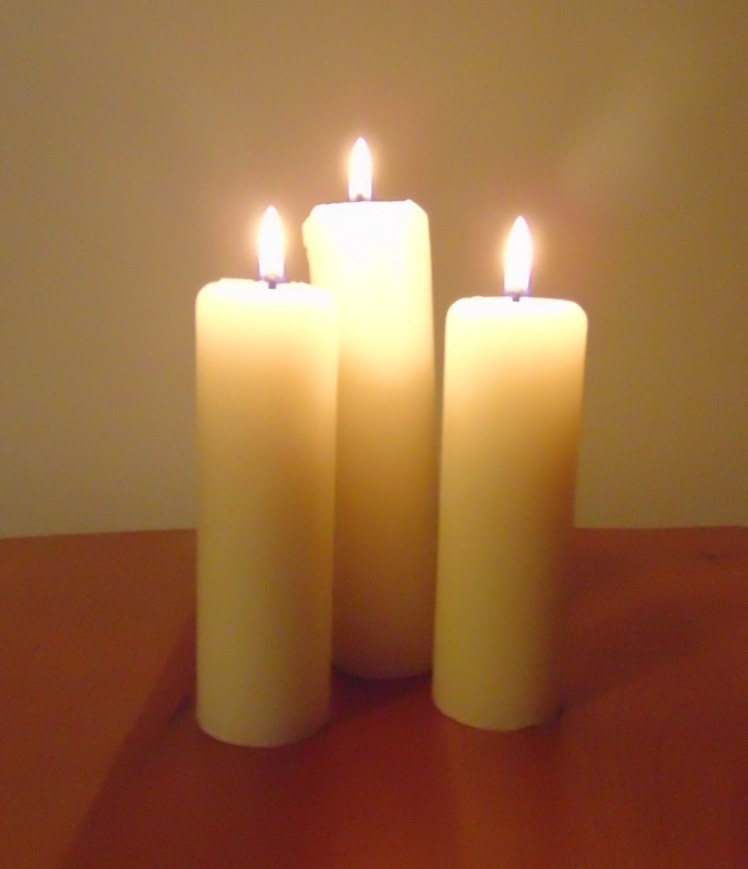
three candles
Trinity candles

I grew up in pews every Sunday, four years in parochial school. I believed in God, believed in having a relationship with God, felt a deep, meaningful connection to liturgical ritual (I was the type of child who would notice how much the sanctuary candles had burned down each week and would notice when the shortened candles would be replaced with new candles)….. I later left the pews in my mid-twenties, in part because I couldn’t intellectually accept everything in the Nicene Creed (specifically, the parts that I would later call “biologically implausibilities” – a virgin birth, the ascension….).

Later, a profound reconversion brought me back to the pews (I tell that story here ). It was the type of experience that makes this explanation palpable:

“The Greek Fathers liken man’s encounter with God to the experience of someone walking over the mountains in the mist: he takes a step forward and suddenly finds that he is on the edge of a precipice, with no sold ground beneath his foot but only a bottomless abyss.” Quote: The Orthodox Way (Revised Edition, page 13), Bishop Kallistos Ware

In my reconversion experience and in the time that followed, I deeply experienced that God loves me. I found tremendous value in reading Teresa of Avila’s autobiography and the writings of John of the Cross who “schematized the steps of mystical ascent—a self-communion that in quietude leads the individual from the inharmonious distractions of the world to the sublime peace of reunion between the soul and God.”

Experiencing that God loves us is life-changing. I came to recognize that “we can’t think our way to God.”

Wondering what faith is meant to be about? Whether your faith is on track? Wondering how to engage more deeply in faith?

Love really is the measure what faith is all about. Matthew 22: 34-40: “The greatest commandments are…love the Lord your God….and….love your neighbor as you love yourself.”

Having a loving interactive prayer relationship with God is absolutely part of what makes faith meaningful. An active prayer life is what animates an active faith. “There can be no faith without prayer” and “prayer is the respiration of faith” are quotes I’ve come across that make sense.

In my experience, an interactive prayer life is what subsequently animates faith made visible via “love the Lord your God…and…love your neighbor.”

Wondering about how to have an active prayer life?

The apostles asked, “Lord, teach us to pray.” Most of us aren’t born knowing how to pray. Thus, the apostle’s question resulted in them being given The Lord’s Prayer.

Rather than prayer being an activity, prayer is a relationship. There’s a faith song with a line “There’s a hunger in our hearts….” Yes, we do live with a hunger. A longing for a relationship with the divine.

There’s an explanation about prayer being a relationship that may be attributed to Fr. Mike Schmidt (i.e., “Bible in a year” podcast). The explanation goes something like this: Prayer is a two-way communication, like a phone call. You wouldn’t call someone, tell them something, then hang up without giving the other person an opportunity to respond. Prayer should be the same way. When we pray, it should be a two-way communication in which we communicate to God and allow God to be tangibly present to us in response.

So, how can we pray? Really, this question asks “how can we have a relationship with God?” Ultimately, there are as many ways to pray are there are people. A few examples of approaches to prayer:

  • Lectio Divina: Reflectfully reading and praying upon scripture and additional faith reading.
  • Contemplative prayer: simply being quiet in God’s presence. For more about this style of “Be still and know that I am God” prayer, check out the Contemplative Outreach network.
  • Attending church. Church services are a form of communal prayer.
  • Rote prayers (check out examples here of the prayers recited at church).

Beyond prayer – a place where we experience loving God and being loved by God – there is then loving our neighbor. For those of us who are “saints in training” rather than “saints already,” loving our neighbor is learned rather than an auto-pilot activity.

There are endless ways to love the people in our lives. There’s a phrase that may have come from Presbyterians: “Love your neighbor means everybody.” We don’t get to pick and choose who we are to love. We are to love everybody. For many of us, that’s a tall order.

How do we “love everybody?” If you’re like me, you’re not there yet. For starters, loving everybody means we can’t hate anybody. We need to become ever conscious of “how am I going to treat everyone I encounter with love and dignity?” How we achieve that varies depending on the context. “Whatsoever you do for the least of my fellows” – we take care of people who need our assistance. We treat everyone with dignity. We stand tall in being good to the people in our daily lives. There are endless ways to be good to everybody we encounter. For most of us, there are plenty of ways to continually improve at this – a good way to focus on growing in faithfulness.

Kim Burkhardt blogs at A Parish Catechist (and is a member of the Association of Catholic Publishers). Blogging is sustainable via blog readership (i.e. readers/subscribers). If you are a new visitor, it would be great to have you subscribe to follow this blog (thank you!). If you know someone who would like this blog, please share it with them and invite them to subscribe (thank you!).

Easter: Resurrection, surrender, transformation

John the Baptist

Easter: Christ has risen!

In Christ’s resurrection, we are offered transformation. 

We – in and of ourselves – cannot transform ourselves into the fullness of who we are meant to be.

….This is the fourth Lenten season in a row when I have experienced medical challenges – surgeries, etc.   This year, I broke my left foot on March 19th.  

After March 19, I continued falling (mishaps with crutches, etc.).   In addition to a broken left foot, I subsequently sprained my right foot.  Ended up with medical boots on both feet.   Then….On the morning of April 6, I fell again (two boots makes navigation difficult).    I sent an email to a couple people about this, ending the email with “Anger doesn’t begin to describe…..”   One person replied with insightful observations about surrender.

It’s true.  I know it’s true – I reach such a point of surrender-to-God in 2016 with a subsequent transformation in 2016 (that surrender involved a homily at an Irish mass and a broken ankle!).

For Christ to truly transform us, we have to surrender ourselves and our greatest difficulties to God.

Surrendering doesn’t just mean some limited-scope prayer to God and “hoping” that something positive will happen.   It doesn’t mean we hang onto some aspect of what we supposedly surrender – as if what we surrender still somehow belongs to us.   No.   True surrender means that we no longer have possession (ownership) or control.

True surrender comes when we surrender our hardest challenges.  The challenges we don’t tell people about.  Challenges that we somehow feel tied to…..  Challenges that are eating away at our very being.

When we truly surrender these aspects of our lives to God and allow God to do whatever God wants to do (WE DON’T KNOW WHAT GOD’S GOING TO DO!), true and life-giving transformation of our very selves happens in and through God.  Galatians 2:20:  “I have been crucified with Christ; and it is no longer I who live, but Christ who lives in me. And the life I now live in the flesh I live by faith in the Son of God, who loved me and gave Himself for me.”

It’s Easter, Christ has risen!   A great time to surrender to experience transformation offered by the Risen Christ.

Kim Burkhardt blogs at A Parish Catechist (and is a member of the Association of Catholic Publishers). Blogging is sustainable via blog readership (i.e. readers/subscribers). If you are a new visitor, it would be great to have you subscribe to follow this blog (thank you!). If you know someone who would like this blog, please share it with them and invite them to subscribe (thank you!).

Good Friday, Tenebrae, grace, pending resurrection

Welcome to Good Friday.

In his book Beyond Tenebrae, author Bradley J. Birzer writes “I am fascinated by the recognition of Tenebrae (…..3 pm on Good Friday)…… The extinguishing of light, candle by candle, the stripping of the altar, the bearing of the books, the departure from the chapel in a deafening silence.” As we move through Holy Week, I am

God’s grace in our lives and the transformation offered us as a result of the resurrection are how I find my being within Christianity. I wrote in a recent post, “We are indeed ‘a resurrection people,’ our redemption is made possible as a result of Christ’s death on the cross.   There’s a redemptive joy possible through God’s ability to transfigure us – when we allow God to work in us – that motivates my continued prayer life…..”

As you experience Good Friday today, make it an encounter with Christ rather than just another day. Reflect: what are your plans for the upcoming Easter season (the time between Easter and Pentecost)? This is a great season within the liturgical year to surrender into a transformative relationship with Christ, allowing God to move us more fully into the people we are meant to be. If anyone is pondering whether it’s worth it to surrender into allowing God to transform our very being, just ponder how well one’s inner life and life circumstances are going without surrendering to God being in charge – that should satisfactorily answer whether to turn one’s life over to God. This opportunity to surrender is one in which “I have been Crucified with Christ. It is no longer I, but Christ who lives in me” (Galatians 2:20). We give up any pretense of running our own lives. Acts 17:28: “For it is in God that we live and move and have our being.”

Easter is coming! Alleluia!

Kim Burkhardt blogs at A Parish Catechist (and is a member of the Association of Catholic Publishers). Blogging is sustainable via blog readership (i.e. readers/subscribers). If you are a new visitor, it would be great to have you subscribe to follow this blog (thank you!). If you know someone who would like this blog, please share it with them and invite them to subscribe (thank you!).

Book Review: J.R.R. Tolkien’s Sanctifying Myth (Birzer)

Book cover: Tolkien's Sanctifying Myth
Book cover for book about Tolkien

This book – J.R.R. Tolkien’s Sanctifying Myth, Understanding Middle Earth by Bradley J. Birzer – is a book I’ve been wishing existed ever since I read The Fellowship: The Literary Lives of the Inklings: J.R.R. Tolkien, C.S. Lewis, Owen Barfield, Charles Williams (that book is also a good read).

When I read The Fellowship: The Literary Lives of the Inklings, I enjoyed getting more acquainted with the literary aspects of Tolkien, Lewis, and the people around them. Yet, as I also found myself deeply curious about the religious relationship – and what I was sure must have included strains – between a British (South African!) Catholic and an Ulster Protestant (that aspect wasn’t delved into particularly in The Fellowship: The Literary lives..).

Birzer’s book Sanctifying Myth takes a sociological look into Tolkien and mythology. Tolkien, for example, considers myth to by sociologically necessary for humanity and to be every bit as tangible as scientific learning. This book also provides a deep dive into the religious relationship and tensions between Tolkien and Lewis. For example, Tolkien considered his Hobbit books to be more Christian in nature than C.S. Lewis’ The Screwtape Letters! There are also other curious tidbits in this book. For example, when Tolkien’s son Christopher enlisted in WWII, an RAF form asked Christopher Tolkien to list his father’s occupation; he listed his father’s occupation as “wizard.”

Most evenings, I read a book for a few minutes before going to sleep. At present, I am reading Sanctifying Myth before going to sleep. However, I am finding that I need to read this book earlier in the day; there’s enough stimulation and tension in the book to keep a person awake…..

I will be reading more books by author Bradley J. Birzer.

Kim Burkhardt blogs at A Parish Catechist (and is a member of the Association of Catholic Publishers). Blogging is sustainable via blog readership (i.e. readers/subscribers). If you are a new visitor, it would be great to have you subscribe to follow this blog (thank you!). If you know someone who would like this blog, please share it with them and invite them to subscribe (thank you!).