Book Review: Growing into God….Christian Maturity
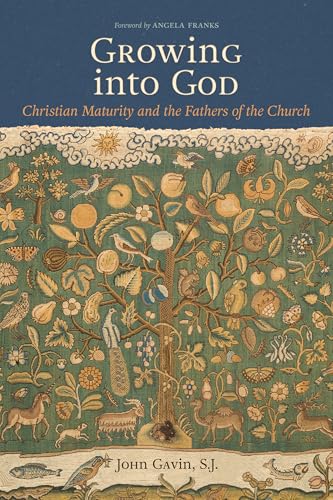
When I saw this book on the Catholic University of America Press website, it took no time at all for me to pursue getting a copy – I very much wanted to read the insights offered in the book. I wanted to use the book to gauge if I am maturing (I would like to think so!) and find measuring sticks and tools for maturing further.  In addition, I wanted the book to help me collect ideas on helping others move toward Christian maturity.

In the foreword of the book, Angela Franks states, “In an age of self-help books, Fr. Gavin has written a God-help book, and this is exactly what we need.”  Amen.

On pages two and three of Growing into God: the Fathers of the Church on Christian Maturity, Fr. Gavin spoke to the traditional idea of “moving toward Christian perfection” (if one spends enough time in church and reads enough books on Christianity, one comes across this idea occasionally) and indicated that we should instead move toward Christian maturity.  The idea of moving toward maturity rather than perfection seems more plausible.

Fr. Gavin also speaks briefly at the beginning of the book of some of the immaturities of our age (being childish instead of childlike) and of the need for more than scientific descriptions of stages of maturation – he indicates a need for instruction on how to overcome the roadblocks to maturity.  He then moves into lessons from the early Christian fathers – “the pastors, preachers, teachers, catechists, and theologians “ from Christianity’s first seven centuries – about how to grow in Christian maturity.  He tells the reader at the outset that the book will be written in several sections: “establish(ing) the three pillars of Christian maturity…., the opposition to maturation….., examin(ing) the means of maturity given to us in the life of the church…., [and a review of] four essential expressions of Christian adulthood…” (page five).  

As I hoped, this book pushes the reader beyond “easy” (and, therefore, not very fruitful) efforts toward maturity to a willingness to do the harder work of truly maturing.  I admire people who can move us toward a willingness to be better and achieve more.   Fr. Gavin, in this book, writes of the two-fold factors necessary for Christian maturity – inspiring/pushing us to apply our own “hard work” effort toward maturity coupled with surrendering to that which God alone does in bringing about in our human development.  Gavin writes of Christ’s baptism in the Jordan River when he began his public ministry – locals at the time would have recognized the Jordan River as the river crossed by the Jews to leave slavery behind and enter the Promised Land.   We likewise surrender our inadequate selves, allowing God to transform us into the people God means for us to become.  [Why, I must ask, do so many of us seem to do that surrender in small units over a lifetime?  A fuller transformation earlier in life would be so much better…… I mentally return to what James Fowler spoke of in his Stages of Faith book.  He writes that not many people grow into the highest stages of faith development.  He lists Mother Teresa, Martin Luther King, and Ghandi as three people who reach the highest level of faith maturity….].

Interspersed with direct insights toward how to mature in Father Gavin’s book are a number of “pithy” insights.  For example: “Biological growth, with all its complications and challenges, does not guarantee human maturation.  Embodiment does indeed shape the psychological and even spiritual sies of the person, but the mystery of human freedom and interiority defy the parameters of corporal extension, girth, and hormones.  The precocity of a youth, the vigor of an elder, and the childish behavior of some adults demonstrate that humans ripen or rot at any time of life. (page 6)”

This book, Growing into God: The Fathers of the Church on Christian Maturity, also makes great reading in that Fr. Gavin works in writings and insights from a cross section of Patristic Fathers – allowing us to sample writings in one place from multiple early Christian writers.

This book is a useful read for readers of any age who wants to grow up.

Kim Burkhardt blogs about faith at The Hermitage Within. Thank you for reading this faith blog and for sharing it with your friends. While you are here, please feel welcome to provide support to sustain this blog ($$).
Pondering religious imagination….

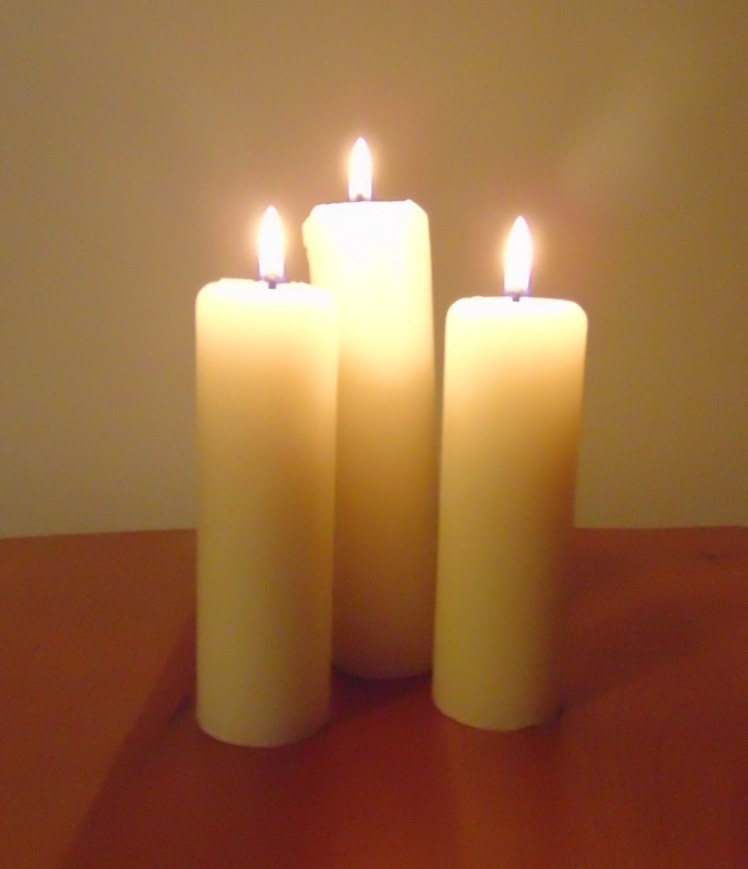
Trinity of candles

I was recently given Frank J. Cunningham’s Vesper Time: The Spiritual Practice of Growing Older. Early in the book, he mentions “The Catholic Imagination.”

I am intrigued by the phrase. I happened across the phrase once before and immediately recognized that yes, there is a “Catholic Imagination.”

When I first encountered the phrase “A/The Catholic imagination,” I recalled an experience circa 2011. In 2011, I was trying to discuss a matter with a couple of non-Catholics (they were both lovely, well-meaning people). We went in circles, got nowhere. They were trying one mental and verbal approach to exploring the matter at hand, I recognized that I was clearly approaching the subject very differently. At the time, I could recognize a difference in approaches, but I couldn’t articulate the contours of either approach. When I later “happened across” the phrase “The Catholic imagination,” I instantly recognized that my involvement in the above-mentioned discussion (2011) was attempting to frame the topic via a Catholic imagination while the other two parties were employing a secular approach. Even though I was a lapsed Catholic at the time, “The Catholic Imagination” had so thoroughly infused my thinking while growing up that it stayed with me even when I was away from church.

Google’s AI effectively synthesizes several credible-source descriptions of “The Catholic imagination”: “The Catholic imagination is a worldview seeing God’s presence in the physical world, viewing earthly life, objects, and experiences as channels of grace, rooted in the belief that Jesus’s humanity makes the sacred accessible through the material. It’s a sacramental perspective, finding deeper meaning and spiritual significance in everyday things, stories, and rituals, encompassing themes of sin, redemption, and ultimate hope through a framework of divine providence and the ‘complex of opposites’ (light/dark, good/evil).”

For those who live within – and/or were raised within – a particular faith tradition, do you recognize your tradition’s “style of imagination?” Do you see that “style of imagination” infusing how you see and interact with the people and events around you? Religious imagination truly exerts a powerful influence on how we live in the world – from how we interpret meaning within events, themes, etc. to how we communicate and interact with the people in our lives. It’s easy enough to know whether or not we bring explicitly-stated religious ideas into our daily life (“I believe that God is present in my life,” “I am religiously accountable for my behavior,” etc.). It’s another matter to recognize perhaps more implicitly-incorporated ideas – a ritualized pattern of looking at daily patterns in our lives or bringing a “complex of opposites” perspective into seeing the events in our lives that might not be shared by neighbors or co-workers (good/evil, light/dark, etc.).

Hmmm…… It might be interesting to undertake psychological studies contrasting people with a particular religious imagination to to people without such a perspective. For example, is there a distinct psychological roadmap to learning life’s “shades of gray” for individuals with a “complex of opposites” worldview? Maybe such studies have already been done?

Kim Burkhardt blogs about faith at The Hermitage Within. Thank you for reading this faith blog and for sharing it with your friends. While you are here, please feel welcome to provide support to sustain this blog ($$).

Pondering our spiritual landscape

Harrison Hot Springs

I was born in Colorado (a high-altitude, mountainous geography with some areas dry, flat, and/or farmland areas); I have spent most of my life in North America’s Pacific Northwest. When I periodically drive to Colorado to visit relatives, I am struck by the contrast of the lush geography of where I live and the simple beauty of the semi-arid geography found in parts of Wyoming located between Washington State/B.C./Oregon and Colorado. Wyoming’s dry stretches with layered, red cliffs and “red rocks” particularly attract my imagination.

We sometimes use our physical surroundings as an analogy for reflecting upon our spiritual, emotional, and intellectual lives. I am deeply rooted, for example, in the rainforest-esque rich landscape of where I live and I appreciate the opportunity to take photos such as the one above. I find it appealing to compare such geography to luscious experience of spiritual realms. Yet, arid geographies also have their beauty.

Deserts can be analogous to dry periods in one’s spiritual life. We all experience spiritual deserts at one time or another (sometimes, for long, perplexing, and/or difficult periods!). Finding out way out of such periods can be challenging (listening for the quiet voice of the spirit inviting us out of such deserts can be helpful!). With that said, the beauty – and simplicity – of semi-arid geography can also be an opportunity to focus on our spiritual life without distraction. Rather than being a barren or desolate experience, such times can be fruitful opportunities to clear away the clutter in our faith journeys. Times to focus on simplicity and directness with clarity of vision. What really matters in our lives? What do I need to clear out of my life? When feeling emotionally depleted or spiritually bankrupt, going to dry, arid geography can sometimes help to to cultivate a focused relationship with the divine. Such simplicity draws some people to contemplative prayer and/or to a life in which we focus more on the inner experience of faith and on being of service to other people – the aspects of faith that matter – rather than opting for the avoiding-what-matters (or, avoiding-what-I-don’t-want-to-deal-with) distractions available in more abundant geographies and in cities.

For anyone interested in exploring contemplative prayer, please feel welcome to check out Contemplative Outreach or the writings of mystics (such as Teresa of Avila, John of the Cross, or Julian of Norwich). For anyone interested in spirituality in dry geographic locations, I came upon an appealing blog: 11 Sacred Places in New Mexico.

Kim Burkhardt blogs at A Parish Catechist (and is a member of the Association of Catholic Publishers). Blogging is sustainable via blog readership (i.e. readers/subscribers). If you are a new visitor, it would be great to have you subscribe to follow this blog (thank you!). If you know someone who would like this blog, please share it with them and invite them to subscribe (thank you!).