Twists and turns amongst Catholic rites – with a surprise
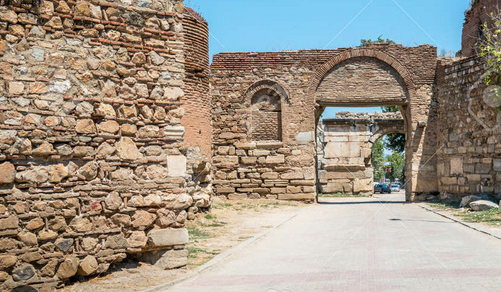
I started reading about Eastern Catholic rites and Eastern Orthodox traditions in 2023. I periodically visit their weekend services.

I was surprised to learn that there are more than twenty Catholic rites in full communion with Rome (Eritrean Rite, Byzantine Rite, etc.) and a similar number of Orthodox traditions (Greek Orthodox, Russian Orthodox, Ukrainian Orthodox, Syrian Orthodox, Coptic Orthodox, Eritrean Orthodox, Byzantine Orthodox, etc.). When I recently tried to identify all the rites and traditions, I was grateful to find a list here (scroll down to page two).

If anyone wants to take a deep dive down this rabbit hole of learning about Eastern Churches, here’s a list of relevant books I’ve read in the last three years (the last time I moved, I looked for a residence with enough wall space for my bookshelves!):

I find it interesting how much these rites and traditions have in common and, alternately, the distinct ways in which “each lung breaths.” Pope John Paul wrote in his 1995 encyclical Ut Unum Sint, in gist, “Living only within the western or eastern church is like living with only one lung; both traditions are needed for the full breath of the Christian faith. “

In looking at how much these rites and traditions have in common, one can start by looking at the liturgy (i.e. how a service is structured). Anyone who is familiar with the liturgy of one rite can visit another rite – even in another language – and anticipate the general flow of the service: the mass or divine liturgy (depending up on the rite or tradition) begins with the priest processing into the church (typically with music), then there are readings and a homily, then there is the Eucharist (holy communion), then the closing of the service. We also share belief in the Kerygma (belief in Jesus, that in his death and resurrection he has conquered sin and death). There’s plenty that we share in common…..

What fascinates me at the moment is something I read this month in Drobner’s Fathers of the Church: A Comprehensive Introduction. It turns out that there were churches/groups in the early days of Christianity that didn’t Hellenize. What ?!?!

I had to put down Drobner’s Fathers of the Church: A Comprehensive Introduction. I was floored at the very idea that there might be non-Hellenized Christianity. What exactly would that look like?

Anyone generally familiar with the history and development of Christianity knows that as the apostles and early Church fathers led the church, aspects of Greek (i.e., Hellenistic) philosophy (neoplatonic thought, etc.) were incorporated into how most of us understand Christianity. Concepts of duality, the construct of the Trinity, etc. – Hellenistic philosophy has significantly impacted how Christianity is taught to many of us. Therefore, I was stunned that there would be non-Hellenized Christians. What would this look like?

I, in much surprise, went down an online rabbit hole to learn more about “Non-Hellenized Christianity.” It turns out that there are still small numbers of Non-Hellenized or little-Hellenized Christians around, some of whose rites are in communion with Rome. They perceive Christianity much like early Hebrew Christianity, with little or no input of Greek philosophy. They have more of a focus on one’s community in the here-and-now and less focus on the kingdom to come, less focus on various aspects of duality, etc.

I don’t know yet how much time I will spend learning about non-Hellenized Christianity. I did wonder how non-Hellenized Christianity could be reconciled with broader Christian thought. Hmmm….. Isn’t the Holy Spirit moving us toward a fuller understanding of how God wants us to understand Christian theology? Therefore, wasn’t an incorporation of Hellenistic philosophy necessary for the full expression of Christian theology (since that’s the road that Christianity went down)? On the other hand, part of me is attracted to a simpler Christianity. Part of me has always had some discomfort with having incorporated secular philosophy into Christian thought (I am not alone in raising this question)…. How to think about this? I am still taking this in. So far, I have decided that grasping non-Hellenistic Christianity must fall under “breathing with both lungs” (see above).

There is always more to learn….

Kim Burkhardt blogs about faith at The Hermitage Within. Thank you for reading this faith blog and for sharing it with your friends. While you are here, please feel welcome to provide support to sustain this blog ($$).
Fall is approaching and so is religious education

As we squeeze in a few more end-of-summer activities, students are getting ready to head back to school.

Education is not just classroom academics.

For people of faith, our faith development is also a life-long journey. What we learned about religion in Sunday School laid a child’s-level foundation. As adults, we continue our life-long education on how to manage finances, grow in navigating adult-level relationships, manage careers, etc. There is also always more to learn in our adult faith journeys.

Adult religious education is multi-faceted. Bible studies educate us about the Biblical content and how to make it relevant in our lives. As mentioned in our previous blog post, for example, “Historically within Judaism, water symbolically represented tumult and chaos. So, in separating water and land [in the Genesis creation story]… God was establishing that he separates tumultuous chaos from calm…” while “Peter demonstrated his utter trust in Christ by…walking toward him on the waiter, but then Peter lost his faith and began to sink when the wind began to blow and the water would have become choppy. This is a story about us losing our faith when the winds and waters of live become chaotic……Yet, God is always here for us in our brokenness.” Theological studies go on to study faith in a myriad of ways……

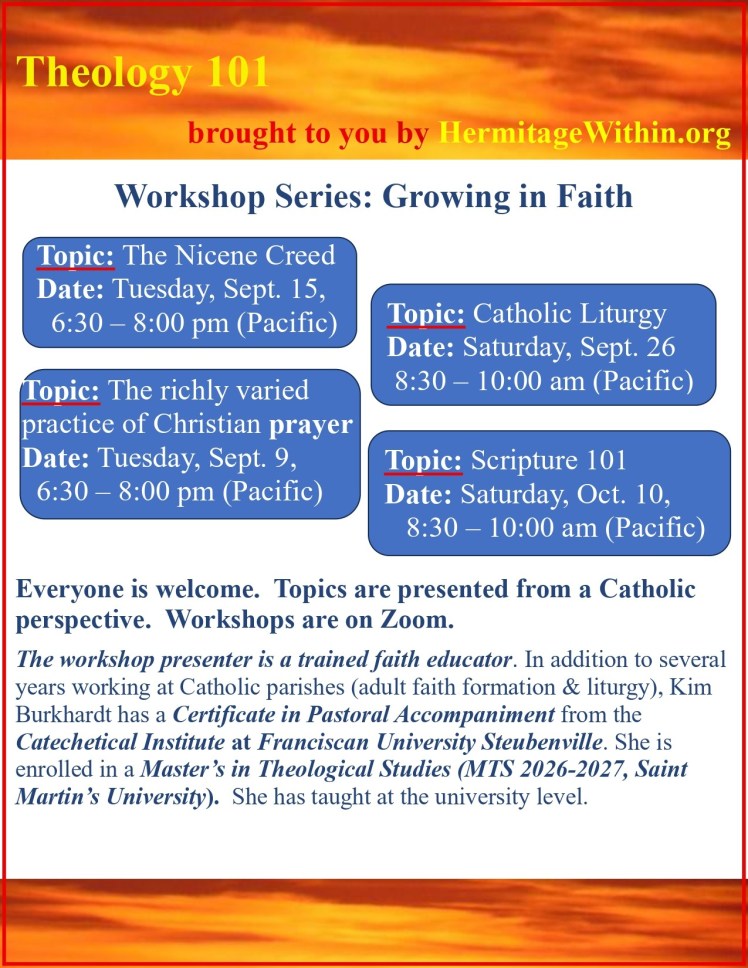
Coming this fall, The Hermitage Within (which delivers this faith blog you read) is delivering adult religious ed sessions over several Tuesday evenings and Saturday mornings in September and October. The presenter, Kim Burkhardt, has delivered these types of workshops at churches. She has a Certificate in Pastoral Accompaniment and is currently earning a Master’s in Theological Studies. We invite you to join us. Registration is now open (Zoom – you can “learn from home!”).

Sign up here for one or more of these growing-in-faith sessions. You can also contact us to ask any event-related questions. We welcome you to these religious education events.

Kim Burkhardt blogs about faith at The Hermitage Within. Thank you for reading this faith blog and for sharing it with your friends. While you are here, please feel welcome to provide support to sustain this blog ($$).
Book Review: Ars Celebrandi

Book
Ars Celebrandi: Celebrating and Concelebrating Mass

This book, written for priests to inspire artful presiding at mass, brings to life the nuts and bolts of how the Catholic mass brings liturgy – the work of the people – is celebrated. For the non-ordained among us, Ars Celebrandi: Celebrating and Concelebrating Mass provides insight into how the liturgy is designed to invigorate the faith of the faithful.

In practical terms, this book picks up where the General Instruction of the Roman Missal (the “GIRM”) ends….. The GIRM is the instruction manual of “how to do a Catholic mass,” whereas Ars Celebrandi gets into the art of how to preside.

Two examples of this book’s insights come from the foreward of Ars Celebrandi (written by Bishop Mark Seitz):

“The liturgy is the action of the entire people of God who are being more perfectly formed into the Body of Christ.  The Second Vatican Council’s seminal teaching that the people of God are called to full, conscious, and active participation is based upon this fundamental recognition.”

“The liturgy, as we know,  is a language and a certain style of communication that comes down to us from the ages but is also constantly adapting under the guidance of the Spirit in every age.  It a language of signs and symbols that are read universally by people in the church.  To be sure, there are regional and cultural aspects that are rightly represented as local communities worship, but these are secondary to the expressions that unite us across times and places.”

Then, we lay readers learn in this book about the complexity of presiding at church services. For example:

“[Presiding at a liturgy] involve a marriage of books and ministers. The liturgical norms [i.e., what is suppose to be done] encounter a real-time relationship with the individual persons ordained to carry them out….The relationship presumes that priests know the liturgical norms. However, the rules are complex. The books detailing them are many. Some laws keep changing….Furthermore, not every aspect of liturgy is prescribed. When presiding, a typical priest is suppose to do certain things, is free to do certain other things, and takes freedom to do even more….” [Subsequent paragraphs delve into specific examples of these “certain things” and “certain other things.}

Reading this book is of interest for we lay people in that we become more observant of the nuts and bolts of what happens at church. A book worth reading.

Kim Burkhardt blogs at A Parish Catechist. If you are a new visitor, it would be great to have you subscribe to follow this blog (it’s free – thank you!). If you know someone who would like this blog, please share it with them and invite them to subscribe (thank you!).

Experiencing the Liturgy of the Mass

Is church attendance defined simply as “something we attend?” Or something in which we are active participants? A form of prayer? How much a person engages in being present at mass depends on the person. Mass meant to be experienced – we are meant to be active participants and pray-ers.

There’s a lot to unpack about participating in mass:

First of all, there’s the concept of being fully present. The intention is for parishioners to enter into the mass as attentive and engaged attendees.

Be on time, pay attention, be engaged. If you don’t feel connected, there is an option of getting involved as a volunteer parishioner (becoming an usher, greeter, lector, etc.).

In addition, there are multiple ways to actively pray at mass. We all verbally recite the prayers of the mass. Beyond that, we can all pray personally during mass as a form of cultivating a relationship with God. God wants to have a relationship with us; relationships require communication. Prayer is a two-way communication in which we communicate our thoughts, feelings, hopes, and needs to God and are also receptive to allowing God to be present to us, with us. Find personal prayer styles that work for you.

Faith is a verb. Faith is something we do – cultivating a relationship with God, allowing God to be present to us, living out our faith by allowing God to turn us into better people, by being good and useful people in the world.

Understanding the Ritual of the Mass

It’s commonly known that the Catholic mass is a ritual and that the ritual has much the same formula – or format – each time we attend mass, with some variations. Some variations are easy to recognize. During the more exceptional times of the liturgical year, mass “ramps up” during Advent, Christmas, Lent, Easter, etc. (in this post, we are looking at the Latin Rite; the Latin Rite is one of multiple Catholic rites that are in communion with Rome). An Advent wreath is present at mass during the four weeks of Advent (heading into Christmas), with candles being lit at weekend masses (purple candles on three of the weeks, a pink candle the other week). The liturgical colors present at mass (i.e., the colors of banners, the priest’s vestments, and the like) change throughout the year, corresponding to the colors specified for each liturgical season (green for Ordinary Time, etc.). The Gloria and Alleluia are not sung during Lent. There are several Holy Days of Obligation throughout the year on which days Catholics are expected to attend mass and there are feast days for various saints throughout the year.

It’s less widely considered that there are sequentially specified “principal parts” of a Catholic mass that are referred to by those who prepare and deliver the mass (priests, liturgists, sacristans, etc.). There are four principal parts of the mass, to be precise – each spelled out as “The Order of the Mass.”

The Order of the Mass begins with the Introductory Rites (the priest’s procession into the church, the greeting, the penitential act, Glory to God, the collect). Thus begins the mass.

Then the mass moves into the first of the two main parts of the mass – The Liturgy of the Word. During the Liturgy of the Word, readings are read, the homily is delivered, parishioners participate in the Profession of Faith, and we have the Prayers of the Faithful.

During most of the calendar year, the three readings during the Liturgy of the Word at weekend masses come – in sequential order – from the Old Testament (read by parishioners who are lectors), the New Testament (also read by a lector), and a Gospel reading (read by a priest or deacon). In the weeks between Easter and Pentecost – commemorating the time between Christ’s resurrection and his Pentecost visit to the Apostles when he instructed them to go forth, carrying his message – both the first and second readings come from the Acts of the Apostles (New Testament) so as to focus on the mission of the Apostles to build the Church.

There is a three-year cycle of assigned readings for weekend masses and a two-year cycle for assigned readings for weekday masses; these cycles (Years A, B, and C) are repeated on an ongoing basis so that people who attend mass regularly hear the major themes of the Bible read over time.

The homily brings the message of the readings into our lives as prepared and delivered by the priest or deacon. The style and content of homilies vary from priest to priest, deacon to deacon.

Following the Liturgy of the Word, the mass moves into the second of the two main parts of the mass – the Liturgy of the Eucharist……..

The Liturgy of the Eucharist is the preparation for and the receiving of the Eucharist (Communion). Receiving the Eucharist is “the source and summit of our faith” – from which we derive and achieve the high point of our faith (physically receiving Jesus is immediate intimacy of receiving Christ within us). This part of the mass begins with the unconsecrated bread and wine being brought to the altar. Then the priest proceeds into consecrating the bread and wine. Consecration is when the bread and wine become the body and blood of Christ. Once the bread and wine are consecrated, the host and wine remain the body and blood of Christ. Sacristans – the parishioners who help set up before mass – set out an amount of bread (hosts) and wine thought to be enough for the number of people expected to attend mass, with a few additional communion hosts kept to be held in the Tabernacle for the next mass (DID YOU KNOW: the Tabernacle always has communion hosts – the physical presence of Christ – present every day of the year except Good Friday. Good Friday, heading into Easter, is the anniversary of Christ’s crucifixion, so on that day we don’t keep hosts recognizing Christ’s alive status in the Tabernacle). After the bread and wine are consecrated, mass attendees receive the Eucharist during the portion of the mass called The Communion Rite (i.e., the source and summit of our faith). After everyone “receives” (i.e., receives the Eucharist), remaining hosts are placed in the Tabernacle and any remaining wine/blood is consumed by the priest.

Finally, the fourth and final portion of the mass is the Concluding Rites – announcements, blessings, and dismissal. The dismissal is when the priest (with any special guests, lectors , and altar servers) process out of the sanctuary and nave of the church (i.e., exit the church).

Did you know? Priests, deacons, support staff, and volunteers involved in the mass have access to publications on the various aspects of the mass – publications such as the General Instruction of the Roman Missal (GIRM) and liturgical texts kept in the parish sacristy.

More about The Order of the Mass can be read on the USCCB website here (the U.S. Conference of Catholic Bishops).

Kim Burkhardt blogs at A Parish Catechist and The Books of the Ages. If you are a new visitor, it would be great to have you follow this blog (thank you!). If you know someone who would like this blog post, please share it with them (thank you!).