Being vulnerable in prayer – reach toward “saint in training”
Reflection

We humans are imperfect. In anyone questions our fallibility, just turn on the evening news and watch what humans are doing to each other. For those of us whose failings don’t make it on to the evening news (hopefully, most of us), we typically have friends and relatives who are familiar with our particular human failings.

I have an active prayer life. In recent months, I have surrendered in prayer yet again, “God fix my particular combination of failings. Do something to improve this mess.” Not that my mess is news-worthy (local TV journalists haven’t been called to my door!), but there are aspects of my life that “I wouldn’t have chosen” (I learned that phrase several years ago from a friend named Linda). I didn’t intentionally create this stuff that “I wouldn’t have chosen,” but I am also seeing that solving some of this just might require that I inch closer to sainthood (i.e., try being a saint in training).

I was taught long ago that I when I surrender to letting God fix something in my life (i.e., improve me rather than expecting my circumstances to be improved), it’s my job to not interfere in God’s plans. In other words, let God “do his thing” and be emotionally responsive to whatever promptings God initiates (and, if necessary, talk with a fellow human about this process to be sure I’m not mis-reading cues). Sometimes, that level of surrender is terrifying. “What’s God going to do in changing me or my life?” News flash: God doesn’t do anything bad. Just because we can’t see yet what the results are going to be doesn’t mean that the results are going to be something we will be dissatisfied with. The results are always good.

I am currently in the midst of that surrender-in-prayer and some subsequent emotional change. I’ve learned over time that these time periods are fruitful. The process, though, can be “discombobulating.” That’s okay. I’ve got to a point that I’ve learned to muddle through the discombobulation (i.e., “roll with it”). One of the “fruitful lessons” at present seems to be that I need to be freer and more conversationally open with the people around me. Yikes. For someone as introverted as me, that’s a challenge. A few times recently, though, being more communicative has had positive results.

Being vulnerable in prayer to letting God improve us is always a good thing. Have you given that a try lately? God loves us and will show up when invited! God wants us to be the people he created us to be.

Kim Burkhardt blogs about faith at The Hermitage Within. Thank you for reading this faith blog and for sharing it with your friends. While you are here, please feel welcome to provide support to sustain this blog ($$).

Fall is approaching and so is religious education

As we squeeze in a few more end-of-summer activities, students are getting ready to head back to school.

Education is not just classroom academics.

For people of faith, our faith development is also a life-long journey. What we learned about religion in Sunday School laid a child’s-level foundation. As adults, we continue our life-long education on how to manage finances, grow in navigating adult-level relationships, manage careers, etc. There is also always more to learn in our adult faith journeys.

Adult religious education is multi-faceted. Bible studies educate us about the Biblical content and how to make it relevant in our lives. As mentioned in our previous blog post, for example, “Historically within Judaism, water symbolically represented tumult and chaos. So, in separating water and land [in the Genesis creation story]… God was establishing that he separates tumultuous chaos from calm…” while “Peter demonstrated his utter trust in Christ by…walking toward him on the waiter, but then Peter lost his faith and began to sink when the wind began to blow and the water would have become choppy. This is a story about us losing our faith when the winds and waters of live become chaotic……Yet, God is always here for us in our brokenness.” Theological studies go on to study faith in a myriad of ways……

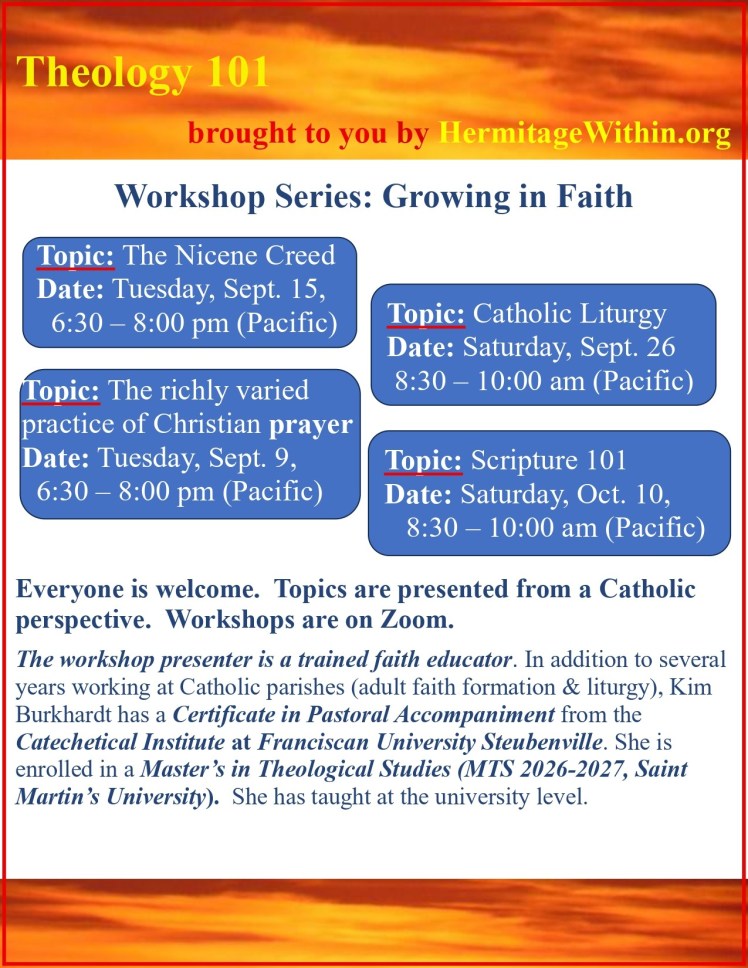
Coming this fall, The Hermitage Within (which delivers this faith blog you read) is delivering adult religious ed sessions over several Tuesday evenings and Saturday mornings in September and October. The presenter, Kim Burkhardt, has delivered these types of workshops at churches. She has a Certificate in Pastoral Accompaniment and is currently earning a Master’s in Theological Studies. We invite you to join us. Registration is now open (Zoom – you can “learn from home!”).

Sign up here for one or more of these growing-in-faith sessions. You can also contact us to ask any event-related questions. We welcome you to these religious education events.

Kim Burkhardt blogs about faith at The Hermitage Within. Thank you for reading this faith blog and for sharing it with your friends. While you are here, please feel welcome to provide support to sustain this blog ($$).
Prayer: genuine engagement

Clonmacnoise window

On December 24, 2017, a pastor was driving me home from an evening Christmas Eve service. As we were winding through snowy roads, I was telling him about the angst I was feeling about a personal problem that was “eating up my insides” at the time. He asked if I had prayed about the matter. “No,” I replied, “I haven’t prayed about this. I have been having such a positive prayer relationship with God for the last year – I don’t want to ruin this positive prayer relationship by bringing my problems to God.” I can still feel this heavy weight of the subsequent silence in the car as the pastor’s face puckered. Finally – after a moment that lasted too long – he sternly replied, “You have to bring EVERYTHING to God.”

I got the point.

We are to bring our whole selves to God. Not just the parts we want to bring to prayer. There’s no point packaging ourselves – or our situations – to present to God as we would wish. Do we really think God doesn’t know the real dirt?

God doesn’t want to deal with any superficialities that we might “sugar coat” in prayer. Prayer becomes meaningful when we get real. God loves us, wants to have a real, meaningful relationship with us.

Prayer is also a long-haul relationship. Prayer doesn’t become meaningful when we pray as an equivalent to 30 second chats held in a busy hallway. Prayer becomes real when we make real and continuing time to be meaningfully present with God. The shape and form of being “meaningfully present” in prayer is going to be different for each of us. A faith person who I admire mentioned to me several years ago (after the Christmas Eve car ride mentioned above) that everyone one of us is going to have a different prayer relationship with God because of the different nature of who each of us is…. What matters for each of us is that we commit sustained, ongoing time to building personal “prayer”being present” time with God. The fruits of that prayer become clear and substantive when we continue such sustained, meaningful time in prayer.

Wondering about new ways to pray? Check out a ways-to-pray list in one of my previous blog posts.

Kim Burkhardt blogs about faith at A Parish Catechist. Thank you for reading this faith blog and for sharing it with your friends. While you are here, please feel welcome to provide support to sustain this blog ($$).

List: How many ways to pray (types of prayer)?

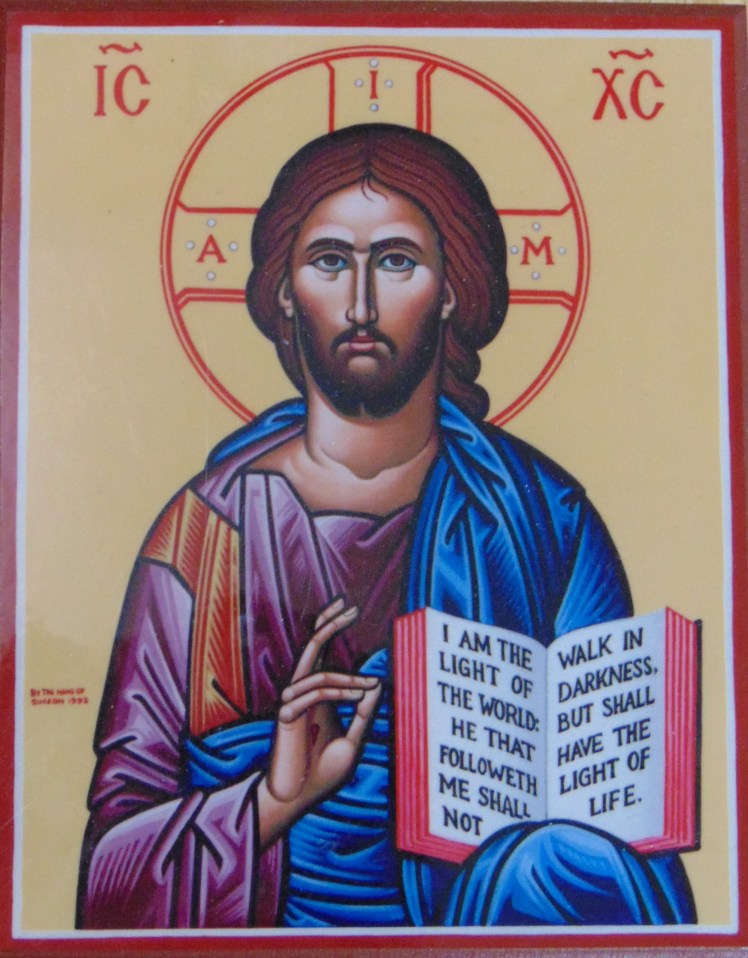
image of Christ
depiction of Christ

variety of prayer options available within Catholicism.

Catholic prayer is a vibrant and varied tradition, bringing to fullness a life-giving relationship between us and God. Jesus came “that we might have life, and have it more abundantly” (John 10:10). “…prayer is not merely an exchange of words, but it engages the whole person in a relationship with God the Father, through the Son, and in the Holy Spirit” (U.S. Conference of Catholic Bishops, USCCB).

How many ways are there to pray?

The essence of prayer is communication, a relationship with God, a being-with or being-in-the-presence-of. When we find a relationship with God – an interactive, two-way interaction rather than a one-way monologue (we wouldn’t relate to the people in our lives exclusively via uni-directional monologues!) – there comes a discovery that God is present with us in prayer.

A friend said to me, “prayer is a very personal communion with God that is meant to be personal, and unique to you….People are… very different in their personal experience in prayer, and that in itself is a beautiful thing.”

Just as we have many differing relationships with the various people in our lives – and a variety of ways that we communicate with the people in our lives – there are any number of ways of communicating with God. A prayer style that works for one person may be very different than what works for the next person. Here are several approaches to prayer:

  • Rote prayer (formal, memorized prayers – these are often provided to us by our houses of worship). Prayers such as the Lord’s Prayer are full of meaning and help us learn to pray. Such prayers give us ready prayer content that we can easily put to use.
  • Psalms. The Book of Psalms – which were meant to be sung – are summarized by Wikipedia thus: the Book of Psalms are “an anthology of Hebrew religious hymns…including hymns or songs of praise, communal and individual laments, royal psalms, imprecation, and individual thanksgivings.  The book also includes psalms of communal thanksgiving, wisdom, pilgrimage, and other categories.”
  • “Talking to God.” Our spontaneous thoughts and words directed to God. God wants to have a relationship with us; relationships are two-way, be open to feeling God’s presence in response.
  • Contemplative Prayer. Resting reflectively in prayer, without a need for words or any human language. Contemplative prayer can – and for some people, does – include a sense of God’s presence in prayer. For more information about contemplative prayer, visit Contemplative Outreach.
  • Praying the Rosary. The rosary is a reflective way of praying a set of rote prayers with a formulaic set of Catholic prayer beads (focusing time on specified topics). Instructions for praying the rosary is available here.
  • Lectio Divina. Lectio Divina “describes a way of reading the Scriptures whereby we gradually let go of our own agenda and open ourselves to what God wants to say to us” (this particular description provided by the Carmelites).
  • Singing at church. “Those who sing pray twice” (a popular phrase in churches).
  • Intercessory prayer. Intercessory prayer that we pray for other people. We come to God with the challenges of those who are in need of support.

My favorite Catholic pray-ers:

  • Teresa of Avila, (16th-century mystic, Doctor of the Church, Carmelite nun, reformer of the Carmelite religious order, Carmelite saint)
  • John of the Cross (16th-century mystic, Doctor of the Church, Carmelite monk and priest, co-reformer of the Carmelite religious order, Carmelite saint)
  • Edith Stein, Carmelite nun, Carmelite saint
  • Fr. Thomas Keating, founder of Contemplative Outreach

Books for further reading:

Clinging: The Experience of Prayer (Emilie Griffin)

The Tradition of Catholic Prayer (The Monks of Meinrad Monastery)

Kim Burkhardt blogs at A Parish Catechist (and is a member of the Association of Catholic Publishers). Blogging is sustainable via blog readership (i.e. readers/subscribers). If you are a new visitor, it would be great to have you subscribe to follow this blog (thank you!). If you know someone who would like this blog, please share it with them and invite them to subscribe (thank you!).