And then there was light…..
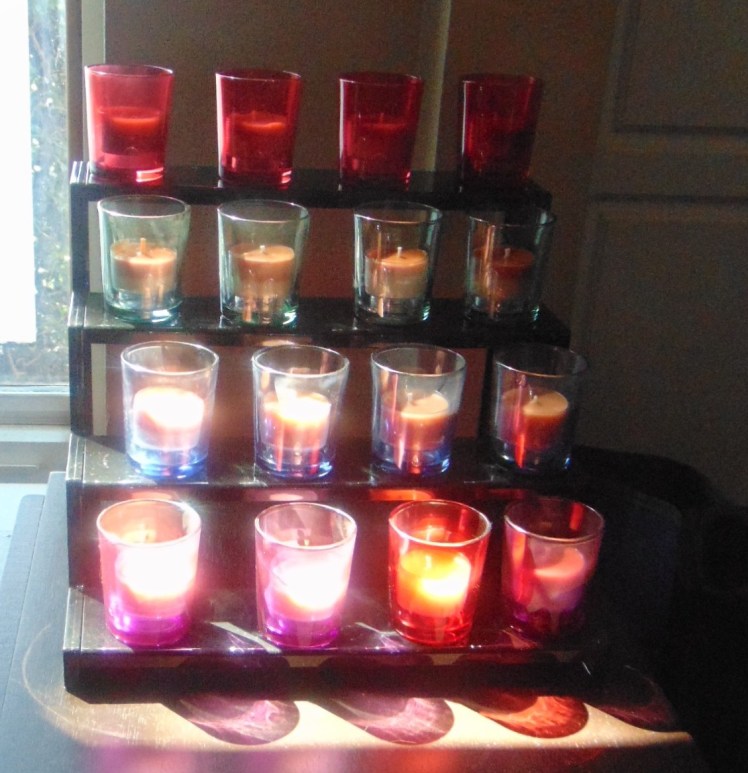
When you walk along the nave (body) of most Catholic churches, you’ll find rows of votive candles for parishioners to light as a prayer and reflection activity (often, these candles are lit to pray for someone or to pray about a pressing personal matter).

This year, I put together my own version of “church prayer candles” at home. As shown above, I display them where they receive afternoon sunlight. Sunlight resting upon the candles provides me with a moment of cheer.

Themes of light and darkness are a frequent form of symbolism in Christianity.

On the first day of Earth’s creation, we read in Genesis, “the earth was formless and void, and darkness was over the surface of the deep. And the Spirit of God was hovering over the surface of the waters. And God said, ‘Let there be light,” and there was light.’ And God saw that the light was good, and He separated the light from the darkness.… (Genesis 1:2-4).”

When we talk about faith and our lives, we likewise make reference to light whenever we speak of that which is good while referring to darkness when talking about challenges.

Further along in the Genesis creation story, “God said, ‘Let the water under the sky be gathered to one place, and let dry ground appear.’ And it was so.  God called the dry ground ‘land,’ and the gathered waters he called ‘seas.’ And God saw that it was good (Genesis 1:9-10).” Historically within Judaism, water symbolically represented tumult and chaos. So, in separating water and land… God was establishing that he separates tumultuous chaos from calm. Likewise, Peter trusted Christ in walking toward him on the sea in the story told in Matthew Chapter 14. The disciples had ween Christ walking on water as he approached their boat. Peter demonstrated his utter trust in Christ by likewise walking toward him on the waiter, but then Peter lost his faith and began to sind when the wind began to blow and the water would have become choppy. This is a story about us losing our faith when the winds and waters of live become chaotic……Yet, God is always here for us in our brokenness.

In Trevor Thomson’s Christ in Me Arise song, we prayerfully sing at church “Christ in me arise and dispel all the darkness. Christ in me arise with all your strength and I will rise in you.”

I have been reflecting lately on the varying ways that our light shines when we surrender to allowing God transform our brokenness. The specifics of this look different from one person to the next. In one person, they give up being the outwardly difficult person who makes life hard for the people around them, becoming a person who finds daily ways to be helpful and useful to the people in them. Another person outgrows a childhood of economic and social challenges to become an adult who inspires the best in the people around them.

Allowing God to change us into the people we are truly meant to be is transformative. Who doesn’t want to become their best self? Yet, how easy it can be to remain stuck in fear and habit. Peter, when approaching Christ in utter faith, lost faith and began to sink when the water became tumultuous. Don’t we also want to hang on to our own desire to control our circumstances rather than trusting God to change our very most inner self? It really is an either/or situation: let God transform our very being or fail to become the person God intends for us to be. FYI, if you are struggling to give up control (by the way, how well is that working?)…..God has no negative plans for the transformative light that he intends for us.

When we surrender to God working within us, God truly will transform us into our best self.
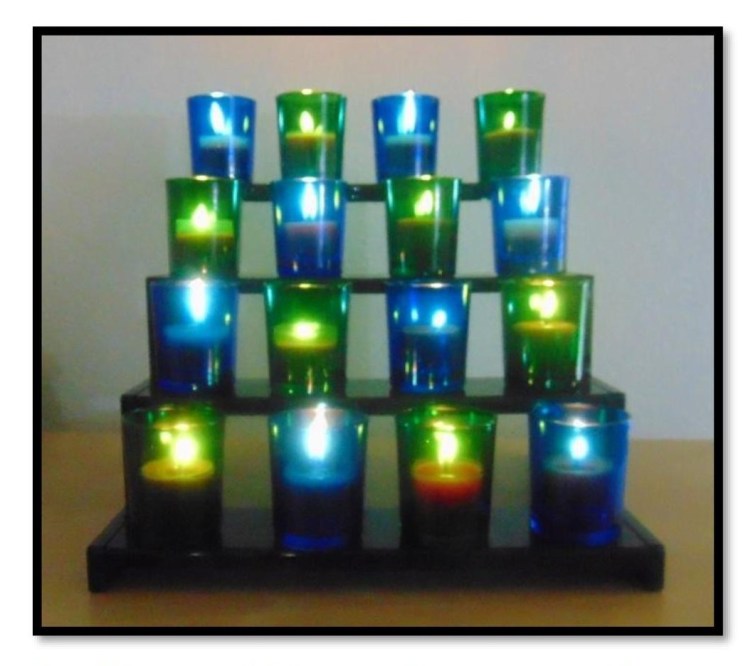
Have fun with “Church candles at home.” Contact
The Hermitage Within blog about creating “church
candles at home” with candle holders that match the
colors of your favorite sports team or your favorite
school!

Kim Burkhardt blogs about faith at The Hermitage Within. Thank you for reading this faith blog and for sharing it with your friends. While you are here, please feel welcome to provide support to sustain this blog ($$).
Pondering religious imagination….

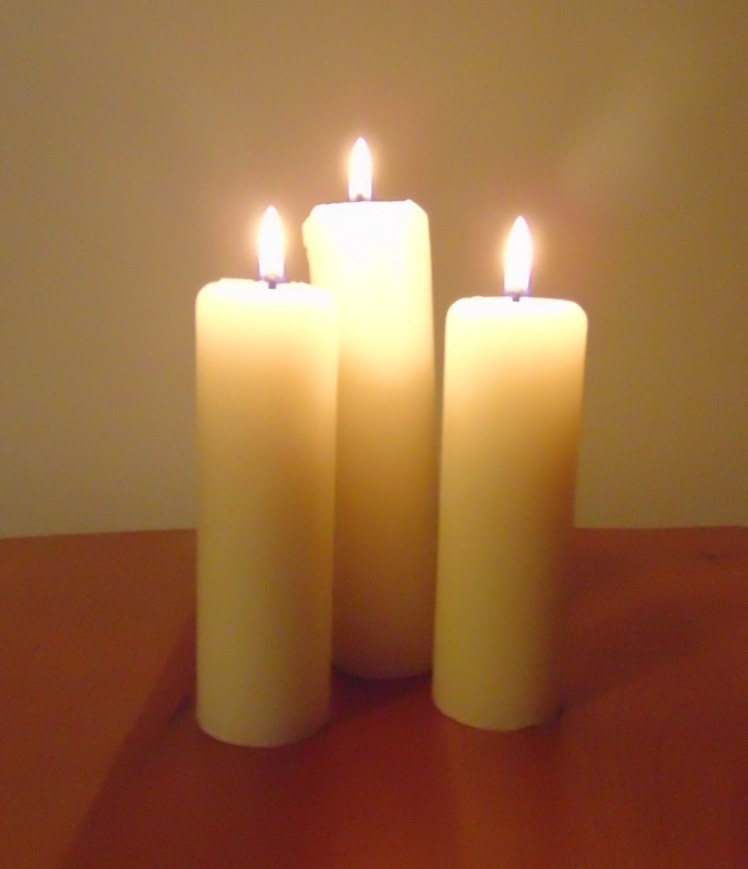
Trinity of candles

I was recently given Frank J. Cunningham’s Vesper Time: The Spiritual Practice of Growing Older. Early in the book, he mentions “The Catholic Imagination.”

I am intrigued by the phrase. I happened across the phrase once before and immediately recognized that yes, there is a “Catholic Imagination.”

When I first encountered the phrase “A/The Catholic imagination,” I recalled an experience circa 2011. In 2011, I was trying to discuss a matter with a couple of non-Catholics (they were both lovely, well-meaning people). We went in circles, got nowhere. They were trying one mental and verbal approach to exploring the matter at hand, I recognized that I was clearly approaching the subject very differently. At the time, I could recognize a difference in approaches, but I couldn’t articulate the contours of either approach. When I later “happened across” the phrase “The Catholic imagination,” I instantly recognized that my involvement in the above-mentioned discussion (2011) was attempting to frame the topic via a Catholic imagination while the other two parties were employing a secular approach. Even though I was a lapsed Catholic at the time, “The Catholic Imagination” had so thoroughly infused my thinking while growing up that it stayed with me even when I was away from church.

Google’s AI effectively synthesizes several credible-source descriptions of “The Catholic imagination”: “The Catholic imagination is a worldview seeing God’s presence in the physical world, viewing earthly life, objects, and experiences as channels of grace, rooted in the belief that Jesus’s humanity makes the sacred accessible through the material. It’s a sacramental perspective, finding deeper meaning and spiritual significance in everyday things, stories, and rituals, encompassing themes of sin, redemption, and ultimate hope through a framework of divine providence and the ‘complex of opposites’ (light/dark, good/evil).”

For those who live within – and/or were raised within – a particular faith tradition, do you recognize your tradition’s “style of imagination?” Do you see that “style of imagination” infusing how you see and interact with the people and events around you? Religious imagination truly exerts a powerful influence on how we live in the world – from how we interpret meaning within events, themes, etc. to how we communicate and interact with the people in our lives. It’s easy enough to know whether or not we bring explicitly-stated religious ideas into our daily life (“I believe that God is present in my life,” “I am religiously accountable for my behavior,” etc.). It’s another matter to recognize perhaps more implicitly-incorporated ideas – a ritualized pattern of looking at daily patterns in our lives or bringing a “complex of opposites” perspective into seeing the events in our lives that might not be shared by neighbors or co-workers (good/evil, light/dark, etc.).

Hmmm…… It might be interesting to undertake psychological studies contrasting people with a particular religious imagination to to people without such a perspective. For example, is there a distinct psychological roadmap to learning life’s “shades of gray” for individuals with a “complex of opposites” worldview? Maybe such studies have already been done?

Kim Burkhardt blogs about faith at The Hermitage Within. Thank you for reading this faith blog and for sharing it with your friends. While you are here, please feel welcome to provide support to sustain this blog ($$).

Book Review: Paths to the Heart – Sufism and the Christian East

Book: Paths to the Heart
Paths to the Heart: Sufism and the Christian East

I have recently been reading books about Eastern Orthodox Christianity. I have a particular interest in the contemplative tradition within Christianity and have discovered that there is a strong contemplative aspect within the Eastern Orthodox tradition.

Paths to the Heart: Sufism and the Christian East is a compilation of presentations from a conference held shortly after 9/11 where a group of people met to discuss similarities of the religious views between the Christian East (i.e.., Eastern Orthodox) and Sufi Muslim.

I am more than half-way through this book. What emerges in this book is engaging observations about the contemplative aspects of Eastern Orthodox and Sufi Islam. For anyone interested in the contemplative aspects of Eastern Orthodox, Sufi Islam, or both….. Paths to the Heart: Sufism and the Christian East is an insightful read.

For my particular area of interest – the contemplative prayer aspect within Christianity – I am learning in this book about Hesychasm – described by Wikipedia as “a contemplative monastic tradition in the Eastern Christian traditions of the Eastern Orthodox Church and Eastern Catholic Churches in which stillness (hēsychia) is sought through uninterrupted Jesus prayer. While rooted in early Christian monasticism, it took its definitive form in the 14th century at Mount Athos.”

Kim Burkhardt blogs at A Parish Catechist. If you are a new visitor, it would be great to have you subscribe to follow this blog (it’s free – thank you!). If you know someone who would like this blog, please share it with them and invite them to subscribe (thank you!).