For many of us, we first conceptualize prayer as mentally talking to God. Mentally speaking in sentences, much like we would talk to a person. Telling God what we want to say, submitting prayer requests (intercessions, our “wish list”), hoping for “an answer.”
Such prayer is certainly one way to initiate a prayer life.
There are many more ways to pray. Prayer is meant to be communication, a relationship. An analogy I heard – and like – compares prayer to a phone call. We wouldn’t just call a person we know, tell them what we want to say, then hang up as if communication were complete. Such phone calls wouldn’t help us sustain relationships with the people in our lives. That approach to prayer wouldn’t produce a full prayer life, either. Communication is relational. Prayer is relational.
God hungers to have a relationship with us – more than “one way phone calls” from us.
God hungers to be present in our lives, to transform our lives. God hungers to share love with us in a relational way in which we feel and experience God’s love for us. In order for this to happen, we need to participate in a two-way relationship with God. Prayer can be a truly interactive, relational activity in which we allow God to transform our lives. More than just a one-way phone call.
There are a myriad of ways pray. Several ways to pray include:
- Attending church is prayer
- Rote prayer, prayers of the liturgy: Lord’s Prayer, etc.
- Psalms (they are always sung!)
- Lectio Divina (reading faith books reflectively to take in the book’s meaning prayerfully)
- Talking to God the way we would talk to a person
- Contemplative Prayer (resting in God’s presence – sitting with God)
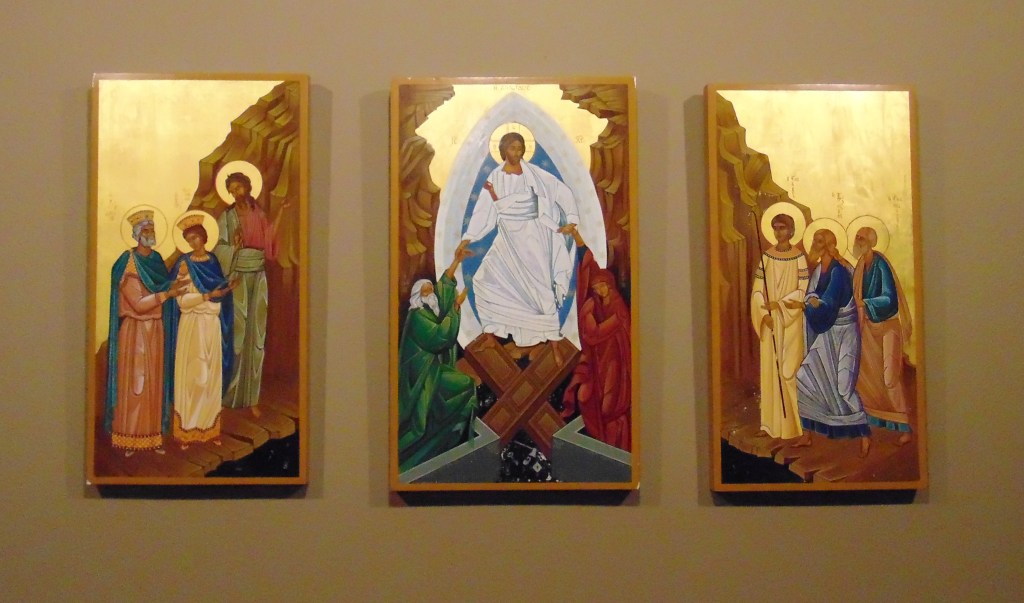
Personally, contemplative prayer is the type of prayer I find most meaningful – relationship-building. I have largely given up any “human language” in prayer (except for when I specifically do intercessory prayer); rather, my prayer life mostly consists of “resting in God’s presence.” I’m fortunate – I responded in 2016 to a “nudging of the Holy Spirit” in which I was gifted with a sustained period of feeling God’s presence in prayer. It was a life-transforming period of time; I found my way to Contemplative Outreach Northwest and now I talk to people about the power of God our lives. At present, my morning prayer consists of reflecting on the Anastasis icon above – an iconographic representation of the Harrowing of Hell; the Harrowing of Hell was Christ’s descent into Hell (between his death and resurrection) to free Adam and Eve from the result of The Fall. This particular version of Anastastis iconography is located in the chapel at St. Andrew’s Episcopal parish in Seattle, Washington. I find Anastasis to be a powerful depiction of God’s desire to free us, to transform us. God wants us to experience God’s love for us.
If prayer is unfamiliar to you or “less than what you’d like it to be,” consider taking on “prayer homework.” Pray twice per day for five minutes each time. Try out the various types of prayer listed above to find a style of prayer that you find to be of value. If you’d like to learn more about several types of prayer, my favorite book describing multiple types of prayer can be found here.
“Be still and know that I am God.” Psalm 46:10
Kim Burkhardt’s blog can be found at A Parish Catechist.