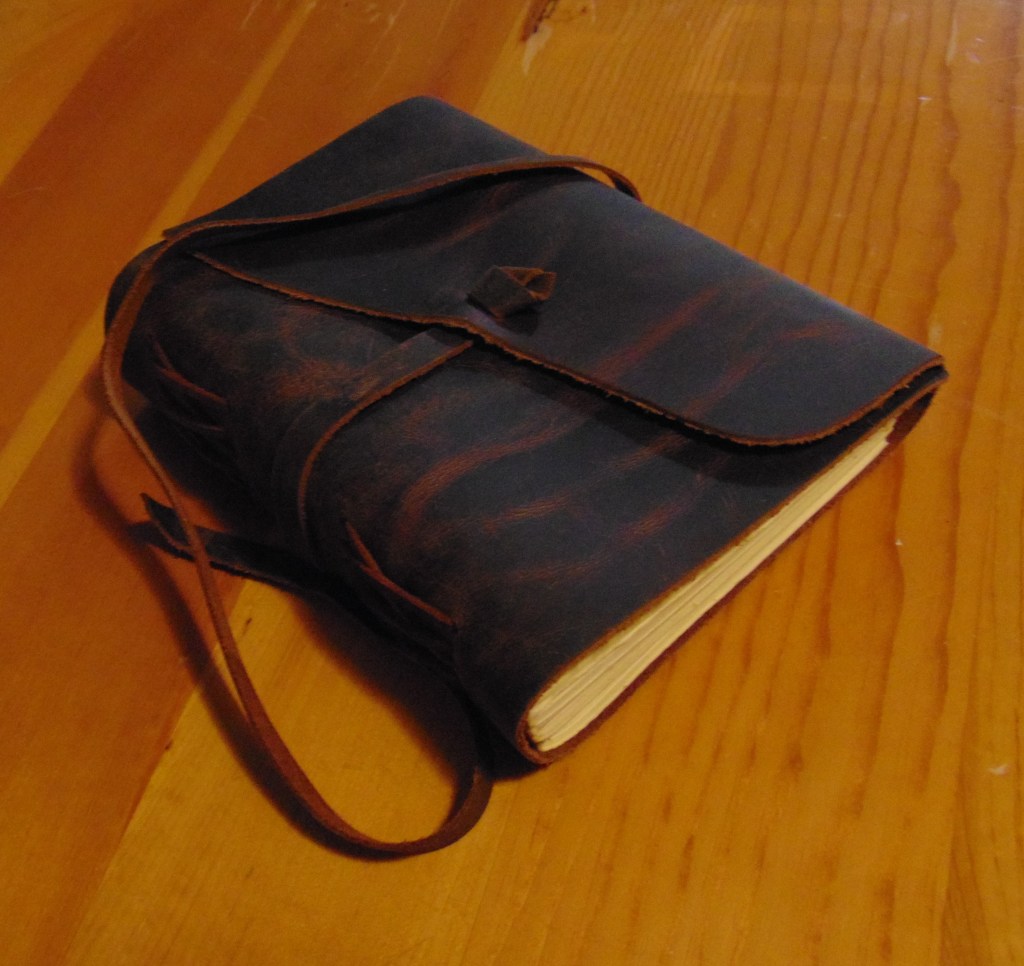
I was recently given a leather-bound journal.
Leather-bound books can bring to mind monks hand-copying books in medieval monasteries (surviving copies of such books sometimes have page border notations such as “it is very cold”). Alternately, we may think of learned scholars in the earliest days of books who wandered from place to place via dirt roads with a leather-bound manuscript in their possession.
We sometimes connect such imagery with thoughts of more spiritual times. ”If I lived in a medieval monastery, I would have been more faith-focused than I am today in a technologically-advanced city in the twenty-first century.” Different times and places each have their own zeitgeist, certainly. And, of course, there are places specifically dedicated to faith pursuits.
We can all be people of faith. Teresa of Avila, a sixteenth-century mystic in Spain, took on reforming the Carmelite religious order (she was a Carmelite nun) to return it to a more religiously-focused character than it had been for a period of time. Just as specifically religious environments can undergo re-invigoration, we can work to make our own lives spiritually vigorous even if we live in a secular environment. A commitment to growing in faith, participating in a faith tradition, daily prayer, making time regularly for activities such as reading faith-focused books and participating in faith-sharing groups, sharing about our faith development efforts (with a friend, a prayer group, a spiritual director, a pastor, etc.), living one’s faith by being of service to others – we can be faith-filled through a combination of all these things.
Daily prayer is a critical component of a faith-filled life. There’s a saying: “There can be no faith without prayer” (source uncertain). Within a theistic vision of faith, a life of faith must involve a relationship with the divine. Our relationships with the people in our lives are defined by relationship: social interactions. This also applies in our faith life – there can be no faith without a relationship with God. Our relationship with God unfolds in two ways – through focused interaction with God (prayer!) and by being of service to God’s children (every human being is a child of God). In the Acts of the Apostles (Acts 1:14), we read that the apostles – following Jesus’ ascension – “all joined together constantly in prayer, along with the women and Mary the mother of Jesus, and with his brothers.”
Not sure how to pray? Not sure how to deepen one’s prayer life? The first thing to know is to pray daily. Relationships aren’t built sporadically – they develop and grow through sustained interaction. Further, relationships are two-way. I like the analogy of comparing prayer to a phone call. We don’t sustain relationships with the people in our lives by phoning someone and saying, “I’m calling to tell you X” – then hanging up. Rather, a phone call is a give-and-take, two-way interaction. Prayer is the same way. We don’t just send our communication to God in a one-way phone call. We both communicate to God in prayer and also rest in stillness to allow God to present to us.
There are many ways to pray:
- Talking to God as we would talk to a friend (either verbally or through what’s often called “mental prayer”)
- Lectio Divina (a method of praying the scriptures reflectfully)
- Attending church services (church is itself a form of prayer)
- Religious singing (“Those who sing pray twice”)
- Contemplative prayer (for example, learn about this form of prayer through an organization called Contemplative Outreach)
Interested in reading more about prayer? A couple of great books include:
Clinging: The Experience of Prayer (Emilie Griffin)
The Tradition of Catholic Prayer (The Monks of Meinrad Monastery)
Kim Burkhardt blogs at A Parish Catechist and The Books of the Ages (and a member of the Association of Catholic Publishers). If you are a new visitor, it would be great to have you follow this blog (thank you!). If you know someone who would like this blog, please share it with them (thank you!). You can also support this blog by clicking here when you are going to shop on Amazon (that lands A Parish Catechist a commission on Amazon sales).

2 thoughts on “We can all strive to be monks-in-training!”