Perspectives: how we engage with specific faith concepts

Christian writers and denominations variously emphasize different religious ideas. ”Are we justified by faith or by works,” etc…..

In being a person of faith, we don’t get to choose whether the principles of faith are applicable in our lives. Just as we don’t choose whether gravity affects our physical movement or whether we need oxygen to survive, we don’t get to choose whether being faithful is contingent upon growing in “love your neighbor,” whether we should live the ten commandments, if we should develop our prayer lives, etc.

While we don’t get to choose whether truths of faith are applicable in our lives, it’s interesting to ponder how we engage with these ideas. Right now, for example, I’m reading L. Gregory Jones’ book Embodying Forgiveness (an important read!). He states in the book’s early pages that we can only receive God’s grace through learning to forgive (that’s how I read what he said, anyway). Yes, forgiveness is a nonnegotiable, important practice and we receive grace by forgiving others (“forgive us our trespasses as we forgive….”). With that said, I have experienced God’s grace in a situation unrelated to forgiveness (I tell that story here). Just because I’ve experienced God’s loving grace in a situation other than one of forgiveness -seemingly at odds with what I read – doesn’t mean that I don’t accept the need to forgive others in order to be in good relationship with God and with the people around me. 

As for the question of whether we are justified by faith or by good works, I accept my denomination’s argument that we are justified by faith. There are people who do good works without being a person of faith – but one cannot be truly faithful without performing good deeds. A faithful life calls us to care for other people (i.e., “faith without works is dead”).

Some faith precepts “get our attention” at different times in our lives (and in different ways). That’s okay. Engaging with the faith principles that reach us at any given time will lead us in “continuous conversion.” “The first work of the Holy Spirit is conversion. Moved by grace, man turns towards God…..(CCC#1989).” As long as we are engaged in growing in faith – with a healthy level of discipline – we are moving forward (I am drawn to the idea of continuous conversion!). What matters most – I think – is that we allow God to direct us in the direction(s) God wants us to go. When dry periods in our faith experience come along – and they do – we must simply continue trying to grow in faith. Even John of the Cross (my second-favorite mystic, after Teresa of Avila with whom he worked) wrote of seemingly dry periods (he said to continuing praying even when prayer seems dry – or dark; he rightly said that we’ll see afterward that God has worked within us during dry/dark periods of prayer, even if we didn’t see it at the time).

Kim Burkhardt blogs at A Parish Catechist and The Books of the Ages (and a member of the Association of Catholic Publishers). If you are a new visitor, it would be great to have you follow this blog (thank you!). If you know someone who would like this blog, please share it with them (thank you!). You can also support this blog by clicking here when you are going to shop on Amazon (that lands A Parish Catechist a commission on Amazon sales).

List: examples of faith being hard work, path to joy

Stairs, moss

Living Christianity is both hard work and a path to joy and freedom.

Examples of having to work at living Christianity include:

  • “It is easier for a camel to pass through the eye of a needle than for a rich man to enter the kingdom of God” (Matthew 19:24). Putting faith into practice – such as giving up our attachment to worldly goods – is a challenge.
  • The bumper sticker “Love your neighbor means everybody” (a reflection on Matthew 22: 34-40: “The greatest commandments are…love the Lord your God….and….love your neighbor as you love yourself.”) speaks to the heart of Christianity and of the Christian faith being hard work.  It’s easy to love the people we like. It’s harder to love people who we are naturally inclined to dislike (the disheveled homeless person who went through our trash and left a mess, a political figure we disagree with, the difficult relative, an argumentative person at work, etc.). Yet, “love your neighbor” does mean “everybody” – we don’t get to pick and choose. Many or all aspects of living the Christian faith are required to practice treating everyone with dignity and grace. Loving people is a verb – a self-giving action. If we were all to practice this well (hard work!), the world would be a better place.
  • The pastor and writer L. Gregory Jones writes (in his book Embodying Forgiveness) ““Christian forgiveness involves a high cost, both for God and for those who embody it. It requires the disciplines of dying and rising with Christ, disciplines for which there are no shortcuts, no handy techniques to replace the risk and vulnerability of giving up ‘possession’ of one’s self, which is done through the practices of forgiveness and repentance.” Yes, there is a ‘high cost’ to doing forgiveness – but also high rewards.

While there are plenty of examples of how living one’s faith is a lifelong effort (an “ongoing conversion,” in challenging ways such as those noted above), there are also joys:

  • “And the peace of God, which surpasses all comprehension, will guard your hearts and minds in Christ Jesus (Phillipians 4:7).”
  • “Blessed are those who hunger and thirst for righteousness, for they will be filled (Matthew 5:6).”
  • Living faith principles – including surrender to allowing God to transform us – turns us into the people God intends for us to be. God wants us to be happy and will – if we allow it – adjust who we are to that purpose.
  • In living out the principles of faith, we contribute positively to our communities – helping to make the world a better place.
  • Living faith principles teaches us to bring joy into the lives of other people – which is among the primary reasons for us to be alive. We are all God’s children; bringing joy into the lives of God’s children is a wonderful thing!

The Christian path is a great, joyous path. A loving path that turns us into better people.

Kim Burkhardt blogs at A Parish Catechist and The Books of the Ages (and a member of the Association of Catholic Publishers). If you are a new visitor, it would be great to have you follow this blog (thank you!). If you know someone who would like this blog, please share it with them (thank you!). You can also support this blog by clicking here when you are going to shop on Amazon (that lands A Parish Catechist a commission on Amazon sales).
Book Review: Embodying Forgiveness

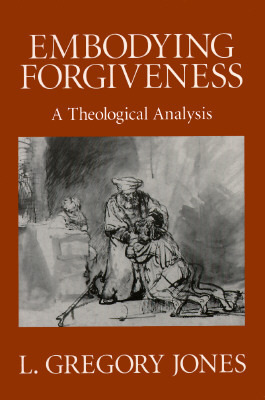
Embodying Forgiveness: A Theological Analysis

This book, Embodying Forgiveness by Methodist pastor L. Gregory Jones, makes forgiveness more possible by demonstrating its’ theological necessity. Therefore, this is an important grow-my-faith book for individuals committed to truly living their faith. The book challenges readers to grow in ways that can be uncomfortable (growth that’s challenging to achieve can move us with particular stride along the long-haul journey of genuine maturing in faith).

This is a book that must be read slowly. The concepts presented grab a reader’s attention such that one must pause to take in the book’s ideas, find the emotional capacity to live each aspect of the book’s insights.

Sample excerpts include:

  • “….people are mistaken if they think of Christian forgiveness primarily as absolution from guilt. The purpose of forgiveness is the restoration of communion [between parties] (page five).”
  • “Christian forgiveness involves a high cost, both for God and for those who embody it. It requires the disciplines of dying and rising with Christ, disciplines for which there are no shortcuts, no handy techniques to replace the risk and vulnerability of giving up ‘possession’ of one’s self, which is done through the practices of forgiveness and repentance. This does not involve self-denial, nor the ‘death’ of self through annihilation. Rather, it is learning to see oneself and one’s life in the context of communion [i.e., community] (pages 5-6).”

A worthwhile read!

Kim Burkhardt blogs at A Parish Catechist and The Books of the Ages (and a “Content Creator/Individual” member of the Association of Catholic Publishers). If you are a new visitor, it would be great to have you follow this blog (thank you!). If you know someone who would like this blog post, please share it with them (thank you!). You can also support this blog by clicking here when you are going to shop on Amazon (that lands A Parish Catechist a commission on Amazon sales).
Book Reviews: Books about “The Creed”

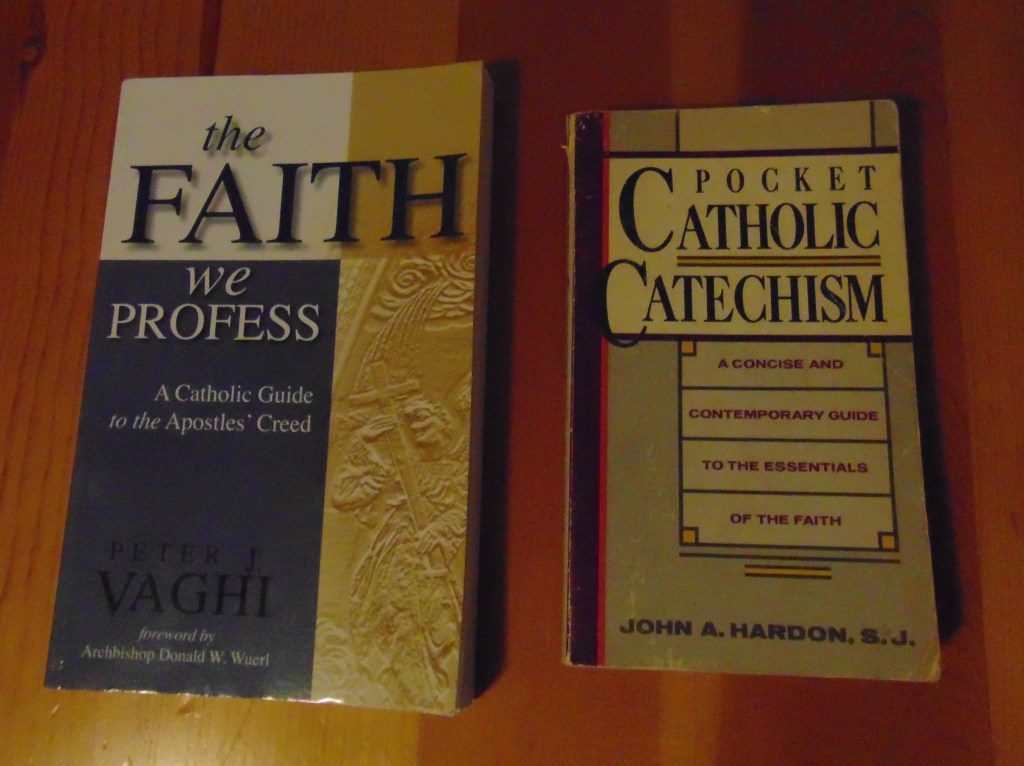
When I was in college, I found myself unable to describe what beliefs made my denomination distinct when talking to people who belonged to other denominations. “I just know my denomination, I don’t know how to explain it” (I have since heard other people say the same thing, usually said with dismay similar to what I felt). I was surprised by my inability to articulate the beliefs of my denomination. So, I bought and read Fr. John A. Hardon’s Pocket Catholic Catechism to be better able to articulate denominational beliefs (I still have that book).

More recently, I came upon – and started reading – Fr. Peter J. Vaghi’s The Faith We Profess: A Catholic Guide to the Apostles’ Creed.

Both of these books – and any number of books like them – provide a line-by-line explanations of the Apostles Creed and/or the Nicene Creed. These types of books are worth reading for church-attendees and non-church goers alike – these books inform us about the basic beliefs that many Christian denominations profess (the two books I mention here are written from a denomination-specific stance). While my reading of The Pocket Catholic Catechism in college may have broadly more Christian than the denomination-specific book I sought, there was certainly Catholicism within it…..

It’s worth providing a historical context about the Nicene Creed and the Apostle’s Creed. Christianity grew out of a Jewish context, Jesus’s presence and his teachings. Following Jesus’ time on earth, the faith tradition that became Christianity was initially a Jewish sect that began attracting non-Jewish converts – then becoming a distinct religion named after Jesus Christ (i.e., “Christ-ianity”). As Christianity became a distinct – and non-Jewish – religion, it took time for Christianity to fully develop the contours that we now recognize. In the early 300’s, church leaders recognized that any number of groups and individuals were communicating their own ideas and beliefs about what defines Christianity; not all those ideas were compatible with one another, nor were all ideas what we now call orthodox (“mainstream” if you like) – some ideas were viewed as heretical. Therefore, church leaders met in Nicea (in modern-day Turkey) in the year 325 (i.e., the first “Council of Nicea”) and established the Nicene Creed – laying out the core beliefs of Christianity. The Apostle’s Creed – which is of very similar content – is likewise accepted as Christianity’s “Creed” of beliefs. Many Christian denominations accept and profess one or both of these Creeds. These Creeds are often professed by congregations at church services.

These worthwhile books provide thoughtful discussion of exactly what the Apostle’s Creed and the Nicene Creed mean. Simply reciting one of these Creeds at church can be a rote activity; really understanding the Creeds requires thoughtful study. It can be worth taking a fresh look periodically at The Creeds – and these types of books – to see how our perspective and reflections on The Creed changes as we move through life.

Kim Burkhardt blogs at A Parish Catechist and The Books of the Ages (and a “Content Creator/Individual” member of the Association of Catholic Publishers). If you are a new visitor, it would be great to have you follow this blog (thank you!). If you know someone who would like this blog post, please share it with them (thank you!).

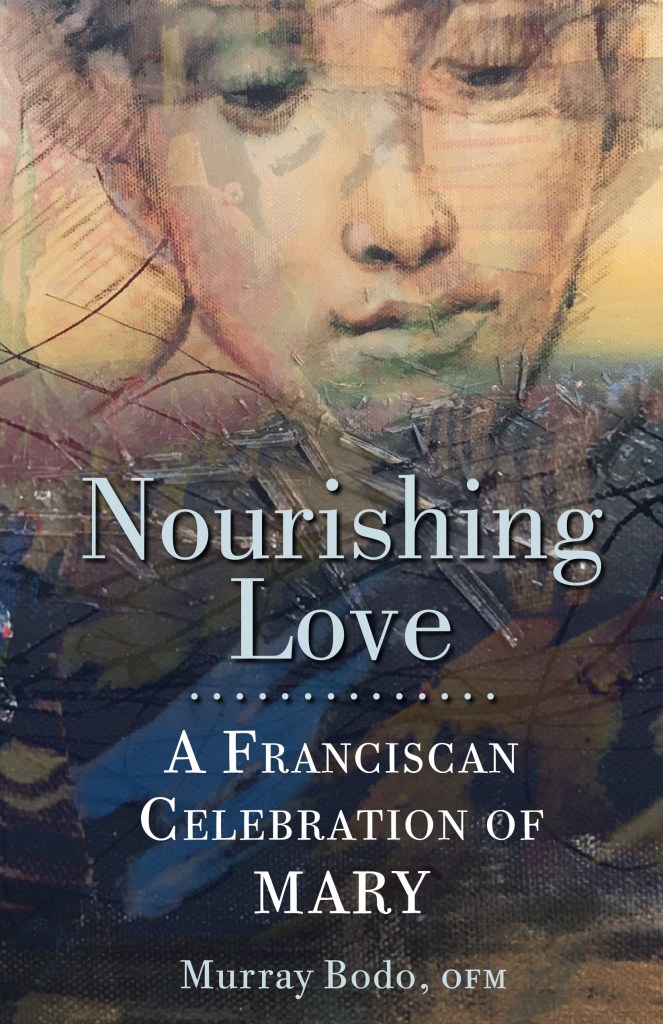
Book Review: Nourishing Love – A Franciscan Celebration of Mary

This book takes readers on a novel way of exploring Mary’s life (no, not a novel). For those of us who tend think of Mary either historically and/or as a saint, this book brings us an additional way to consider Mary.

Franciscan author (and priest) Murray Bodo offers us something similar to that of The Chosen TV series: a conceptual view of what it could have been like living Jesus’ or Mary’s lives – making their day-to-day lives more tangible for us than what many of us consider when reading the Gospels. Both this book and The Chosen contain historical aspects of the lives of Mary and Jesus (respectively). Reading historical accounts alone – however – don’t necessarily take us into thinking about the daily aspects what they did and felt as people.

In this book, Nourishing Love, there are reflections that take us to ponder, “what thoughts did Mary ponder?” After Jesus offered her and John to one another as mother-and-son, what conversations Mary and John have about Jesus? Possibly ponderings by Mary and possible – plausible – conversations between Mary and John are presented here to bring us into considering their lives on a very human level.

At one point in the book, the author writes, “Since Jesus was both God and man, he had his mother’s genes and was deeply influenced genetically, as most of us are, by his mother. He was Mary’s son, prompting us to imagine how Mary herself was in fact revealed in the person of her son.” Hmm….. Did genetics cause Jesus to look like his mother? Did Mary and Jesus share similar voice inflections? Did Jesus maintain some of Mary’s habits once he became an adult (ate the same foods for breakfast, had the same evening routines, etc.)? How much did Mary’s human personality influence Jesus’ human personality? The author of this book observes that the stories Mary told Jesus during his infancy and childhood may have influenced the types of stories Jesus chose to tell as an adult – including the parables he told. How she cared for the people around her could have been socially instructive for the human Jesus.

The way this book is constructed made me think of Ignatian exercises in terms of the creativity brought to subjects of faith. There’s a degree to which I felt uncomfortable with this book – I would more naturally gravitate to an academically-oriented sociological construct/analysis of people’s daily lives in first-century Palestine to get a sense of Mary’s life (that type of book would also be interesting!). Sometimes, though, discomfort is good. Discomfort can challenge us to consider topics in new ways; new perspectives help us grow.

Kim Burkhardt blogs at A Parish Catechist and The Books of the Ages (and a “Content Creator/Individual” member of the Association of Catholic Publishers). If you are a new visitor, it would be great to have you follow this blog (thank you!). If you know someone who would like this blog post, please share it with them (thank you!).

Feast Day of Hildegard von Bingen

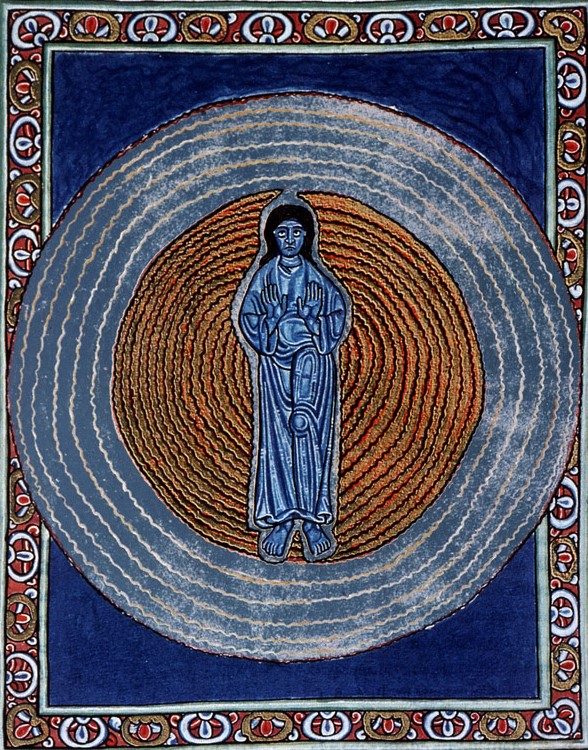
Above: Hildegard’s own artwork of the Trinity

Today – September 17 – is the Feast Day of Hildegard von Bingen: a saint, polymath (a person with significant multiple talents), and Doctor of the Church (Doctors of the Church are saints recognized for having made significant contributions to the Catholic Church).

I have been listening to Hildegard’s music for several years. She lived her life in the region of Germany where my father’s mother’s ancestors later lived and was a Benedictine (I am a parishioner at a St. Benedict parish – another personal reason to like her!).

Hildegard – with her wide-ranging interests, talents, activities, and achievements – is broadly popular across many social strata.

The following summary of Hildegard’s life comes from Wikipedia:

Hildegard of Bingen c. 1098 – 17 September 1179)…. was a German Benedictine abbess and polymath active as a writer, composer, philosopher, mystic, visionary, and as a medical writer and practitioner during the High Middle Ages. She is one of the best-known composers of sacred mononphony, as well as the most recorded in modern history. She has been considered by scholars to be the founder of scientific natural history in Germany.”Hildegard of Bingen… c. 1098 – 17 September 1179)…. was a German Benedictine abbess and polymath active as a writer, composer, philosopher, mystic, visionary, and as a medical writer and practitioner during the High Middle Ages. She is one of the best-known composers of sacred mononphony, as well as the most recorded in modern history. She has been considered by scholars to be the founder of scientific natural history in Germany. Hildegard’s convent elected her as magistra (mother superior) in 1136. She founded the monasteries of Rupertsberg in 1150 and Eibingen in 1165. Hildegard wrote theological, botanical, and medicinal works, as well as letters, hymns, and antiphons for the liturgy. She wrote poems, and supervised miniature illuminations in the Rupertsberg manuscript of her first work, Scivias. There are more surviving chants by Hildegard than by any other composer from the entire Middle Ages, and she is one of the few known composers to have written both the music and the words. One of her works, the Ordo Virtutum, is an early example of liturgical drama and arguably the oldest surviving morality play. She is noted for the invention of a constructed language known as Lingua Ignota.”

A timeline of her achievements is listed here by worldhistory.org .

If you would like to read up on individual saints, Hildegard’s life story provides many interesting facets to read up on.

Kim Burkhardt blogs at A Parish Catechist and The Books of the Ages. If you are a new visitor, it would be great to have you follow this blog (thank you!). If you know someone who would like this blog post, please share it with them (thank you!).

Being a person of faith: more than mental beliefs about religion

Photo: Window at Clonmacnoise Monastery, Co. Offaly, Ireland

In his book Opening to God: Lectio Divina and Life as Prayer, Irish poet David G. Benner writes “Too often faith is reduced to beliefs. But cognitive ascent to propositions has very little to do with genuine faith, which is more a posture of the heart than of the mind. Faith in God is leaning with confidence into God. (page 32)”

I spent years “trying to think my way to God.” That doesn’t work. In 2016, I had a re-conversion experience in which I felt God’s love for me; my faith moved into “a posture of the heart” that I had been trying for years to experience (my faith story is told in more detail here.).

So, how does one move from merely “reducing faith to a set of beliefs” to faith that is experienced and lived? A few thoughts:

  • Certainly, a living faith does necessitate religious learning. Who is God? Who are we in relationship to God? What are the precepts of a life of faith? Individual faith traditions provide such instruction. It is then up to us to allow these precepts to move into our being and to incorporate these precepts into our lives (i.e., incorporate these ideas into how we relate to God, relate to other people, and live our lives).
  • Faith is experiential: a relationship with God. Faith becoming experiential involves doses of grace, surrender, prayer, and love. Living faith is made possible through grace given to us by God (in the Christian tradition, this grace is conferred upon us beginning with baptism….and then grace continues to show up at other times when God knocks on our door). Our portion of “doing faith” – what David G. Benner describes as “leaning with confidence into God” – requires surrender and prayer. Surrender is an emotional giving up, ascenting to allow God to take the driver’s seat in our lives. Prayer is where we participate in a relationship with God. Rather than prayer being a uni-directional monologue of us talking at or to God, prayer is relational and interactive. In prayer, we both communicate to God and receive the presence of God (analogy: our relationships with the people in our lives are likewise interactive rather than uni-directional). I write more about prayer here. The fruits of grace, surrender, and prayer become “the fruits of the spirit” listed in Galatians 5:22-23: “”love, joy, peace, forbearance, kindness, goodness, faithfulness, gentleness and self-control.”
  • We live our faith through how we live. Growing into being a person of faith involves allowing our inner work of faith (grace, surrender, prayer, and resulting love – listed above) to direct our being-ness in the world. A life of faith is absolutely about our own relationship with God, but it is also essentially more than that – life isn’t just about us personally or about our own relationship with God. We are here to be of service to all of God’s children. Everyone is a beloved child of God, our lives are measured to the degree that we move into loving God’s children in thought and deed. Living our faith is about “love God and love your neighbor” (Matthew 22: 36-40) and applyin the precepts of one’s faith tradition (“The Golden Rule,” “Christian charity,” etc.).

Faith is more than a set of beliefs – it is how we relate to the divine and live among God’s children. Acts 17:28: “It is in God that we live and move and have our being.”

Kim Burkhardt blogs at A Parish Catechist and The Books of the Ages. If you are a new visitor, it would be great to have you follow this blog (thank you!). If you know someone who would like this blog post, please share it with them (thank you!).

Hearing God’s voice….in stillness

…….It is often in the stillness where we hear – and can respond to – the promptings of God’s voice.

In 1 Kings Chapter 19 (19:11-13), we read: “The Lord said, ‘Go out and stand on the mountain in the presence of the Lord, for the Lord is about to pass by.’ Then a great and powerful wind tore the mountains apart and shattered the rocks before the Lord, but the Lord was not in the wind. After the wind there was an earthquake, but the Lord was not in the earthquake. After the earthquake came a fire, but the Lord was not in the fire. And after the fire came a gentle whisper. When Elijah heard it, he pulled his cloak over his face and went out and stood at the mouth of the cave. Then a voice said to him, ‘What are you doing here, Elijah?’”…..

Jesus also frequently went to quiet desert spaces to pray to his father. Prayed in solitude and stillness.

For us, a relationship with God likewise requires a willingness to “go inward” – to step away from life’s hustle and bustle encouraged by our outwardly-focused society and sit in stillness. Stillness is uncomfortable for some. Pausing to go inward isn’t always comfortable – we bump up against our own inner tumult. Yet, prayer can get us through such tumult.

When we find a relationship with God – an interactive, two-way interaction rather than a one-way monologue of intercessory prayers from us directed to God (we wouldn’t relate to the people in our lives exclusively via uni-directional monologues!) – there comes a discovery that God sits with us in prayer. God’s felt presence in our lives can – and does – provide “peace that passeth all understanding.”

We also experience a relationship with God by being of service to others – by working to improve the lives of other people (Jesus told his apostles that the greatest commandments are “Love God and love your neighbor” – Matthew 22: 36-40 ). Mother Teresa lived this in the streets of Calcutta. Richard Rohr focuses on the need for both rest in God’s presence and the need to be active in the world through his Center for Action and Contemplation.

Wondering about how to go about stillness and prayer? Start praying. If you’re not praying yet, start praying twice per day for five minutes each time. Sit in stillness – go with whatever comes in that stillness and “become comfortable” with whatever comes in that stillness. Find someone with whom to discuss what you experience in stillness. Wondering how to pray, how to move deeper in prayer? Consider:

Kim Burkhardt blogs at A Parish Catechist and The Books of the Ages. If you are a new visitor, it would be great to have you follow this blog (thank you!). If you know someone who would like this blog post, please share it with them (thank you!).

Interested in the contours of your inner faith journey?

As an introvert and as one easily drawn to religious ritual, the contours of the inward journey – both my journey and the journeys of other people – have always been of interest to me. Do you also take an interest in the experience of the inner faith journey?

Some people, I hear, avoid their inner experience. The human condition inherently includes challenges – including dark corners within our individual psyches and the uncomfortable emotional debris we acquire from bumping up against life’s difficulties. Thus, some people prefer to focus outwardly so as to avoid the darkness and difficulties that lie within. Some societies encourage an outward-focused, extroverted existence.

Yet, our inner journeys are ever so remarkable and worth engaging in! Any darkness that is avoided doesn’t go away by ignoring it. One has to engage with it, sort through it, walk through it. “Wrestle one’s demons,” if you will. Engaging with one’s inner experience can lead to healing from life’s ragged edges, to a more fruitful wholeness, and to the amazing relationship with God that God wants to have with us – a journey that is very worth the trip.

A number of ponderings are offered below from writers, quotes, and books about engaging with our inward faith experience:

Treading into the Spiritual Depths: The (not depressing!) Dark Night of the Soul

Teresa of Avila and her protege John of the Cross – 16th-century Spaniards – are my two favorite mystics. In his book Dark Night of the Soul, John of the Cross writes about how the sometimes unviewable-to-us aspects of our inner faith journey are part of where God works within us to transform us (rather than this title being about a depressive view on things!). Attentiveness to our inner journey can allow us to at least a glimpse of when this (at least somewhat) unviewable aspect of our spiritual growth is being wrought within us – particularly if we have an active relationship with God in prayer (I write about such prayer here).

Gerald May’s book of the same title speaks to this idea about “The Dark Night of the Soul”: “May emphasises that the dark night is not necessarily a time of suffering and near despair, but a time of deep transition, a search for new orientation when things are clouded and full of mystery. The dark gives depth, dimension and fullness to the spiritual life.”

Is there joy in the inner experience?

Absolutely. Irish writer John O’Donohue articulates this well: “I would love to live like a river flows, carried by the surprise of its own unfolding.”

Prayer is also where we inwardly have a personal relationship with God via prayer. When such a relationship is an active one, it can be amazing and fruitful. I sometimes write about the particulars of an active prayer life; please feel welcome to read one such blog posting here.

The Inner Journey and Walking

I’m known for walking. All over town. Friends started something of a “Where’s Waldo” conversation about where they see me pop up around town (they were entertained by this conversation!). “I – or we – saw Kim walking ‘over here,’ at ‘X intersection’ or at ‘Y location….'” As a result of people knowing that I walk, a friend gave me a book called Wanderers: A history of women walking and a book by Thich Nhat Hanh called How to walk. I loved both books. Walking, as discussed by these books, is a time when some people – myself included – ponder. It turns out that a search on Goodreads for books titled “Women who walk leads to a long listing of relevant books. There is even a network called Women Who Walk.

Enjoy the inner journey!

Kim Burkhardt blogs at A Parish Catechist and The Books of the Ages. If you are a new visitor, it would be great to have you follow this blog (thank you!). If you know someone who would like this blog post, please share it with them so they can subscribe (thank you!).

Book Review: Daily strengths for daily needs

Thank you to A Parish Catechist friend Karen Chartier for this book review. Much appreciated!

Book Review: Daily Strengths for Daily Needs

Mary W. Tileston

The Family Inspirational Library

Copyright 1928

Mary Tileston’s book Daily Strengths for Daily Needs offers a compilation of quotes from thoughtful, spiritual thinkers throughout the ages, from those found in the Bible to R.W. Emerson, to Marcus Antoninus, to George Elliot, to St. Frances de Sales — and scores of others.

Published first in 1884, it remains pertinent to the present. ‘In these days of great emotion and radical changes, we need the steady, persistent and refreshing inspiration of spiritual thoughts, which, entering the texture of our life in the morning, will guide and refresh us through the day, or, in the evening, give a sense of confidence and peace.’ opens the preface, and both the need and the outcomes outlined are relevant.

I was given this book by a friend and have been inspired by it throughout the year. I highly recommend it. Below are examples of quotes of Tileson’s book.

The one who will be found in trial capable of great acts of love, is ever the one who is always doing considerate small ones.          F. W. Robertson

A man is relieved and gay when he has put his heart into his work and done his best; but what he has said or done otherwise, shall give him no peace.                   R. W. Emerson

We may, if we choose, make the worst of one another.  Everyone has his weak points; everyone has his faults; we may make the worst of these; we may fix our attention constantly upon these.  But we may also make the best of one another.  We may forgive, even as we hope to be forgiven…By loving whatever is loveable in those around us, love will flow back from them to us, and life will become a pleasure instead of a pain; and earth will become like heaven; and we shall become not unworthy followers of Him whose name is Love.                      A. P. Stanley

Book Reviewer: Karen Chartier