Book Review: Dictionary of Early Christian Beliefs
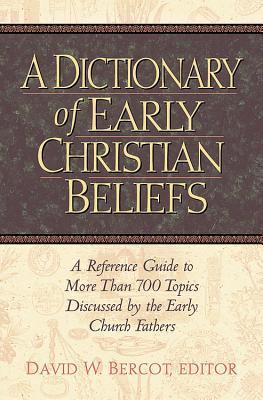
Dictionary: Early Christian Beliefs

There was a time when I would have read this reference book from cover to cover (I am among the readers who believe that when I read a book, I should read the entire book…..).

This is a useful, scholarly book to have on one’s bookshelf as a reference to inform one’s study of any number of topics. I am reading some of it now and plan to refer to it on occasion as the reference book it is intended to be.

Christianity is 2,000 years old. In 2024, the majority of us – with the possible exception of those Biblical scholars who specialize in Early Christian Literature – are not going to be familiar with the ins and outs of the topics discussed in the early church. Nor are most of us current on the etymology of what every word meant 2,000 years ago (“dictionary definitions” of words and the cultural context of vocabulary changes over time…).

“Sure,” some will say, “We know what early Christians were talking about. They were talking about Jesus, the resurrection, the gospels, and how to be Christian.” Yes, that’s true. But how exactly did those conversations unfold in Palestine, Greece, Turkey, etc. in, say, the year 75, 125, or 300 AD?

The gospels weren’t written down until several decades after Christ’s death. Jesus said during his lifetime that he would return during “this generation;” thus, it initially seemed unnecessary to Jesus’ contemporaries to write down his life and teachings for future generations…. Eventually, it started to become clear that he wasn’t coming back imminently, so his narrative began to be written for posterity. It then took time for the early church to decide which gospels – from among the gospels that were written down – are canonical (accepted as church doctrine). It wasn’t immediately clear to the early church that “the Bible” was going to include (and only include) Matthew, Mark, Luke, and John.

Likewise, it took time for the early church to develop and “come together” on any number of topics that we recognize today as “Christianity.”

So, precisely which “Christian topics” were under discussion in the early days of Christianity? This book – A Dictionary of Early Christian Beliefs – provides useful insights in to this question. Having this reference on one’s bookshelf can inform our understanding in any number of settings – when studying Sunday’s readings at church, when we want to learn more about a specific aspect of Christianity, when studying church history, etc.

A sampling of several topical entries in this 704-page resource include:

  • Christ, Divinity (how the early church came to understand this one topic gets 25 pages!)
  • Descent into Hades
  • Gifts of the spirit
  • “Keys of the Kingdom”
  • Patriarchs
  • Paul, apostle
  • Prayer
  • Rapture
  • Schism
  • At the end of the book, there are “Quotable quotes from the Early Christians.”

I appreciate having this book on my bookshelf.

Kim Burkhardt blogs at A Parish Catechist and The Books of the Ages (and a member of the Association of Catholic Publishers). If you are a new visitor, it would be great to have you follow this blog (thank you!). If you know someone who would like this blog, please share it with them (thank you!). You can also support this blog by clicking here when you are going to shop on Amazon (that lands A Parish Catechist a commission on Amazon sales).
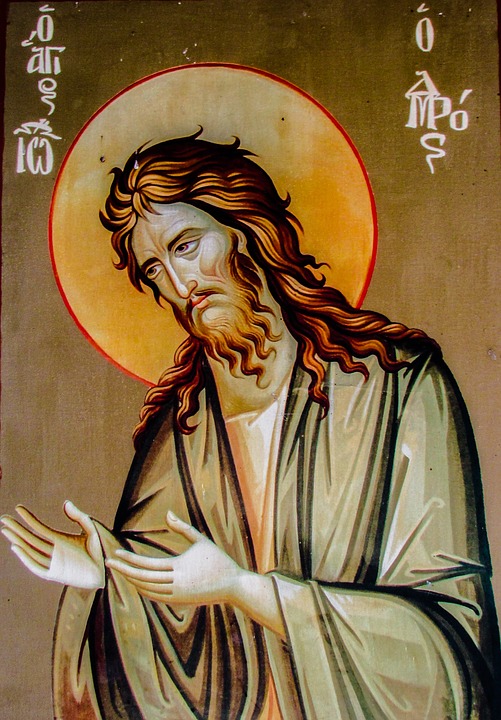

Pondering Judas, Job, and the Prodigal Son

Every year. we hear the salvation story at Easter . God loved us so much that he sent his only son to die for our sins.

Our salvation involved Jesus’ death, so his death was predestined. So, someone – some human – had to somehow be complicit in Jesus’ death?

When Judas came to realize what he had done – that he had betrayed Jesus such that this betrayal was to involved in the circumstances of Jesus’ death – he took his own life.

Given that it seems that one of us – some human – had to somehow be complicit in Jesus’s death…. Hmmm…. This raises difficult questions about the circumstances involvingJudas.

It’s fine for God to decide to die for our sake. But to necessitate that some human(s) be complicit? Have some human(s) end up with Jesus’ betrayal on their conscience? How fair is that?

When I raised this for discussion with someone recently, I heard it argued that Judas had free will. He didn’t have to betray Jesus. Further, Judas repented to the chief priests and elders when he realized the consequences of what he had done (that Jesus was to be crucified). But, somehow someone had to be complicit in Jesus’ death (betrayal, hanging Christ on the cross)? So, someone was going to have this on their conscience – somehow? I also heard it said that free will means that Judas didn’t have to take his own life. He could have asked God for forgiveness (in fact, he did go so far as repenting to the chief priests – Matthew 27: 1 – 10).

What would you or I have done if we saw that we had betrayed Jesus toward death? Would we give in to despair the same way Judas did and take our own lives? Would we request forgiveness? Become bitter? Or??? It feels to me that such a burden would be worse than being Job.

Is there a way that Christ could have died for us without any individual humans ending up with a burden heavier than Job?

It didn’t occur to me until this week – when pondering Judas’ perspective – that Judas had the option of asking God’s forgiveness rather than giving into despair to the point of taking his own life. Requesting such forgiveness would have been amazingly difficult to do!!!! It took some effort to wrap my head around this. If Judas had the option of asking for God’s forgiveness – “The Prodigal Son on a much grander scale” – then what of us?

When we fall into despair – whether because of challenging circumstances seemingly beyond our control or because of difficult results of our own choices – how well do we turn to God and accept God’s love – and redemption, when necessary – in our lives? Compared to Judas [“Anguish beyond that of (of course, innocent rather than guilty] Job!” is my new phrase to contemplate guilty Judas), what’s so impossible in our circumstances that we can’t turn to God…. and to enter into a healing relationship with God in whatever form is necessary (forgiveness, redemption, allowing God to love us toward wellness, etc.)?

Kim Burkhardt blogs at A Parish Catechist and The Books of the Ages (and a member of the Association of Catholic Publishers). If you are a new visitor, it would be great to have you follow this blog (thank you!). If you know someone who would like this blog, please share it with them (thank you!). You can also support this blog by clicking here when you are going to shop on Amazon (that lands A Parish Catechist a commission on Amazon sales).

Death and new life

bird nest in tree

This image of an empty bird’s nest in a winter tree – with spring approaching – speaks visually to nature’s annual cycles of death and the anticipation of new life.

Seattle – where I live – is in the midst of a cold snap after a period of relative winter warmth. Many of us are ready for the increasing warmth and life that comes with the pending spring.

When I saw this empty bird’s nest and the similar-or-contrasting lack of leaves on the tree, I immediately thought of our own spiritual death, rebirth, and – for many people – the perpetual hope of new life. In Christianity, we learn to die to self. Christ died and rose again – for our salvation. Bird nests are often used year after year for the next year’s new baby birds. Annual cycles of new life. Soon, new leaves – another year of life (the color green of leaves symbolizes vibrancy) – will also begin to spring forth on this winter-cold, bare tree.

When I first tried to photograph this bird’s nest, I zoomed in with my camera in an attempt to photograph the bird’s nest and leaf-less tree branches – without the electrical and phone wires that are also visible when photographing the entire tree (i.e., the photo above).

I then realized that there is also value in photographing the broader tree showing the phone and electrical wires showing (see the photo below). Too often, we desire the vibrant new life that comes from dying to the darkest parts of ourselves…. Yet we let the wires in our lives – those distractions that prevent us from allowing God to rejuvenate new life in us – to prevent new vibrancy of life to emerge in us. Sticking to such distractions serves no good in our lives. How stubborn we can be in refusing to let go of that which keeps us bound to the darkness in and around us.

During this Lenten season, we anticipate the anniversary of Christ’s death and resurrection at Easter. Let us – during this Lenten season – allow God into our hearts to clean out that in each of us that needs to be cleansed. Welcome in new life of the spirit.

Allowing God to transform us into new life requires surrender. We give up control. We give up autonomy. In a sense, we give up whatever sense of “self” we cling to (“I may not like all of me, but ‘me’ is what I’ve got”). In today’s society, many of us must also begin to give up rampant individualism – an individualism that isolates us – to join the community of people around and among us. We are meant to live amongst one another.

Easter is coming.

bird nest in tree with wires


Kim Burkhardt blogs at A Parish Catechist and The Books of the Ages (and a member of the Association of Catholic Publishers). If you are a new visitor, it would be great to have you follow this blog (thank you!). If you know someone who would like this blog, please share it with them (thank you!). You can also support this blog by clicking here when you are going to shop on Amazon (that lands A Parish Catechist a commission on Amazon sales).
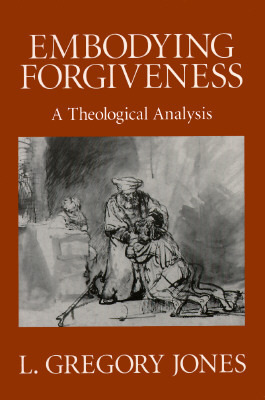
Further consideration of “Embodying Forgiveness”

Embodying Forgiveness: A Theological Analysis

I reviewed L. Gregory Jones’ book Embodying Forgiveness: A Theological Analysis in early January. The book is important enough to discuss a second time. 

Embodying Forgiveness is not a quick read. It’s written rather academically. It is densely packed with important ideas that require thoughtful reading. The book is about a sometimes difficult topic that can take great commitment to apply in one’s life. The book also supports a well-lived faith in which we – as a friend often says – do the “adulting” of living one’s faith (i.e., we grow up and live out the responsibilities we are called to do. In fact, this book helps us “find our inner adult!”). This is the type of book to read when we want to move beyond “easy principles of faith” and fluffy phrases to a faith in which we grow and mature. In other words – it draws us toward meaningful liberation and to living in right relationship with God and the people in our lives. The principles in this book can be intimidating, but that doesn’t mean that the book is a “nonjoyous downer – it’s liberating. In this book, we learn about living for our community rather than being self-centric. We learn about giving up self without being a doormat.  Good news: the author draws readers toward practicing forgiveness, making it palatable when forgiveness feel unpalatable.

This book is so important that I’m posting several excerpts (hint: yes, this is an effort to tempt readers to read the book!):

  • “Forgiveness has long been hard to embody, even among those committed to its importance” (page xi).
  • “…the craft of forgiveness involves the ongoing and ever deepening process of unlearning sin through forgiveness and learning, through specific habits and practices, to live in communion – with the Triune God, with one another, and with the whole Creation” (page xii).
  • The ideas in this book move “beyond….pious, sentimental affirmations that ‘Jesus is my friend,'” to friendship being “a much more formative and transformative relationship” (page xiii).
  • “….forgiveness serves primarily not to absolve guilt but as a reminder, a gracious irritant, of what communion with God and with one another can and should be: and so it should enable and motivate our protest against any situation where people (either ourselves or others) are diminished or destroyed” (page xvi).
  • “….the purpose of forgiveness is the restoration of communion, the reconciliation of brokenness” (page 5).

I am the type of reader who thinks that a book worth reading should be read in its’ entirety. In the case of this book, reading even just a chapter or two – and really applying it in one’s life – would move a person forward in a faith well-lived. A worthwhile read!

Kim Burkhardt blogs at A Parish Catechist and The Books of the Ages (and a member of the Association of Catholic Publishers). If you are a new visitor, it would be great to have you follow this blog (thank you!). If you know someone who would like this blog, please share it with them (thank you!). You can also support this blog by clicking here when you are going to shop on Amazon (that lands A Parish Catechist a commission on Amazon sales).

Perspectives: how we engage with specific faith concepts

Christian writers and denominations variously emphasize different religious ideas. ”Are we justified by faith or by works,” etc…..

In being a person of faith, we don’t get to choose whether the principles of faith are applicable in our lives. Just as we don’t choose whether gravity affects our physical movement or whether we need oxygen to survive, we don’t get to choose whether being faithful is contingent upon growing in “love your neighbor,” whether we should live the ten commandments, if we should develop our prayer lives, etc.

While we don’t get to choose whether truths of faith are applicable in our lives, it’s interesting to ponder how we engage with these ideas. Right now, for example, I’m reading L. Gregory Jones’ book Embodying Forgiveness (an important read!). He states in the book’s early pages that we can only receive God’s grace through learning to forgive (that’s how I read what he said, anyway). Yes, forgiveness is a nonnegotiable, important practice and we receive grace by forgiving others (“forgive us our trespasses as we forgive….”). With that said, I have experienced God’s grace in a situation unrelated to forgiveness (I tell that story here). Just because I’ve experienced God’s loving grace in a situation other than one of forgiveness -seemingly at odds with what I read – doesn’t mean that I don’t accept the need to forgive others in order to be in good relationship with God and with the people around me. 

As for the question of whether we are justified by faith or by good works, I accept my denomination’s argument that we are justified by faith. There are people who do good works without being a person of faith – but one cannot be truly faithful without performing good deeds. A faithful life calls us to care for other people (i.e., “faith without works is dead”).

Some faith precepts “get our attention” at different times in our lives (and in different ways). That’s okay. Engaging with the faith principles that reach us at any given time will lead us in “continuous conversion.” “The first work of the Holy Spirit is conversion. Moved by grace, man turns towards God…..(CCC#1989).” As long as we are engaged in growing in faith – with a healthy level of discipline – we are moving forward (I am drawn to the idea of continuous conversion!). What matters most – I think – is that we allow God to direct us in the direction(s) God wants us to go. When dry periods in our faith experience come along – and they do – we must simply continue trying to grow in faith. Even John of the Cross (my second-favorite mystic, after Teresa of Avila with whom he worked) wrote of seemingly dry periods (he said to continuing praying even when prayer seems dry – or dark; he rightly said that we’ll see afterward that God has worked within us during dry/dark periods of prayer, even if we didn’t see it at the time).

Kim Burkhardt blogs at A Parish Catechist and The Books of the Ages (and a member of the Association of Catholic Publishers). If you are a new visitor, it would be great to have you follow this blog (thank you!). If you know someone who would like this blog, please share it with them (thank you!). You can also support this blog by clicking here when you are going to shop on Amazon (that lands A Parish Catechist a commission on Amazon sales).

List: examples of faith being hard work, path to joy

Stairs, moss

Living Christianity is both hard work and a path to joy and freedom.

Examples of having to work at living Christianity include:

  • “It is easier for a camel to pass through the eye of a needle than for a rich man to enter the kingdom of God” (Matthew 19:24). Putting faith into practice – such as giving up our attachment to worldly goods – is a challenge.
  • The bumper sticker “Love your neighbor means everybody” (a reflection on Matthew 22: 34-40: “The greatest commandments are…love the Lord your God….and….love your neighbor as you love yourself.”) speaks to the heart of Christianity and of the Christian faith being hard work.  It’s easy to love the people we like. It’s harder to love people who we are naturally inclined to dislike (the disheveled homeless person who went through our trash and left a mess, a political figure we disagree with, the difficult relative, an argumentative person at work, etc.). Yet, “love your neighbor” does mean “everybody” – we don’t get to pick and choose. Many or all aspects of living the Christian faith are required to practice treating everyone with dignity and grace. Loving people is a verb – a self-giving action. If we were all to practice this well (hard work!), the world would be a better place.
  • The pastor and writer L. Gregory Jones writes (in his book Embodying Forgiveness) ““Christian forgiveness involves a high cost, both for God and for those who embody it. It requires the disciplines of dying and rising with Christ, disciplines for which there are no shortcuts, no handy techniques to replace the risk and vulnerability of giving up ‘possession’ of one’s self, which is done through the practices of forgiveness and repentance.” Yes, there is a ‘high cost’ to doing forgiveness – but also high rewards.

While there are plenty of examples of how living one’s faith is a lifelong effort (an “ongoing conversion,” in challenging ways such as those noted above), there are also joys:

  • “And the peace of God, which surpasses all comprehension, will guard your hearts and minds in Christ Jesus (Phillipians 4:7).”
  • “Blessed are those who hunger and thirst for righteousness, for they will be filled (Matthew 5:6).”
  • Living faith principles – including surrender to allowing God to transform us – turns us into the people God intends for us to be. God wants us to be happy and will – if we allow it – adjust who we are to that purpose.
  • In living out the principles of faith, we contribute positively to our communities – helping to make the world a better place.
  • Living faith principles teaches us to bring joy into the lives of other people – which is among the primary reasons for us to be alive. We are all God’s children; bringing joy into the lives of God’s children is a wonderful thing!

The Christian path is a great, joyous path. A loving path that turns us into better people.

Kim Burkhardt blogs at A Parish Catechist and The Books of the Ages (and a member of the Association of Catholic Publishers). If you are a new visitor, it would be great to have you follow this blog (thank you!). If you know someone who would like this blog, please share it with them (thank you!). You can also support this blog by clicking here when you are going to shop on Amazon (that lands A Parish Catechist a commission on Amazon sales).
Book Review: Embodying Forgiveness

Embodying Forgiveness: A Theological Analysis

This book, Embodying Forgiveness by Methodist pastor L. Gregory Jones, makes forgiveness more possible by demonstrating its’ theological necessity. Therefore, this is an important grow-my-faith book for individuals committed to truly living their faith. The book challenges readers to grow in ways that can be uncomfortable (growth that’s challenging to achieve can move us with particular stride along the long-haul journey of genuine maturing in faith).

This is a book that must be read slowly. The concepts presented grab a reader’s attention such that one must pause to take in the book’s ideas, find the emotional capacity to live each aspect of the book’s insights.

Sample excerpts include:

  • “….people are mistaken if they think of Christian forgiveness primarily as absolution from guilt. The purpose of forgiveness is the restoration of communion [between parties] (page five).”
  • “Christian forgiveness involves a high cost, both for God and for those who embody it. It requires the disciplines of dying and rising with Christ, disciplines for which there are no shortcuts, no handy techniques to replace the risk and vulnerability of giving up ‘possession’ of one’s self, which is done through the practices of forgiveness and repentance. This does not involve self-denial, nor the ‘death’ of self through annihilation. Rather, it is learning to see oneself and one’s life in the context of communion [i.e., community] (pages 5-6).”

A worthwhile read!

Kim Burkhardt blogs at A Parish Catechist and The Books of the Ages (and a “Content Creator/Individual” member of the Association of Catholic Publishers). If you are a new visitor, it would be great to have you follow this blog (thank you!). If you know someone who would like this blog post, please share it with them (thank you!). You can also support this blog by clicking here when you are going to shop on Amazon (that lands A Parish Catechist a commission on Amazon sales).
Book Reviews: Books about “The Creed”

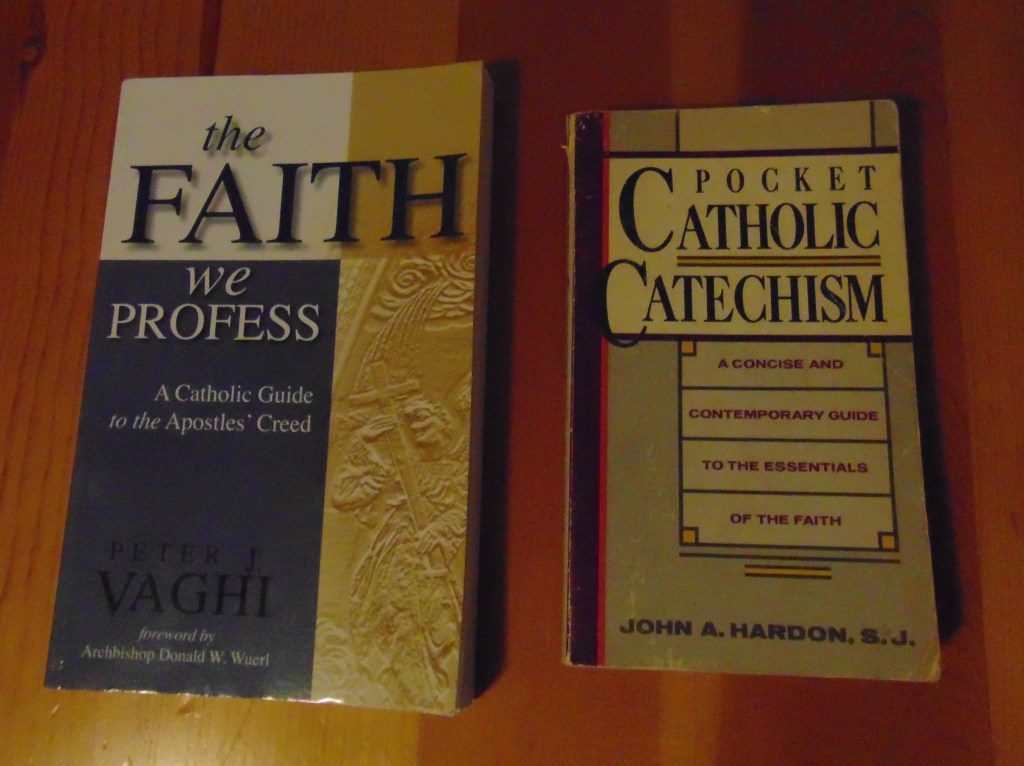
When I was in college, I found myself unable to describe what beliefs made my denomination distinct when talking to people who belonged to other denominations. “I just know my denomination, I don’t know how to explain it” (I have since heard other people say the same thing, usually said with dismay similar to what I felt). I was surprised by my inability to articulate the beliefs of my denomination. So, I bought and read Fr. John A. Hardon’s Pocket Catholic Catechism to be better able to articulate denominational beliefs (I still have that book).

More recently, I came upon – and started reading – Fr. Peter J. Vaghi’s The Faith We Profess: A Catholic Guide to the Apostles’ Creed.

Both of these books – and any number of books like them – provide a line-by-line explanations of the Apostles Creed and/or the Nicene Creed. These types of books are worth reading for church-attendees and non-church goers alike – these books inform us about the basic beliefs that many Christian denominations profess (the two books I mention here are written from a denomination-specific stance). While my reading of The Pocket Catholic Catechism in college may have broadly more Christian than the denomination-specific book I sought, there was certainly Catholicism within it…..

It’s worth providing a historical context about the Nicene Creed and the Apostle’s Creed. Christianity grew out of a Jewish context, Jesus’s presence and his teachings. Following Jesus’ time on earth, the faith tradition that became Christianity was initially a Jewish sect that began attracting non-Jewish converts – then becoming a distinct religion named after Jesus Christ (i.e., “Christ-ianity”). As Christianity became a distinct – and non-Jewish – religion, it took time for Christianity to fully develop the contours that we now recognize. In the early 300’s, church leaders recognized that any number of groups and individuals were communicating their own ideas and beliefs about what defines Christianity; not all those ideas were compatible with one another, nor were all ideas what we now call orthodox (“mainstream” if you like) – some ideas were viewed as heretical. Therefore, church leaders met in Nicea (in modern-day Turkey) in the year 325 (i.e., the first “Council of Nicea”) and established the Nicene Creed – laying out the core beliefs of Christianity. The Apostle’s Creed – which is of very similar content – is likewise accepted as Christianity’s “Creed” of beliefs. Many Christian denominations accept and profess one or both of these Creeds. These Creeds are often professed by congregations at church services.

These worthwhile books provide thoughtful discussion of exactly what the Apostle’s Creed and the Nicene Creed mean. Simply reciting one of these Creeds at church can be a rote activity; really understanding the Creeds requires thoughtful study. It can be worth taking a fresh look periodically at The Creeds – and these types of books – to see how our perspective and reflections on The Creed changes as we move through life.

Kim Burkhardt blogs at A Parish Catechist and The Books of the Ages (and a “Content Creator/Individual” member of the Association of Catholic Publishers). If you are a new visitor, it would be great to have you follow this blog (thank you!). If you know someone who would like this blog post, please share it with them (thank you!).

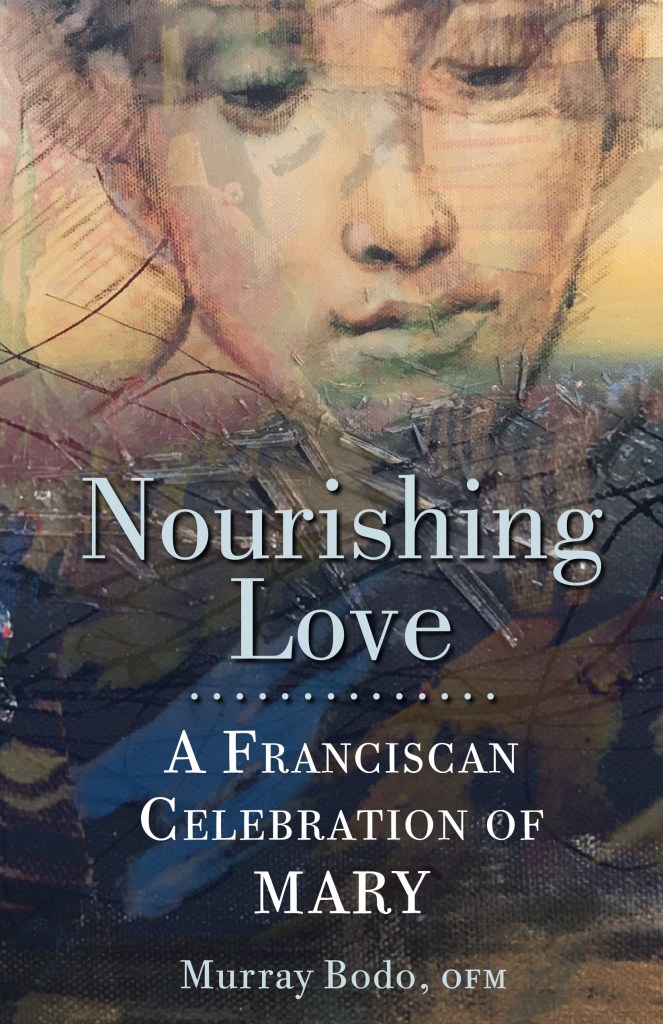
Book Review: Nourishing Love – A Franciscan Celebration of Mary

This book takes readers on a novel way of exploring Mary’s life (no, not a novel). For those of us who tend think of Mary either historically and/or as a saint, this book brings us an additional way to consider Mary.

Franciscan author (and priest) Murray Bodo offers us something similar to that of The Chosen TV series: a conceptual view of what it could have been like living Jesus’ or Mary’s lives – making their day-to-day lives more tangible for us than what many of us consider when reading the Gospels. Both this book and The Chosen contain historical aspects of the lives of Mary and Jesus (respectively). Reading historical accounts alone – however – don’t necessarily take us into thinking about the daily aspects what they did and felt as people.

In this book, Nourishing Love, there are reflections that take us to ponder, “what thoughts did Mary ponder?” After Jesus offered her and John to one another as mother-and-son, what conversations Mary and John have about Jesus? Possibly ponderings by Mary and possible – plausible – conversations between Mary and John are presented here to bring us into considering their lives on a very human level.

At one point in the book, the author writes, “Since Jesus was both God and man, he had his mother’s genes and was deeply influenced genetically, as most of us are, by his mother. He was Mary’s son, prompting us to imagine how Mary herself was in fact revealed in the person of her son.” Hmm….. Did genetics cause Jesus to look like his mother? Did Mary and Jesus share similar voice inflections? Did Jesus maintain some of Mary’s habits once he became an adult (ate the same foods for breakfast, had the same evening routines, etc.)? How much did Mary’s human personality influence Jesus’ human personality? The author of this book observes that the stories Mary told Jesus during his infancy and childhood may have influenced the types of stories Jesus chose to tell as an adult – including the parables he told. How she cared for the people around her could have been socially instructive for the human Jesus.

The way this book is constructed made me think of Ignatian exercises in terms of the creativity brought to subjects of faith. There’s a degree to which I felt uncomfortable with this book – I would more naturally gravitate to an academically-oriented sociological construct/analysis of people’s daily lives in first-century Palestine to get a sense of Mary’s life (that type of book would also be interesting!). Sometimes, though, discomfort is good. Discomfort can challenge us to consider topics in new ways; new perspectives help us grow.

Kim Burkhardt blogs at A Parish Catechist and The Books of the Ages (and a “Content Creator/Individual” member of the Association of Catholic Publishers). If you are a new visitor, it would be great to have you follow this blog (thank you!). If you know someone who would like this blog post, please share it with them (thank you!).

Feast Day of Hildegard von Bingen

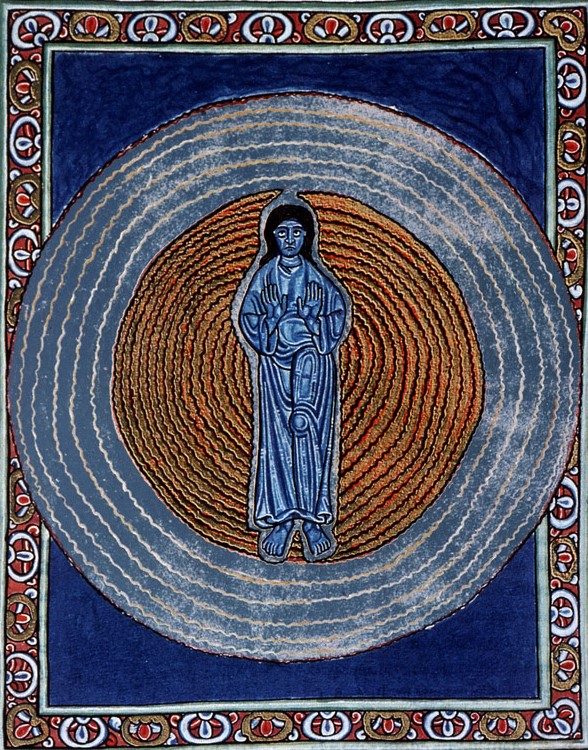
Above: Hildegard’s own artwork of the Trinity

Today – September 17 – is the Feast Day of Hildegard von Bingen: a saint, polymath (a person with significant multiple talents), and Doctor of the Church (Doctors of the Church are saints recognized for having made significant contributions to the Catholic Church).

I have been listening to Hildegard’s music for several years. She lived her life in the region of Germany where my father’s mother’s ancestors later lived and was a Benedictine (I am a parishioner at a St. Benedict parish – another personal reason to like her!).

Hildegard – with her wide-ranging interests, talents, activities, and achievements – is broadly popular across many social strata.

The following summary of Hildegard’s life comes from Wikipedia:

“Hildegard of Bingen… c. 1098 – 17 September 1179)…. was a German Benedictine abbess and polymath active as a writer, composer, philosopher, mystic, visionary, and as a medical writer and practitioner during the High Middle Ages. She is one of the best-known composers of sacred mononphony, as well as the most recorded in modern history. She has been considered by scholars to be the founder of scientific natural history in Germany.”Hildegard of Bingen… c. 1098 – 17 September 1179)…. was a German Benedictine abbess and polymath active as a writer, composer, philosopher, mystic, visionary, and as a medical writer and practitioner during the High Middle Ages. She is one of the best-known composers of sacred mononphony, as well as the most recorded in modern history. She has been considered by scholars to be the founder of scientific natural history in Germany. Hildegard’s convent elected her as magistra (mother superior) in 1136. She founded the monasteries of Rupertsberg in 1150 and Eibingen in 1165. Hildegard wrote theological, botanical, and medicinal works, as well as letters, hymns, and antiphons for the liturgy. She wrote poems, and supervised miniature illuminations in the Rupertsberg manuscript of her first work, Scivias. There are more surviving chants by Hildegard than by any other composer from the entire Middle Ages, and she is one of the few known composers to have written both the music and the words. One of her works, the Ordo Virtutum, is an early example of liturgical drama and arguably the oldest surviving morality play. She is noted for the invention of a constructed language known as Lingua Ignota.”

A timeline of her achievements is listed here by worldhistory.org .

If you would like to read up on individual saints, Hildegard’s life story provides many interesting facets to read up on.

Kim Burkhardt blogs at A Parish Catechist and The Books of the Ages. If you are a new visitor, it would be great to have you follow this blog (thank you!). If you know someone who would like this blog post, please share it with them (thank you!).