I am reading a book about the domestic activities of women living in Colonial New England during the years 1650 – 1750 (Good Wives: Image and Reality….). The detective work that makes such books interests me. The book’s author combed through probate records and other such surviving documents from the time to identify aspects of people’s lives – the contents of people’s household possessions, etc. Probate records would identify things such as “this household had four rooms. “The family’s bed was kept in the parlour downstairs, while the spinning wheel was kept in one of the two upstairs rooms.” From that, deductions can be made about day-to-day domestic logistics…..
When I co-wrote my Irish great-great grandmother’s biography in 2016, we did the same sort of detective work. Much footwork to find public records combined with family interviews went into being able write the following “book cover” summary of the life of my great-great grandmother who died thirty-two years before I was born: “Harriet was born in Co. Sligo the day the U.S. Union Army reorganized during the U.S. Civil War – meaning she was born in Yeats Country two years ahead of William Butler Yeats. Ireland’s emerging railroad system allowed her family to move all over Ireland as her Schoolmaster father moved from job to job. She married in Dublin the year James Joyce was born in that city. Harriet spent the longest period of her life in Co. Wicklow. Stories survive of her reading turn-of-the-century news about the Boer War to an illiterate neighbour. Harriet spent forty years raising children with a blind spouse. She emigrated the year after the Titanic sank (three years before the 1916 uprising). She died the day the Soviets invaded Poland. Two grandsons participated in D-Day, while another participated in the invasion of Japan.”
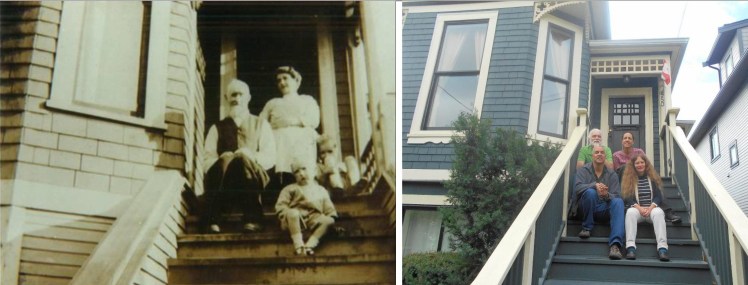
I have three photos of Harriet. In one of those photos, she and my great-great grandfather were sitting on their front steps with two of their grandchildren (including my grandfather). Another photo taken nearly 100 years later shows me and three of my cousins sitting on those same stairs.
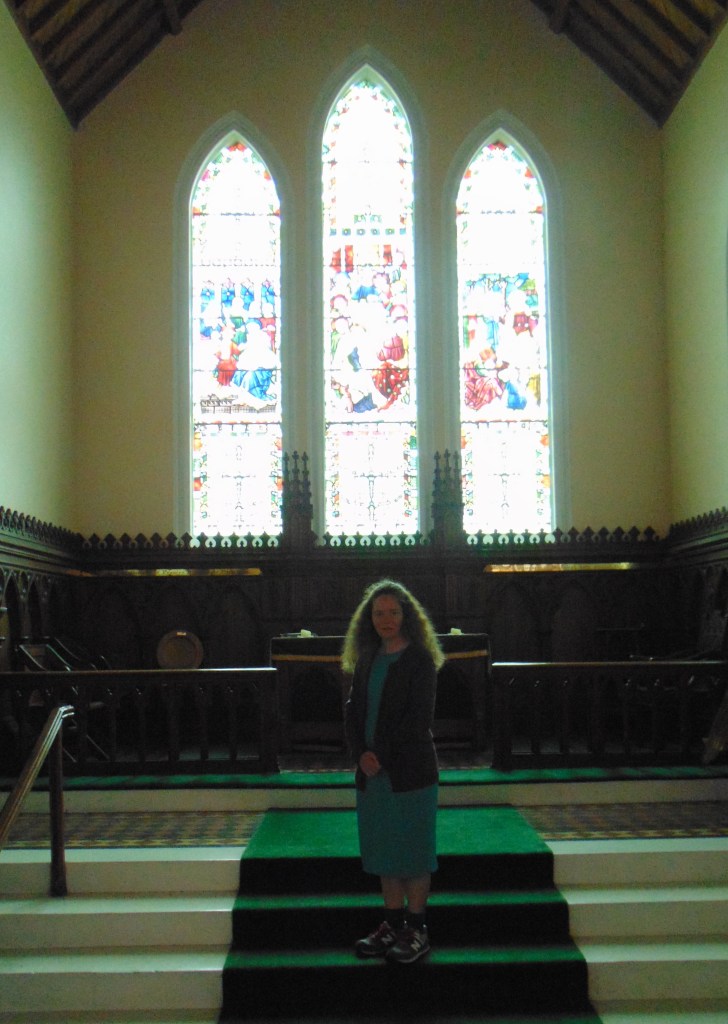
I was fortunate to visit the church in Co. Wicklow where Harriet’s father and her husband’s father served together on the parish vestry (i.e., parish council) in 1870.
In another strand of reading, my current graduate studies instructed us to choose an aspect of theology and/or church history to explore for a paper. I am reading the autobiography of one of the Church fathers, Doctor of the Church Augustine (Confessions).
So, what do the daily domestic activities of women in Colonial New England and the life of an Irish housewife who had thirteen pregnancies (ten of her children survived to adulthood) have to do with St. Augustine in the 4th and 5th centuries in North Africa?
The common thread is exploring and sharing the trajectories of our lives. In the case of Augustine, I am interested in Augustine’s “interiority” (a phrase I just came across a few weeks ago). I’ve been trying to figure out for several years how to get church people today to talk to each other in more depth about how we each experience our faith. I am reading – and writing about – Augustine and his Confessions with a goal toward figuring out how to more actively get people talking. I’m thinking that using the word interiority might help in getting people to identify what it is I want people to discuss.
I am hoping that during the next while, I will better develop ideas about getting people to talk to each other about how we experience our faith journeys.
Kim Burkhardt blogs about faith at The Hermitage Within. Thank you for reading this faith blog and for sharing it with your friends. While you are here, please feel welcome to provide support to sustain this blog ($$).
